Next-Generation mVPN Configuration with mLDP Core Signaling
- What is NG-mVPN? ‹
- What is multicast LDP? ‹
- Configuring mVPN Profile 1 with Default MDT and MP2MP mLDP on IOS XE ‹
- Configuring mVPN Profile 13 with Default MDT, MP2MP mLDP, BGP A-D and BGP C-mcast on IOS XE ‹
- Download section ‹
What is NG-mVPN?
Next-Generation Multicast VPN (NG-mVPN) is a set of features that can be combined to transport independent multicast streams for different customers across a shared Layer-3 MPLS VPN architecture. In essence, NG-mVPN provides a framework to implement various improvements over the Classic Rosen Draft multipoint GRE-based mVPN.
For example, with NG-mVPN a customer's IP multicast stream uses label switching in the provider core with mLDP (or with MPLS Traffic Engineering), and can use BGP in the control plane for PE router auto-discovery and added scalability. These different features are not supported in a Classic mVPN. Altogether, there are 27 profiles to create a multicast VPN and each profile combines a unique set of features.
What is multicast LDP?
Multicast LDP (mLDP) is an extension to the Label Distribution Protocol that enables signaling and creation of multipoint Label Switched Paths (MP-LSP). MLDP is essential to delivering multicast traffic over an MPLS network without enabling PIM or multicast between the core routers.
As such, mLDP is an integral part of NG-mVPN and is used in many of the mVPN profiles. With mLDP, independent customer IP multicast data streams can be label switched, and can benefit from the advanced features of MPLS. The following image provides a summary of a NG-mVPN architecture with Multipoint-to-Multipoint mLDP LSPs.
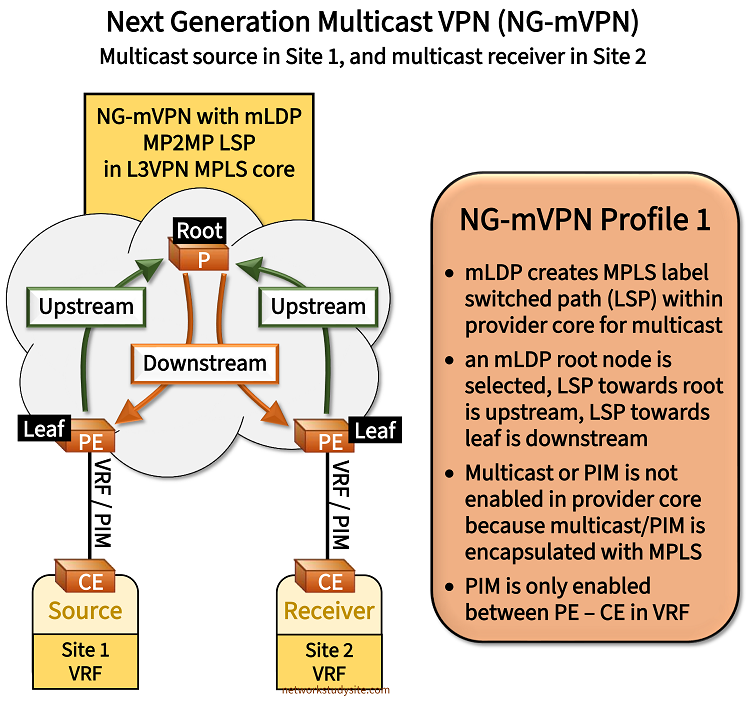
Multicast LDP can create two types of trees (similar to PIM) that can be used to label switch multicast IP traffic. A Point-to-Multipoint (P2MP) and a Multipoint-to-Multipoint (MP2MP) mLDP tree have various benefits but share a common Label Mapping Message structure which is shown in the following packet capture.
The main difference between the two types of mLDP distribution trees is that a P2MP LSP has the ingress PE router at its root, and the root sends traffic downstream to other PEs (the leafs). Whereas, in a MP2MP tree each PE is the leaf, and a root is selected within the provider core.
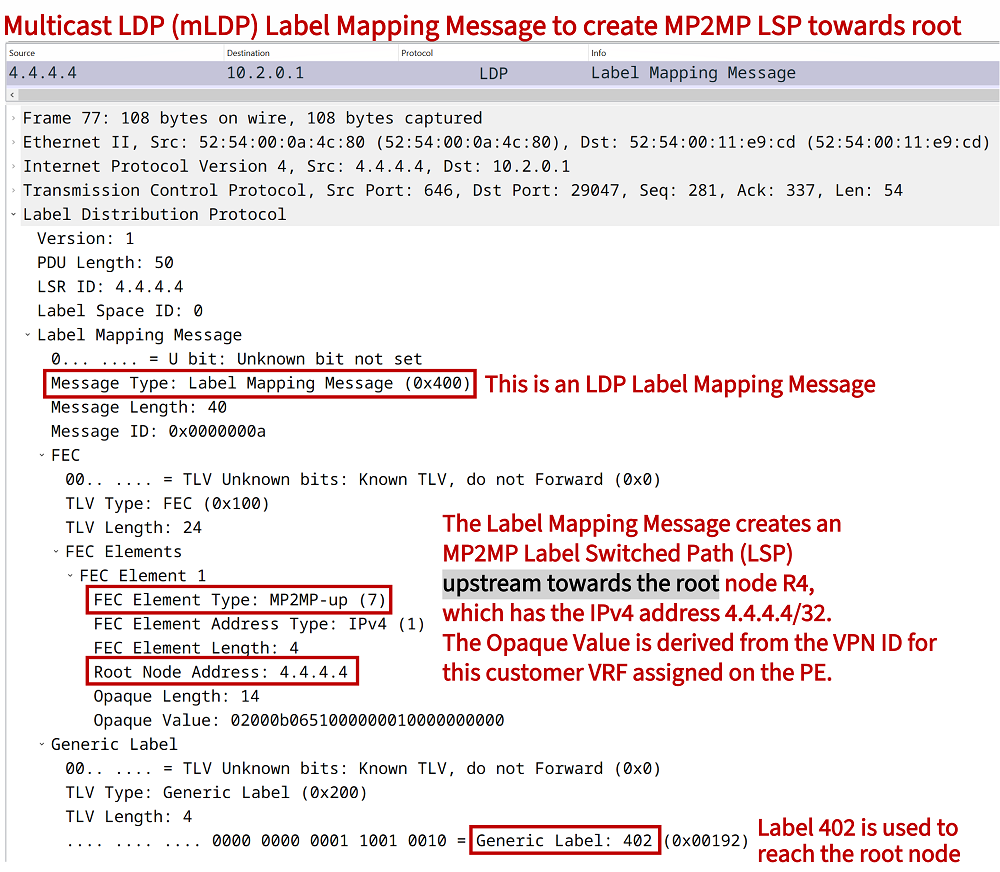
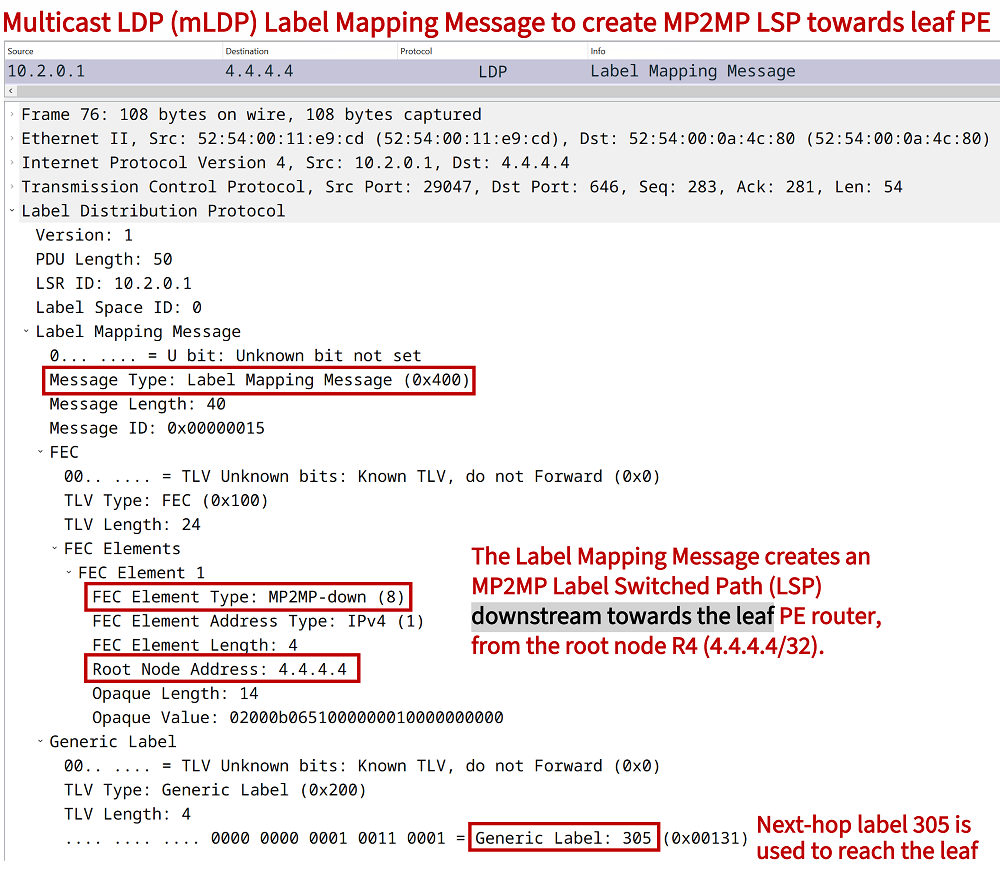
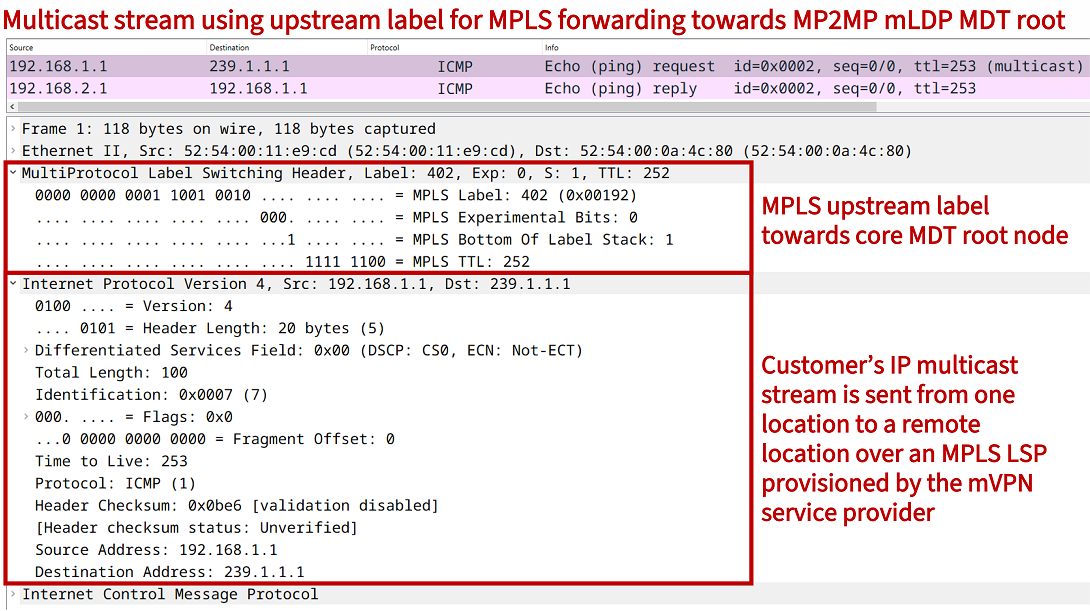
The following outputs from R4 (MP2MP LSP root) show the upstream label 402 assigned to the MDT (Multicast Distribution Tree) which is created for the customer in VRF Gold. The upstream label points to the mLDP MP2MP tree root node. In a MP2MP LSP the leaf nodes are the PE routers, and they receive a label to send traffic upstream towards the root node. This is described in the RFC 6388 and is quoted here:
Traffic from a downstream node follows the upstream LSP toward the root node and branches downward along the downstream LSP as required to reach other leaf nodes.
RFC 6388, Label Distribution Protocol Extensions for Point-to-Multipoint and Multipoint-to-Multipoint Label Switched Paths
R4#show mpls mldp root

 Root node    : 4.4.4.4 (We are the root)                 « R4 is the mLDP root (similar to Rendezvous Point in PIM Sparse Mode)
  Metric      : 0
  Distance    : 0
  Interface   : Loopback10 (via unicast RT)
  FEC count   : 1
  Path count  : 1
  Path(s)     : 4.4.4.4          LDP nbr: none              Loopback10


R4#show mpls forwarding-table
Local      Outgoing   Prefix           Bytes Label   Outgoing   Next Hop
Label      Label      or Tunnel Id     Switched      interface
400        300        2.2.2.2/32       1904          Gi1        10.2.0.1
401        Pop Label  10.1.0.0/30      0             Gi1        10.2.0.1
402        508        [mdt 65100:100 0]   \                                  « Upstream label 402 used from one of the leaf PE routers
                                       11586         Gi2        10.3.0.2
403        Pop Label  10.4.0.0/30      0             Gi2        10.3.0.2
404        502        6.6.6.6/32       1044          Gi2        10.3.0.2
405        No Label   8.8.8.8/32       12286         Gi3        10.5.0.2
406        305        [mdt 65100:100 0]   \                                  « Upstream label 406 used from another leaf PE router, LSPs joined at root
                                       9100          Gi1        10.2.0.1


R4#show mpls mldp bindings
System ID: 1
Type: MP2MP, Root Node: 4.4.4.4, Opaque Len: 14
Opaque value: [mdt 65100:100 0]
lsr: 10.2.0.1:0, local binding[U]: 402, remote binding[D]: 305          « Label bindings Upstream [U], and Downstream [D]
lsr: 10.4.0.2:0, local binding[U]: 406, remote binding[D]: 508


R4#show mpls mldp database
  * For interface indicates MLDP recursive forwarding is enabled
  * For RPF-ID indicates wildcard value
  > Indicates it is a Primary MLDP MDT Branch

LSM ID : 1   Type: MP2MP   Uptime : 00:45:19
  FEC Root           : 4.4.4.4 (we are the root)
  Opaque decoded     : [mdt 65100:100 0]                              « This is the VPN ID configured on the PE routers under the VRF
  Opaque length      : 11 bytes
  Opaque value       : 02 000B 0651000000010000000000                 « This value also appears in the above packet captures
  Upstream client(s) :
    None
      Expires        : N/A           Path Set ID  : 1
  Replication client(s):                                              « Upstream labels to reach root R4, and Downstream labels to reach leaf PEs
    10.2.0.1:0
      Uptime         : 00:45:19      Path Set ID  : 2
      Out label (D)  : 305           Interface    : GigabitEthernet1*
      Local label (U): 402           Next Hop     : 10.2.0.1          « In the following capture this Upstream label is carries multicast traffic
    10.4.0.2:0
      Uptime         : 00:43:02      Path Set ID  : 3
      Out label (D)  : 508           Interface    : GigabitEthernet2*
      Local label (U): 406           Next Hop     : 10.3.0.2
Configuring mVPN Profile 1 with Default MDT and MP2MP mLDP
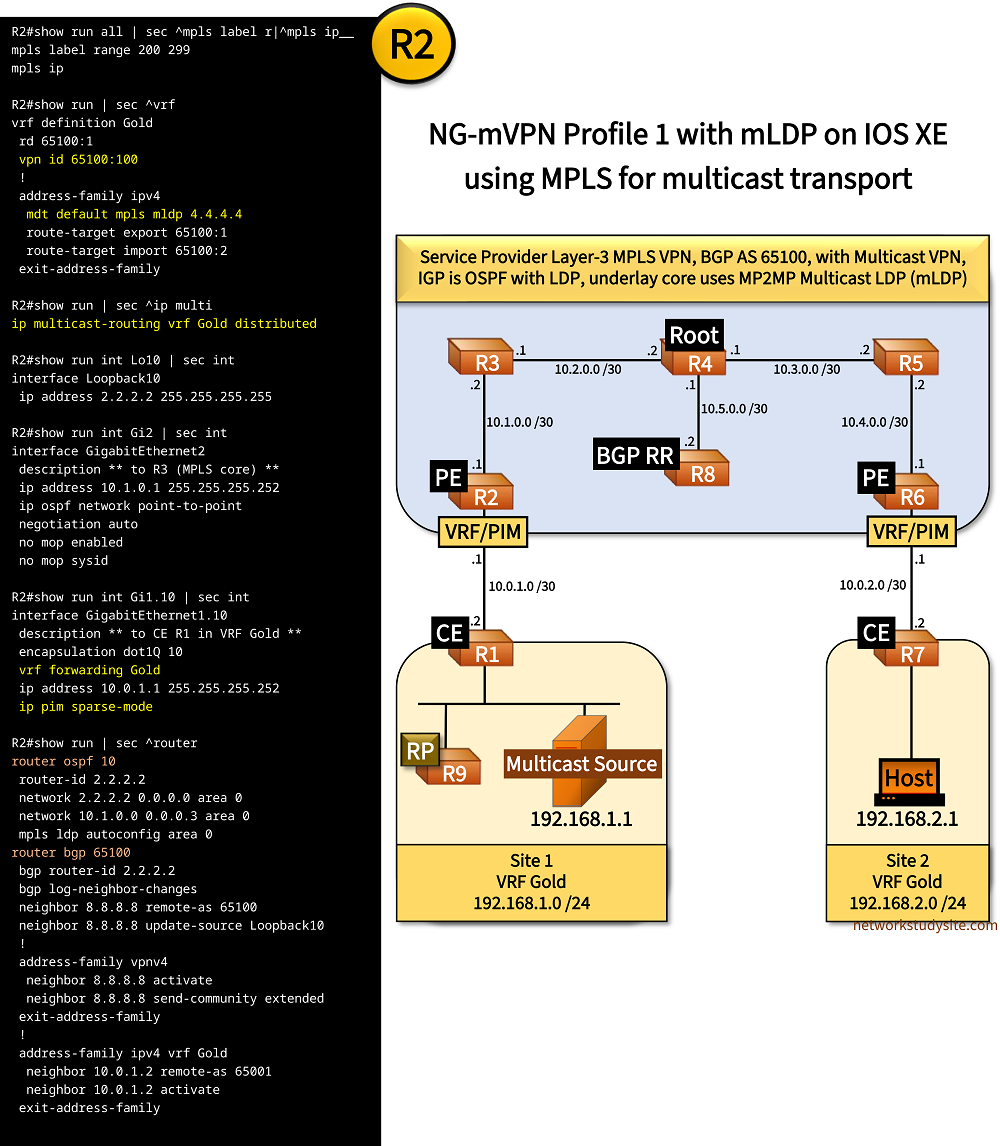
In the following example, mVPN Profile 1 is configured which enables label switching the multicast stream that is sent from Site 1 towards Site 2. The PE routers have a PIM neighborship with the CE routers in VRF Gold, but there are no PIM neighborships, and multicast routing is not enabled in the provider core.
Instead, the PE routers use mLDP to join a Multipoint-to-Multipoint (MP2MP) mLDP distribution tree with the router R4 at its root. MPLS labels are assigned and propagated hop-by-hop to create an upstream LSP (towards the root) and a downstream LSP (towards the PE routers).
When a multicast stream arrives from the customer location Site 2, the PE R2 encapsulates the IP multicast packet with an MPLS header and sends it upstream towards R4. In turn, R4 forwards the MPLS encapsulated frame towards the egress PE R6. The egress PE decapsulates the packet and forwards it towards the CE R7 using multicast in the assigned customer VRF.
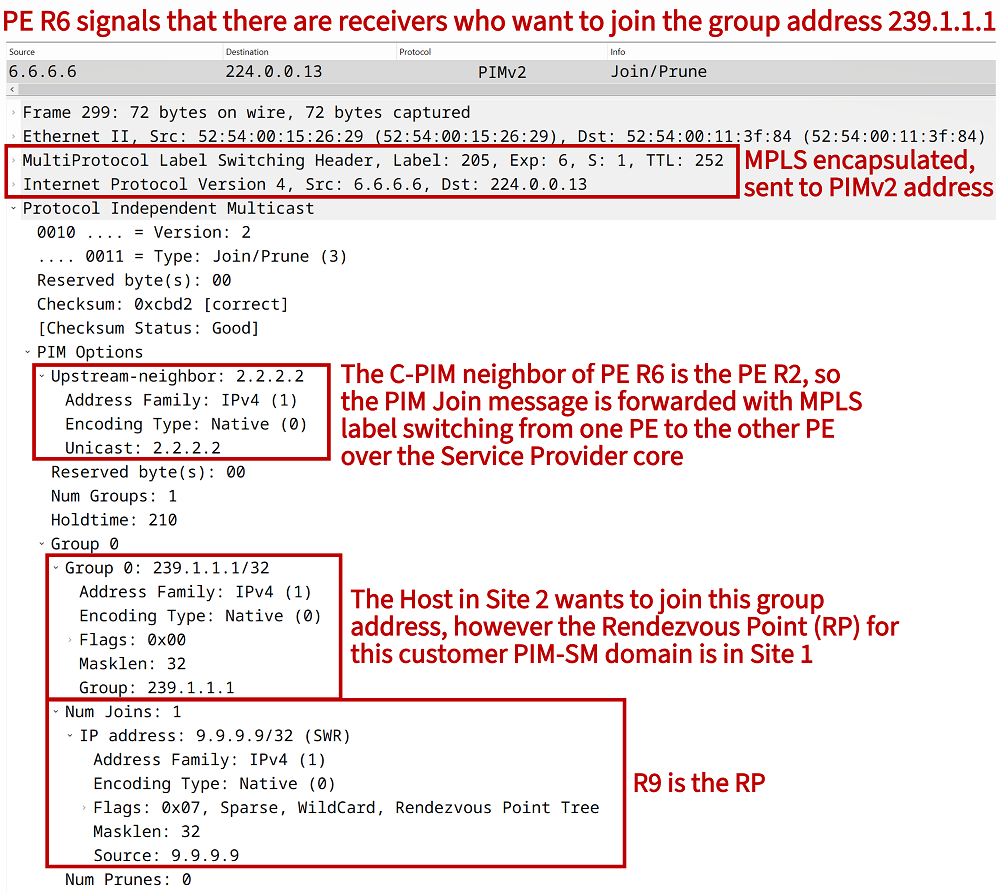
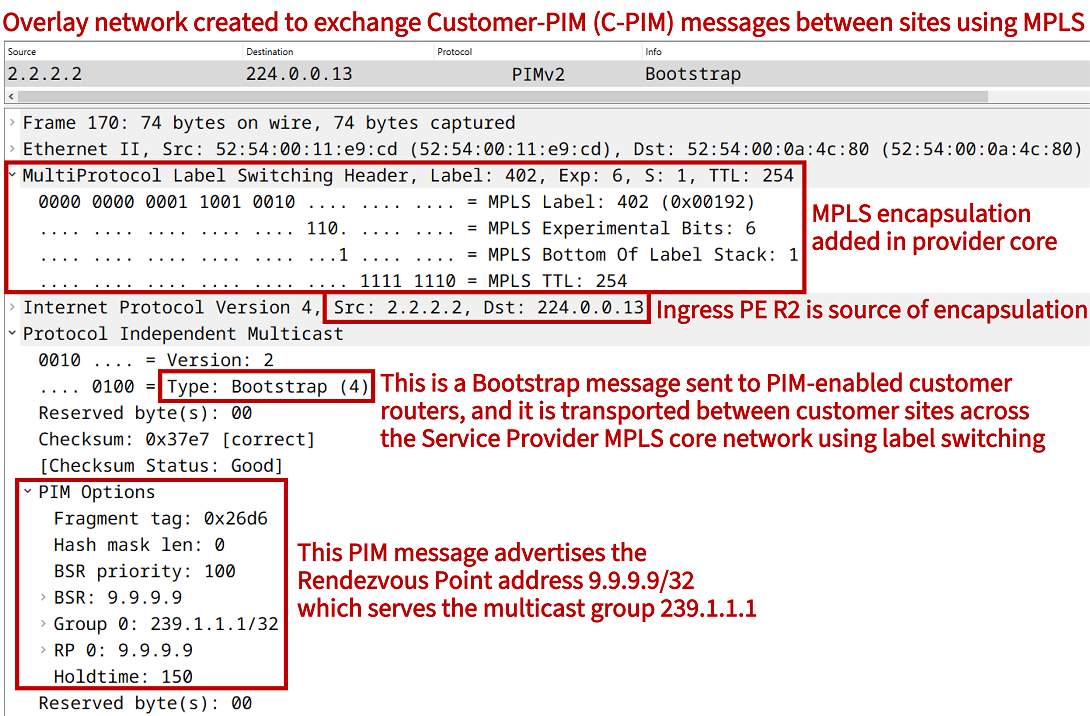
The customer establishes its own overlay network using PIM (encapsulated in MPLS) across the Service Provider's mVPN core. Within the customer network PIM Sparse Mode is used, and the customer's Rendezvous Point is R9 located in Site 2. The customer's control plane traffic (Bootstrap and Join/Prune messsages) are also label switched across the provider's MPLS core.
Configuration:
R2 (PE)
R2#show run all | sec ^mpls label r|^mpls ip__
mpls label range 200 299
mpls ip

R2#show run | sec ^vrf
vrf definition Gold
 rd 65100:1
 vpn id 65100:100
 !
 address-family ipv4
  mdt default mpls mldp 4.4.4.4
  route-target export 65100:1
  route-target import 65100:2
 exit-address-family

R2#show run | sec ^ip multi
ip multicast-routing vrf Gold distributed

R2#show run int Lo10 | sec int
interface Loopback10
 ip address 2.2.2.2 255.255.255.255

R2#show run int Gi2 | sec int
interface GigabitEthernet2
 description ** to R3 (MPLS core) **
 ip address 10.1.0.1 255.255.255.252
 ip ospf network point-to-point
 negotiation auto
 no mop enabled
 no mop sysid

R2#show run int Gi1 | sec int
interface GigabitEthernet1
 description ** to CE R1 **
 no ip address
 negotiation auto
 no mop enabled
 no mop sysid

R2#show run int Gi1.10 | sec int
interface GigabitEthernet1.10
 description ** to CE R1 in VRF Gold **
 encapsulation dot1Q 10
 vrf forwarding Gold
 ip address 10.0.1.1 255.255.255.252
 ip pim sparse-mode

R2#show run | sec ^router
router ospf 10
 router-id 2.2.2.2
 network 2.2.2.2 0.0.0.0 area 0
 network 10.1.0.0 0.0.0.3 area 0
 mpls ldp autoconfig area 0
router bgp 65100
 bgp router-id 2.2.2.2
 bgp log-neighbor-changes
 neighbor 8.8.8.8 remote-as 65100
 neighbor 8.8.8.8 update-source Loopback10
 !
 address-family vpnv4
  neighbor 8.8.8.8 activate
  neighbor 8.8.8.8 send-community extended
 exit-address-family
 !
 address-family ipv4 vrf Gold
  neighbor 10.0.1.2 remote-as 65001
  neighbor 10.0.1.2 activate
 exit-address-family
R6 (PE)
R6#show run all | sec ^mpls label r|^mpls ip__
mpls label range 600 699
mpls ip

R6#show run | sec ^vrf
vrf definition Gold
 rd 65100:2
 vpn id 65100:100
 !
 address-family ipv4
  mdt default mpls mldp 4.4.4.4
  route-target export 65100:2
  route-target import 65100:1
 exit-address-family

R6#show run | sec ^ip multicast
ip multicast-routing vrf Gold distributed

R6#show run int Lo10 | sec int
interface Loopback10
 ip address 6.6.6.6 255.255.255.255

R6#show run int Gi2 | sec int
interface GigabitEthernet2
 description ** to R5 (MPLS core) **
 ip address 10.4.0.1 255.255.255.252
 ip ospf network point-to-point
 negotiation auto
 no mop enabled
 no mop sysid

R6#show run int Gi1 | sec int
interface GigabitEthernet1
 description ** to CE R7 **
 no ip address
 negotiation auto
 no mop enabled
 no mop sysid

R6#show run int Gi1.10 | sec int
interface GigabitEthernet1.10
 description ** to CE R7 in VRF Gold **
 encapsulation dot1Q 10
 vrf forwarding Gold
 ip address 10.0.2.1 255.255.255.252
 ip pim sparse-mode

R6#show run | sec ^router
router ospf 10
 router-id 6.6.6.6
 network 6.6.6.6 0.0.0.0 area 0
 network 10.4.0.0 0.0.0.3 area 0
 mpls ldp autoconfig area 0
router bgp 65100
 bgp router-id 6.6.6.6
 bgp log-neighbor-changes
 neighbor 8.8.8.8 remote-as 65100
 neighbor 8.8.8.8 update-source Loopback10
 !
 address-family vpnv4
  neighbor 8.8.8.8 activate
  neighbor 8.8.8.8 send-community extended
 exit-address-family
 !
 address-family ipv4 vrf Gold
  neighbor 10.0.2.2 remote-as 65002
  neighbor 10.0.2.2 activate
 exit-address-family
R4
R4#show run all | sec ^mpls label r|^mpls ip__
mpls label range 400 499
mpls ip

R4#show run int Lo10 | sec int
interface Loopback10
 ip address 4.4.4.4 255.255.255.255

R4#show run int Gi1 | sec int
interface GigabitEthernet1
 description ** to R3 **
 ip address 10.2.0.2 255.255.255.252
 ip ospf network point-to-point
 negotiation auto
 mpls ip
 no mop enabled
 no mop sysid

R4#show run int Gi2 | sec int
interface GigabitEthernet2
 description ** to R5 **
 ip address 10.3.0.1 255.255.255.252
 ip ospf network point-to-point
 negotiation auto
 mpls ip
 no mop enabled
 no mop sysid

R4#show run int Gi3 | sec int
interface GigabitEthernet3
 description ** to BGP Route Reflector R8 **
 ip address 10.5.0.1 255.255.255.252
 ip ospf network point-to-point
 negotiation auto
 no mop enabled
 no mop sysid

R4#show run | sec ^router
router ospf 10
 router-id 4.4.4.4
 network 4.4.4.4 0.0.0.0 area 0
 network 10.2.0.0 0.0.0.3 area 0
 network 10.3.0.0 0.0.0.3 area 0
 network 10.5.0.0 0.0.0.3 area 0
R8 (BGP Route Reflector)
R8#show run int Lo10 | sec int
interface Loopback10
 ip address 8.8.8.8 255.255.255.255

R8#show run int Gi0/0 | sec int
interface GigabitEthernet0/0
 description ** to R4 **
 ip address 10.5.0.2 255.255.255.252
 ip ospf network point-to-point
 duplex auto
 speed auto
 media-type rj45

R8#show run | sec ^router
router ospf 10
 router-id 8.8.8.8
 network 8.8.8.8 0.0.0.0 area 0
 network 10.5.0.0 0.0.0.3 area 0
router bgp 65100
 bgp router-id 8.8.8.8
 bgp log-neighbor-changes
 neighbor 2.2.2.2 remote-as 65100
 neighbor 2.2.2.2 update-source Loopback10
 neighbor 6.6.6.6 remote-as 65100
 neighbor 6.6.6.6 update-source Loopback10
 !
 address-family vpnv4
  neighbor 2.2.2.2 activate
  neighbor 2.2.2.2 send-community extended
  neighbor 2.2.2.2 route-reflector-client
  neighbor 6.6.6.6 activate
  neighbor 6.6.6.6 send-community extended
  neighbor 6.6.6.6 route-reflector-client
 exit-address-family
R3
R3#show run all | sec ^mpls label r|^mpls ip__
mpls label range 300 399
mpls ip

R3#show run int Gi1 | sec int
interface GigabitEthernet1
 description ** to PE R2 **
 ip address 10.1.0.2 255.255.255.252
 ip ospf network point-to-point
 negotiation auto
 no mop enabled
 no mop sysid

R3#show run int Gi2 | sec int
interface GigabitEthernet2
 description ** to R4 **
 ip address 10.2.0.1 255.255.255.252
 ip ospf network point-to-point
 negotiation auto
 no mop enabled
 no mop sysid

R3#show run | sec ^router
router ospf 10
 router-id 3.3.3.3
 network 10.1.0.0 0.0.0.3 area 0
 network 10.2.0.0 0.0.0.3 area 0
 mpls ldp autoconfig area 0
R5
R5#show run all | sec ^mpls label r|^mpls ip__
mpls label range 500 599
mpls ip

R5#show run int Gi1 | sec int
interface GigabitEthernet1
 description ** to PE R6 **
 ip address 10.4.0.2 255.255.255.252
 ip ospf network point-to-point
 negotiation auto
 no mop enabled
 no mop sysid

R5#show run int Gi2 | sec int
interface GigabitEthernet2
 description ** to R4 **
 ip address 10.3.0.2 255.255.255.252
 ip ospf network point-to-point
 negotiation auto
 no mop enabled
 no mop sysid

R5#show run | sec ^router
router ospf 10
 router-id 5.5.5.5
 network 10.3.0.0 0.0.0.3 area 0
 network 10.4.0.0 0.0.0.3 area 0
 mpls ldp autoconfig area 0
R1 (CE)
R1#show run | sec ^ip multi
ip multicast-routing vrf Gold

R1#show run | sec ^vrf
vrf definition Gold
 rd 1:1
 !
 address-family ipv4
 exit-address-family

R1#show run int Gi0/0 | sec int
interface GigabitEthernet0/0
 description ** to Multicast Source **
 no ip address
 duplex auto
 speed auto
 media-type rj45

R1#show run int Gi0/0.10 | sec int
interface GigabitEthernet0/0.10
 description ** to Multicast Source in VRF Gold **
 encapsulation dot1Q 1 native
 vrf forwarding Gold
 ip address 192.168.1.3 255.255.255.0
 ip pim sparse-mode

R1#show run int Gi0/1 | sec int
interface GigabitEthernet0/1
 description ** to PE R2 **
 no ip address
 duplex auto
 speed auto
 media-type rj45

R1#show run int Gi0/1.10 | sec int
interface GigabitEthernet0/1.10
 description ** to PE R2 in VRF Gold **
 encapsulation dot1Q 10
 vrf forwarding Gold
 ip address 10.0.1.2 255.255.255.252
 ip pim sparse-mode

R1#show run | sec ^router
router ospf 10 vrf Gold
 router-id 1.1.1.1
 network 192.168.1.0 0.0.0.255 area 0
router bgp 65001
 bgp router-id 1.1.1.1
 bgp log-neighbor-changes
 !
 address-family ipv4 vrf Gold
  network 192.168.1.0
  redistribute ospf 10
  neighbor 10.0.1.1 remote-as 65100
  neighbor 10.0.1.1 activate
 exit-address-family
R7 (CE)
R7#show run | sec ^ip multi
ip multicast-routing vrf Gold

R7#show run | sec ^vrf
vrf definition Gold
 rd 1:1
 !
 address-family ipv4
 exit-address-family

R7#show run int Gi0/0 | sec int
interface GigabitEthernet0/0
 description ** to Host (Multicast Receiver) **
 no ip address
 duplex auto
 speed auto
 media-type rj45

R7#show run int Gi0/0.10 | sec int
interface GigabitEthernet0/0.10
 description ** to Host (Multicast Receiver) in VRF Gold **
 encapsulation dot1Q 1 native
 vrf forwarding Gold
 ip address 192.168.2.2 255.255.255.0
 ip pim sparse-mode

R7#show run int Gi0/1 | sec int
interface GigabitEthernet0/1
 description ** to PE R6 **
 no ip address
 duplex auto
 speed auto
 media-type rj45

R7#show run int Gi0/1.10 | sec int
interface GigabitEthernet0/1.10
 description ** to PE R6 in VRF Gold **
 encapsulation dot1Q 10
 vrf forwarding Gold
 ip address 10.0.2.2 255.255.255.252
 ip pim sparse-mode

R7#show run | sec ^router
router bgp 65002
 bgp router-id 7.7.7.7
 bgp log-neighbor-changes
 !
 address-family ipv4 vrf Gold
  network 192.168.2.0
  neighbor 10.0.2.1 remote-as 65100
  neighbor 10.0.2.1 activate
 exit-address-family
R9 (C-PIM Rendezvous Point)
R9#show run | sec ^ip multi
ip multicast-routing vrf Gold

R9#show run | sec ^ip pim
ip pim vrf Gold bsr-candidate Loopback10 0 100 accept-rp-candidate ACL-EXAMPLE-RP
ip pim vrf Gold rp-candidate Loopback10 group-list ACL-EXAMPLE-GROUP priority 100

R9#show run | sec ^ip access
ip access-list standard ACL-EXAMPLE-GROUP
 permit 239.1.1.1
ip access-list standard ACL-EXAMPLE-RP
 permit 9.9.9.9

R9#show run | sec ^vrf
vrf definition Gold
 rd 1:1
 !
 address-family ipv4
 exit-address-family

R9#show run int Lo10 | sec int
interface Loopback10
 description ** C-PIM RP address **
 vrf forwarding Gold
 ip address 9.9.9.9 255.255.255.255
 ip pim sparse-mode

R9#show run int Gi0/0 | sec int
interface GigabitEthernet0/0
 description ** to CE R1 **
 no ip address
 duplex auto
 speed auto
 media-type rj45

R9#show run int Gi0/0.10 | sec int
interface GigabitEthernet0/0.10
 description ** to CE R1 in VRF Gold **
 encapsulation dot1Q 1 native
 vrf forwarding Gold
 ip address 192.168.1.2 255.255.255.0
 ip pim sparse-mode

R9#show run | sec ^router
router ospf 10 vrf Gold
 router-id 9.9.9.9
 network 9.9.9.9 0.0.0.0 area 0
 network 192.168.1.0 0.0.0.255 area 0
Multicast Source
Source#show run int Gi0/0 | sec int
interface GigabitEthernet0/0
 description ** to CE R1 **
 ip address 192.168.1.1 255.255.255.0
 duplex auto
 speed auto
 media-type rj45

Source#show run | sec ^ip route
ip route 0.0.0.0 0.0.0.0 GigabitEthernet0/0 192.168.1.3
Host (Multicast Receiver)
Host#show run int Gi0/0 | sec int
interface GigabitEthernet0/0
 description ** to CE R7 **
 ip address 192.168.2.1 255.255.255.0
 ip igmp join-group 239.1.1.1
 duplex auto
 speed auto
 media-type rj45

Host#show run | sec ^ip route
ip route 0.0.0.0 0.0.0.0 GigabitEthernet0/0 192.168.2.2
Source#ping 192.168.2.1
Type escape sequence to abort.
Sending 5, 100-byte ICMP Echos to 192.168.2.1, timeout is 2 seconds:
!!!!!
Success rate is 100 percent (5/5), round-trip min/avg/max = 49/49/51 ms          « Unicast traffic between Site 1 and Site 2 works


Source#trace 192.168.2.1 probe 1
Type escape sequence to abort.
Tracing the route to 192.168.2.1
VRF info: (vrf in name/id, vrf out name/id)
  1 192.168.1.3 2 msec
  2 10.0.1.1 41 msec
  3 10.1.0.2 [MPLS: Labels 305/606 Exp 0] 54 msec                   « MPLS label stack is added
  4 10.2.0.2 [MPLS: Labels 403/606 Exp 0] 55 msec
  5 10.3.0.2 [MPLS: Labels 502/606 Exp 0] 57 msec
  6 10.0.2.1 [MPLS: Label 606 Exp 0] 26 msec                        « The VPN Service label 606 is assigned by PE R6
  7 10.0.2.2 49 msec
  8 192.168.2.1 48 msec


Source#ping 239.1.1.1 re 5
Type escape sequence to abort.
Sending 5, 100-byte ICMP Echos to 239.1.1.1, timeout is 2 seconds:

Reply to request 0 from 192.168.2.1, 89 ms                          « Multicast stream from Site 1 to Site 2 also works
Reply to request 1 from 192.168.2.1, 49 ms
Reply to request 2 from 192.168.2.1, 50 ms
Reply to request 3 from 192.168.2.1, 51 ms
Reply to request 4 from 192.168.2.1, 49 ms


R2#show ip pim vrf Gold neighbor
PIM Neighbor Table
Mode: B - Bidir Capable, DR - Designated Router, N - Default DR Priority,
      P - Proxy Capable, S - State Refresh Capable, G - GenID Capable,
      L - DR Load-balancing Capable
Neighbor          Interface                Uptime/Expires    Ver   DR
Address                                                            Prio/Mode
10.0.1.2          GigabitEthernet1.10      04:02:35/00:01:29 v2    1 / DR S P G
6.6.6.6           Lspvif0                  03:40:56/00:01:36 v2    1 / DR S P G    « PE creates label switched multicast overlay across core


R2#show interface description
Interface                      Status         Protocol Description
Gi1                            up             up       ** to CE R1 **
Gi1.10                         up             up       ** to CE R1 in VRF Gold **
Gi2                            up             up       ** to R3 (MPLS core) **
Gi3                            admin down     down
Gi4                            admin down     down
Lo10                           up             up
Ls0                            up             up
Tu0                            up             up       Pim Register Tunnel (Encap) for RP 9.9.9.9 on VRF Gold      « Automatically created


R2#show mpls mldp root

 Root node    : 4.4.4.4                             « R4 is a MP2MP root
  Metric      : 3                                   « The IGP OSPF metric is calculated to reach R4
  Distance    : 110                                 « This is the Administrative Distance of OSPF
  Interface   : GigabitEthernet2 (via unicast RT)
  FEC count   : 1
  Path count  : 1
  Path(s)     : 10.1.0.2         LDP nbr: 10.1.0.2:0        GigabitEthernet2


R2#show mpls mldp database
  * For interface indicates MLDP recursive forwarding is enabled
  * For RPF-ID indicates wildcard value
  > Indicates it is a Primary MLDP MDT Branch

LSM ID : 1 (RNR LSM ID: 2)   Type: MP2MP   Uptime : 04:01:39
  FEC Root           : 4.4.4.4
  Opaque decoded     : [mdt 65100:100 0]
  Opaque length      : 11 bytes
  Opaque value       : 02 000B 0651000000010000000000
  RNR active LSP     : (this entry)
  Upstream client(s) :
    10.1.0.2:0    [Active]
      Expires        : Never         Path Set ID  : 1
      Out Label (U)  : 307           Interface    : GigabitEthernet2*
      Local Label (D): 208           Next Hop     : 10.1.0.2
  Replication client(s):
>   MDT  (VRF Gold)                                        « This part references the Multicast Distribution Tree for VRF Gold
      Uptime         : 04:01:39      Path Set ID  : 2
      Interface      : Lspvif0       RPF-ID       : *      « This virtual interface is created for label switched multicast across core


R2#show ip int br
Interface              IP-Address      OK? Method Status                Protocol
GigabitEthernet1       unassigned      YES NVRAM  up                    up
GigabitEthernet1.10    10.0.1.1        YES NVRAM  up                    up
GigabitEthernet2       10.1.0.1        YES NVRAM  up                    up
GigabitEthernet3       unassigned      YES NVRAM  administratively down down
GigabitEthernet4       unassigned      YES NVRAM  administratively down down
Loopback10             2.2.2.2         YES NVRAM  up                    up
Lspvif0                2.2.2.2         YES unset  up                    up
Tunnel0                10.0.1.1        YES unset  up                    up


R2#show int Lspvif0
Lspvif0 is up, line protocol is up
  Hardware is
  Interface is unnumbered. Using address of Loopback10 (2.2.2.2)
  MTU 17892 bytes, BW 8000000 Kbit/sec, DLY 5000 usec,
     reliability 255/255, txload 1/255, rxload 1/255
  Encapsulation LOOPBACK, loopback not set
  Keepalive set (10 sec)
  Last input 00:00:23, output never, output hang never
  Last clearing of "show interface" counters never
  Input queue: 0/375/0/0 (size/max/drops/flushes); Total output drops: 0
  Queueing strategy: fifo
  Output queue: 0/0 (size/max)
  5 minute input rate 0 bits/sec, 0 packets/sec
  5 minute output rate 0 bits/sec, 0 packets/sec
     762 packets input, 56822 bytes, 0 no buffer
     Received 0 broadcasts (0 IP multicasts)
     0 runts, 0 giants, 0 throttles
     0 input errors, 0 CRC, 0 frame, 0 overrun, 0 ignored, 0 abort
     1029 packets output, 55200 bytes, 0 underruns
     Output 0 broadcasts (40 IP multicasts)                     « This output is from the ingress PE, shows sending multicast into provider core
     0 output errors, 0 collisions, 0 interface resets
     0 unknown protocol drops
     0 output buffer failures, 0 output buffers swapped out


R6#show int Lspvif0 | sec Received
     Received 0 broadcasts (53 IP multicasts)                   « This is the egress PE which receives the MPLS encapsulated multicast traffic


R7#show ip pim vrf Gold rp mapping
PIM Group-to-RP Mappings

Group(s) 239.1.1.1/32
  RP 9.9.9.9 (?), v2                                            « This output from the CE router R7 from Site 2 shows RP address received from Site 1
    Info source: 9.9.9.9 (?), via bootstrap, priority 100, holdtime 150
         Uptime: 03:42:42, expires: 00:02:08


R7#show ip route vrf Gold 9.9.9.9

Routing Table: Gold
Routing entry for 9.9.9.9/32
  Known via "bgp 65002", distance 20, metric 0                  « The RP address is propagated through Customer PIM (C-PIM) across provider core
  Tag 65100, type external
  Last update from 10.0.2.1 03:42:25 ago
  Routing Descriptor Blocks:
  * 10.0.2.1, from 10.0.2.1, 03:42:25 ago
      Route metric is 0, traffic share count is 1
      AS Hops 2
      Route tag 65100
      MPLS label: none
Configuring mVPN Profile 13 with Default MDT, MP2MP mLDP, BGP A-D and BGP C-mcast on IOS XE
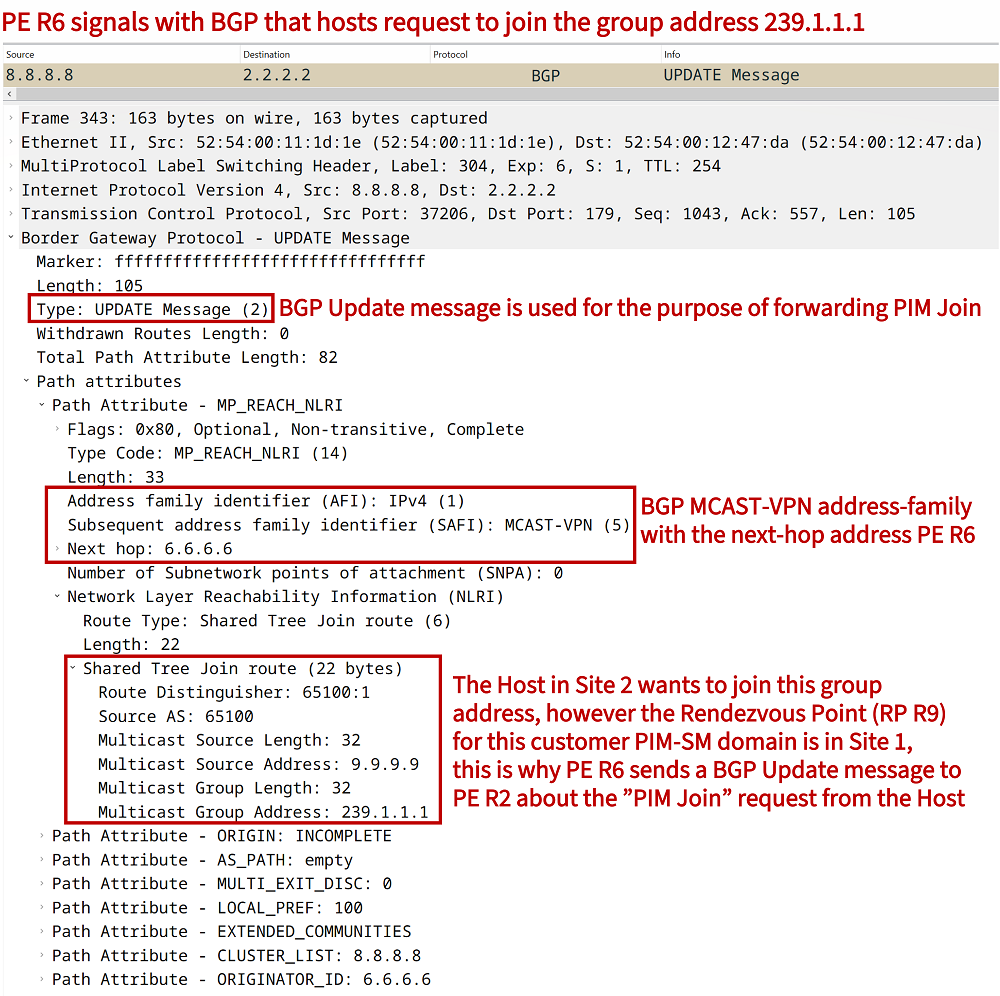
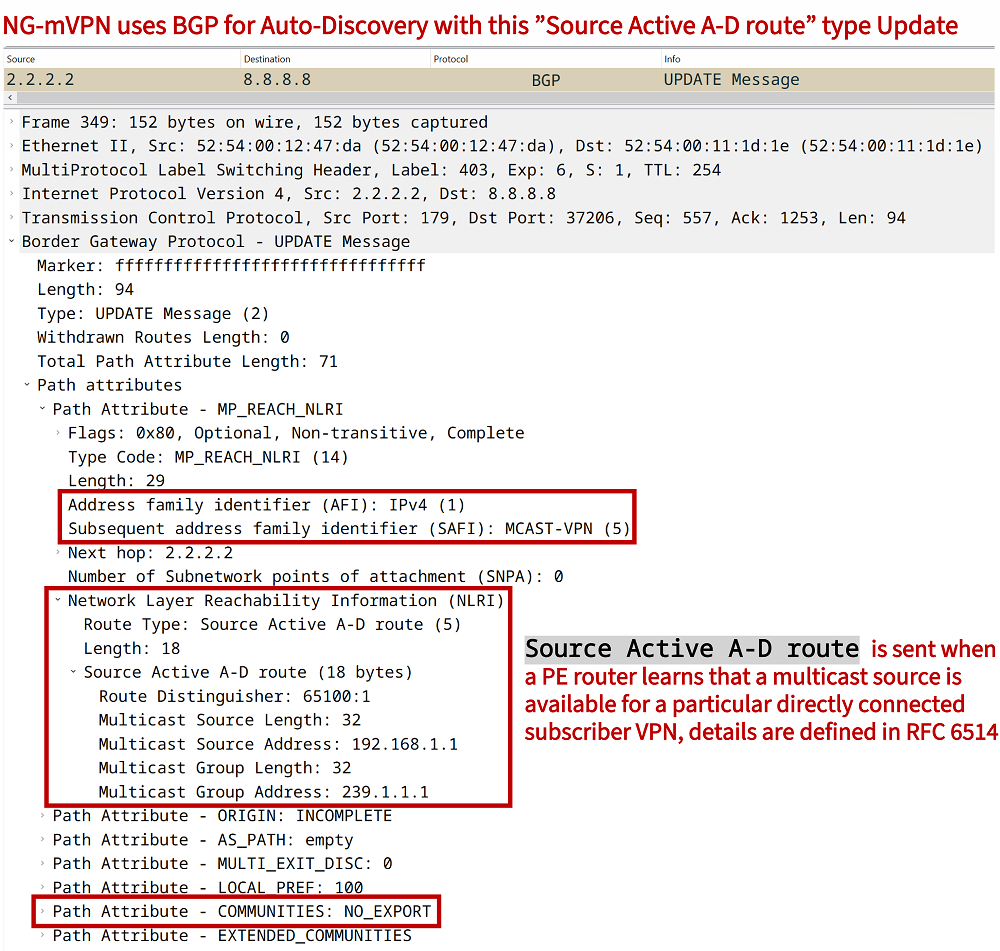
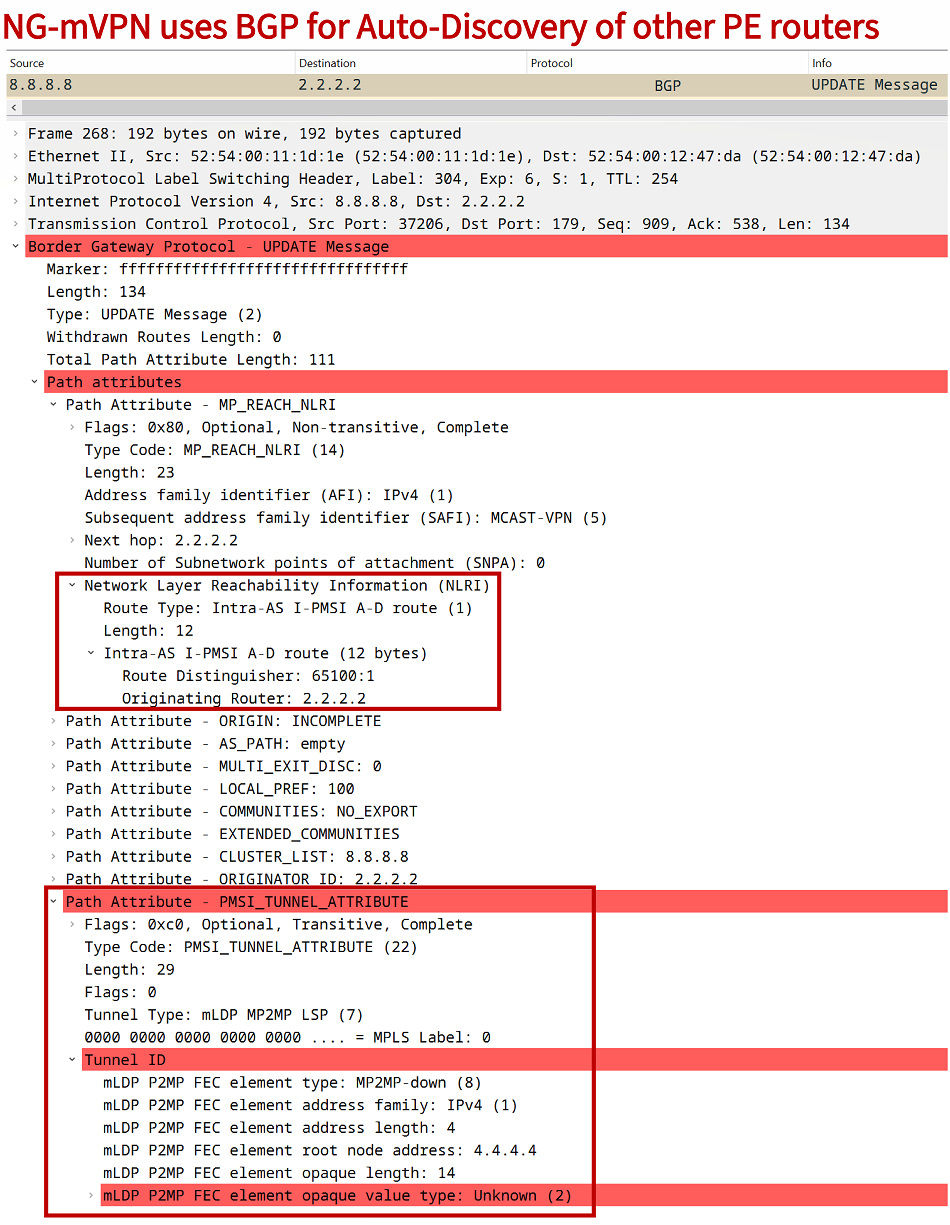
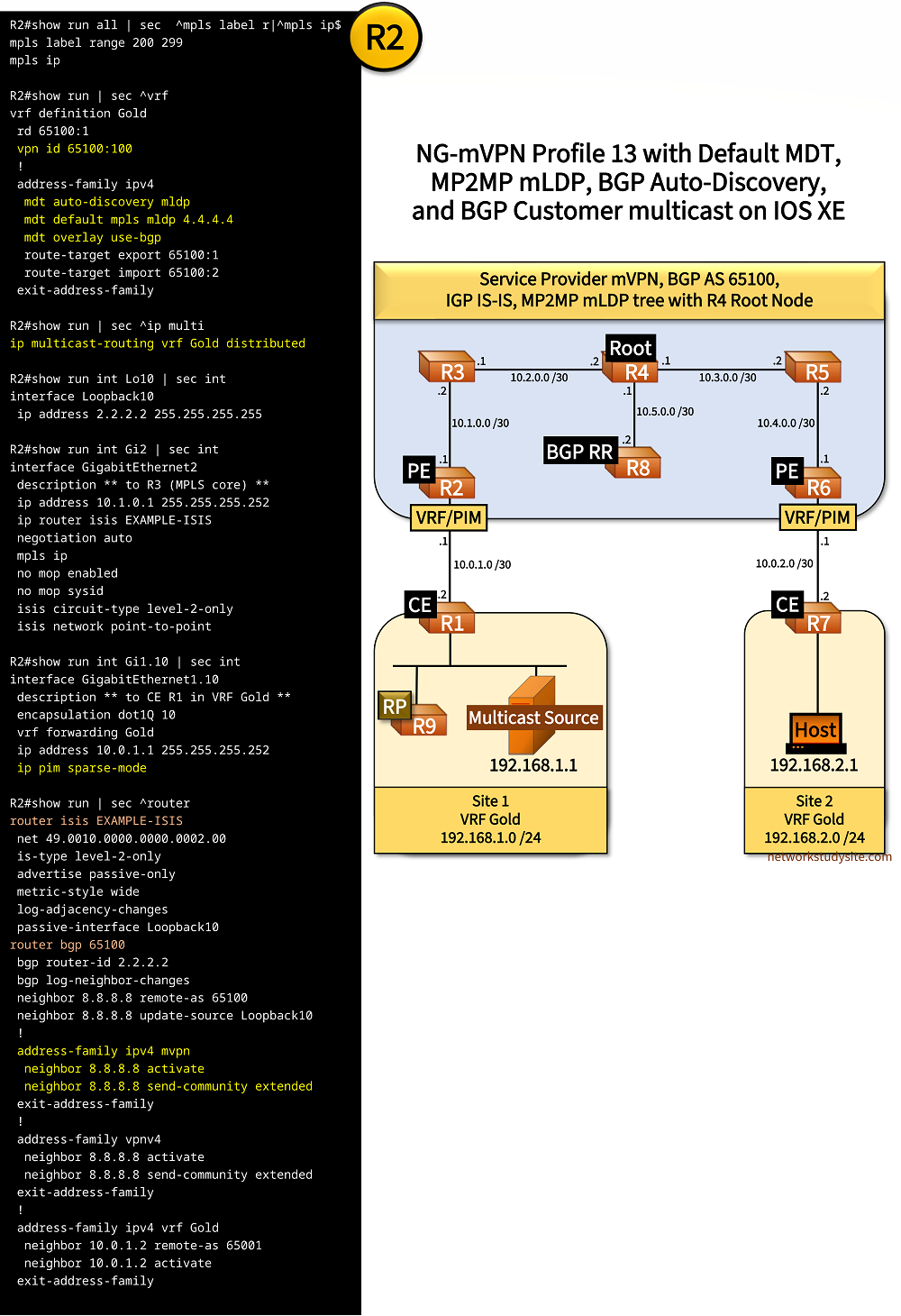
In the following example, mVPN Profile 13 is configured with a customer multicast network in VRF Gold connecting two sites. Profile 13 uses the default MDT and MP2MP mLDP just like Profile 1. But instead of using C-PIM (MPLS encapsulated PIM messages over the provider core network) to send customer join/prune requests, Profile 13 uses BGP in the MCAST-VPN address-family.
Another difference compared to NG-mVPN Profile 1 is that Profile 13 uses BGP for Auto-Discovery of multicast sources as well as also for Auto-Discovery of other mVPN PE routers. The PE Auto-Discovery feature uses the PMSI Tunnel Attribute, which is also implemented in the EVPN address family in Route Type 3 (IMET route).
Configuration:
R2 (PE)
R2#show run all | sec  ^mpls label r|^mpls ip$
mpls label range 200 299
mpls ip

R2#show run | sec ^vrf
vrf definition Gold
 rd 65100:1
 vpn id 65100:100
 !
 address-family ipv4
  mdt auto-discovery mldp
  mdt default mpls mldp 4.4.4.4
  mdt overlay use-bgp
  route-target export 65100:1
  route-target import 65100:2
 exit-address-family

R2#show run | sec ^ip multi
ip multicast-routing vrf Gold distributed

R2#show run int Lo10 | sec int
interface Loopback10
 ip address 2.2.2.2 255.255.255.255

R2#show run int Gi2 | sec int
interface GigabitEthernet2
 description ** to R3 (MPLS core) **
 ip address 10.1.0.1 255.255.255.252
 ip router isis EXAMPLE-ISIS
 negotiation auto
 mpls ip
 no mop enabled
 no mop sysid
 isis circuit-type level-2-only
 isis network point-to-point

R2#show run int Gi1 | sec int
interface GigabitEthernet1
 description ** to CE R1 **
 no ip address
 negotiation auto
 no mop enabled
 no mop sysid

R2#show run int Gi1.10 | sec int
interface GigabitEthernet1.10
 description ** to CE R1 in VRF Gold **
 encapsulation dot1Q 10
 vrf forwarding Gold
 ip address 10.0.1.1 255.255.255.252
 ip pim sparse-mode

R2#show run | sec ^router
router isis EXAMPLE-ISIS
 net 49.0010.0000.0000.0002.00
 is-type level-2-only
 advertise passive-only
 metric-style wide
 log-adjacency-changes
 passive-interface Loopback10
router bgp 65100
 bgp router-id 2.2.2.2
 bgp log-neighbor-changes
 neighbor 8.8.8.8 remote-as 65100
 neighbor 8.8.8.8 update-source Loopback10
 !
 address-family ipv4 mvpn
  neighbor 8.8.8.8 activate
  neighbor 8.8.8.8 send-community extended
 exit-address-family
 !
 address-family vpnv4
  neighbor 8.8.8.8 activate
  neighbor 8.8.8.8 send-community extended
 exit-address-family
 !
 address-family ipv4 vrf Gold
  neighbor 10.0.1.2 remote-as 65001
  neighbor 10.0.1.2 activate
 exit-address-family
R6 (PE)
R6#show run all | sec  ^mpls label r|^mpls ip$
mpls label range 600 699
mpls ip

R6#show run | sec ^vrf
vrf definition Gold
 rd 65100:2
 vpn id 65100:100
 !
 address-family ipv4
  mdt auto-discovery mldp
  mdt default mpls mldp 4.4.4.4
  mdt overlay use-bgp
  route-target export 65100:2
  route-target import 65100:1
 exit-address-family

R6#show run | sec ^ip multi
ip multicast-routing vrf Gold distributed

R6#show run int Lo10 | sec int
interface Loopback10
 ip address 6.6.6.6 255.255.255.255

R6#show run int Gi2 | sec int
interface GigabitEthernet2
 description ** to R5 (MPLS core) **
 ip address 10.4.0.1 255.255.255.252
 ip router isis EXAMPLE-ISIS
 negotiation auto
 mpls ip
 no mop enabled
 no mop sysid
 isis circuit-type level-2-only
 isis network point-to-point

R6#show run int Gi1 | sec int
interface GigabitEthernet1
 description ** to CE R7 **
 no ip address
 negotiation auto
 no mop enabled
 no mop sysid

R6#show run int Gi1.10 | sec int
interface GigabitEthernet1.10
 description ** to CE R7 in VRF Gold **
 encapsulation dot1Q 10
 vrf forwarding Gold
 ip address 10.0.2.1 255.255.255.252
 ip pim sparse-mode

R6#show run | sec ^router
router isis EXAMPLE-ISIS
 net 49.0010.0000.0000.0006.00
 is-type level-2-only
 advertise passive-only
 metric-style wide
 log-adjacency-changes
 passive-interface Loopback10
router bgp 65100
 bgp router-id 6.6.6.6
 bgp log-neighbor-changes
 neighbor 8.8.8.8 remote-as 65100
 neighbor 8.8.8.8 update-source Loopback10
 !
 address-family ipv4 mvpn
  neighbor 8.8.8.8 activate
  neighbor 8.8.8.8 send-community extended
 exit-address-family
 !
 address-family vpnv4
  neighbor 8.8.8.8 activate
  neighbor 8.8.8.8 send-community extended
 exit-address-family
 !
 address-family ipv4 vrf Gold
  neighbor 10.0.2.2 remote-as 65002
  neighbor 10.0.2.2 activate
 exit-address-family
R3
R3#show run all | sec  ^mpls label r|^mpls ip$
mpls label range 300 399
mpls ip

R3#show run int Lo10 | sec int
interface Loopback10
 ip address 3.3.3.3 255.255.255.255

R3#show run int Gi1 | sec int
interface GigabitEthernet1
 description ** to PE R2 **
 ip address 10.1.0.2 255.255.255.252
 ip router isis EXAMPLE-ISIS
 negotiation auto
 mpls ip
 no mop enabled
 no mop sysid
 isis circuit-type level-2-only
 isis network point-to-point

R3#show run int Gi2 | sec int
interface GigabitEthernet2
 description ** to R4 **
 ip address 10.2.0.1 255.255.255.252
 ip router isis EXAMPLE-ISIS
 negotiation auto
 mpls ip
 no mop enabled
 no mop sysid
 isis circuit-type level-2-only
 isis network point-to-point

R3#show run | sec ^router
router isis EXAMPLE-ISIS
 net 49.0010.0000.0000.0003.00
 is-type level-2-only
 advertise passive-only
 metric-style wide
 log-adjacency-changes
 passive-interface Loopback10
R4
R4#show run all | sec  ^mpls label r|^mpls ip$
mpls label range 400 499
mpls ip

R4#show run int Lo10 | sec int
interface Loopback10
 ip address 4.4.4.4 255.255.255.255

R4#show run int Gi1 | sec int
interface GigabitEthernet1
 description ** to R3 **
 ip address 10.2.0.2 255.255.255.252
 ip router isis EXAMPLE-ISIS
 negotiation auto
 mpls ip
 no mop enabled
 no mop sysid
 isis circuit-type level-2-only
 isis network point-to-point

R4#show run int Gi2 | sec int
interface GigabitEthernet2
 description ** to R5 **
 ip address 10.3.0.1 255.255.255.252
 ip router isis EXAMPLE-ISIS
 negotiation auto
 mpls ip
 no mop enabled
 no mop sysid
 isis circuit-type level-2-only
 isis network point-to-point

R4#show run int Gi3 | sec int
interface GigabitEthernet3
 description ** to BGP Route Reflector R8 **
 ip address 10.5.0.1 255.255.255.252
 ip router isis EXAMPLE-ISIS
 negotiation auto
 no mop enabled
 no mop sysid
 isis circuit-type level-2-only
 isis network point-to-point

R4#show run | sec ^router
router isis EXAMPLE-ISIS
 net 49.0010.0000.0000.0004.00
 is-type level-2-only
 advertise passive-only
 metric-style wide
 log-adjacency-changes
 passive-interface Loopback10
R8 (BGP RR)
R8#show run int Lo10 | sec int
interface Loopback10
 ip address 8.8.8.8 255.255.255.255

R8#show run int Gi0/0 | sec int
interface GigabitEthernet0/0
 description ** to R4 **
 ip address 10.5.0.2 255.255.255.252
 ip router isis EXAMPLE-ISIS
 duplex auto
 speed auto
 media-type rj45
 isis circuit-type level-2-only
 isis network point-to-point

R8#show run | sec ^router
router isis EXAMPLE-ISIS
 net 49.0010.0000.0000.0008.00
 is-type level-2-only
 advertise passive-only
 metric-style wide
 log-adjacency-changes
 passive-interface Loopback10
router bgp 65100
 bgp router-id 8.8.8.8
 bgp log-neighbor-changes
 neighbor 2.2.2.2 remote-as 65100
 neighbor 2.2.2.2 update-source Loopback10
 neighbor 6.6.6.6 remote-as 65100
 neighbor 6.6.6.6 update-source Loopback10
 !
 address-family ipv4 mvpn
  neighbor 2.2.2.2 activate
  neighbor 2.2.2.2 send-community extended
  neighbor 2.2.2.2 route-reflector-client
  neighbor 6.6.6.6 activate
  neighbor 6.6.6.6 send-community extended
  neighbor 6.6.6.6 route-reflector-client
 exit-address-family
 !
 address-family vpnv4
  neighbor 2.2.2.2 activate
  neighbor 2.2.2.2 send-community extended
  neighbor 2.2.2.2 route-reflector-client
  neighbor 6.6.6.6 activate
  neighbor 6.6.6.6 send-community extended
  neighbor 6.6.6.6 route-reflector-client
 exit-address-family
R2#show ip pim vrf Gold neighbor
PIM Neighbor Table
Mode: B - Bidir Capable, DR - Designated Router, N - Default DR Priority,
      P - Proxy Capable, S - State Refresh Capable, G - GenID Capable,
      L - DR Load-balancing Capable
Neighbor          Interface                Uptime/Expires    Ver   DR
Address                                                            Prio/Mode
10.0.1.2          GigabitEthernet1.10      03:41:21/00:01:31 v2    1 / DR S P G           « PE has PIM neighborship only with the CE router


R2#show ip bgp ipv4 mvpn all sum | beg Nei
Neighbor        V           AS MsgRcvd MsgSent   TblVer  InQ OutQ Up/Down  State/PfxRcd
8.8.8.8         4        65100      59      50       37    0    0 00:35:52        3       « PE has MVPN BGP address-family neighborship with RR


R2#show ip bgp ipv4 mvpn all | beg Ne
     Network          Next Hop            Metric LocPrf Weight Path
Route Distinguisher: 65100:1 (default for vrf Gold)
 *>   [1][65100:1][2.2.2.2]/12
                      0.0.0.0                            32768 ?
 *>i  [1][65100:1][6.6.6.6]/12                                      « BGP Auto-Discovery route (Type 1)
                      6.6.6.6                  0    100      0 ?
Route Distinguisher: 65100:2
 *>i  [1][65100:2][6.6.6.6]/12
                      6.6.6.6                  0    100      0 ?
Route Distinguisher: 65100:1 (default for vrf Gold)
 *>   [5][65100:1][192.168.1.1][239.1.1.1]/18
                      0.0.0.0                            32768 ?
 *>i  [6][65100:1][65100][9.9.9.9/32][239.1.1.1/32]/22              « BGP Route-Type 6 advertises RP R9 that serves the group address 239.1.1.1
                      6.6.6.6                  0    100      0 ?
 *>i  [7][65100:1][65100][192.168.1.1/32][239.1.1.1/32]/22          « BGP Route-Type 7 lists multicast group and mcast stream source address
                      6.6.6.6                  0    100      0 ?


R2#show mpls mldp root

 Root node    : 4.4.4.4                                             « mLDP is still being used with R4 as Root Node
  Metric      : 20
  Distance    : 115
  Interface   : GigabitEthernet2 (via unicast RT)
  FEC count   : 1
  Path count  : 1
  Path(s)     : 10.1.0.2         LDP nbr: 3.3.3.3:0         GigabitEthernet2


R2#show mpls mldp database
  * For interface indicates MLDP recursive forwarding is enabled
  * For RPF-ID indicates wildcard value
  > Indicates it is a Primary MLDP MDT Branch

LSM ID : 1 (RNR LSM ID: 2)   Type: MP2MP   Uptime : 03:41:15        « Multipoint-to-Multipoint mLDP tree
  FEC Root           : 4.4.4.4
  Opaque decoded     : [mdt 65100:100 0]
  Opaque length      : 11 bytes
  Opaque value       : 02 000B 0651000000010000000000
  RNR active LSP     : (this entry)
  Upstream client(s) :
    3.3.3.3:0    [Active]
      Expires        : Never         Path Set ID  : 1
      Out Label (U)  : 305           Interface    : GigabitEthernet2*
      Local Label (D): 207           Next Hop     : 10.1.0.2
  Replication client(s):
>   MDT  (VRF Gold)
      Uptime         : 03:41:15      Path Set ID  : 2
      Interface      : Lspvif0       RPF-ID       : *


R7#show ip pim vrf Gold rp mapping
PIM Group-to-RP Mappings

Group(s) 224.0.0.0/4
  RP 9.9.9.9 (?), v2                                                « Remote CE R7 receives PIM-SM RP address for VRF Gold PIM overlay network
    Info source: 9.9.9.9 (?), via bootstrap, priority 0, holdtime 150
         Uptime: 03:41:11, expires: 00:02:22


Source#ping 239.1.1.1 re 5
Type escape sequence to abort.
Sending 5, 100-byte ICMP Echos to 239.1.1.1, timeout is 2 seconds:

Reply to request 0 from 192.168.2.1, 11 ms                          « Multicast stream sent from Site 1 is received by Host in Site 2
Reply to request 1 from 192.168.2.1, 8 ms
Reply to request 2 from 192.168.2.1, 9 ms
Reply to request 3 from 192.168.2.1, 9 ms
Reply to request 4 from 192.168.2.1, 9 ms


Host#show ip traffic | sec Mcast
  Mcast: 5 received, 0 sent