MPLS TE Path Protection | Configuring Backup LSP in L3VPN
Table of Contents
- What is MPLS TE path protection? ‹
- Configuring secondary/backup LSP with path protection ‹
- Configuring path option list for multiple backup LSPs ‹
- Download section ‹
What is MPLS TE path protection?
The MPLS TE path protection feature allows to configure a backup label switched path (LSP) that is used in case the primary LSP fails. The backup path is explicitly configured on the Provider Edge (PE) routers. Path protection is not the same as MPLS TE Fast Reroute (FRR). Namely, there is no backup (nhop or nnhop) tunnel configured to bypass a failed link or node, consequently there is no additional MPLS label added to traffic on the secondary LSP.
Configuring secondary/backup LSP with path protection
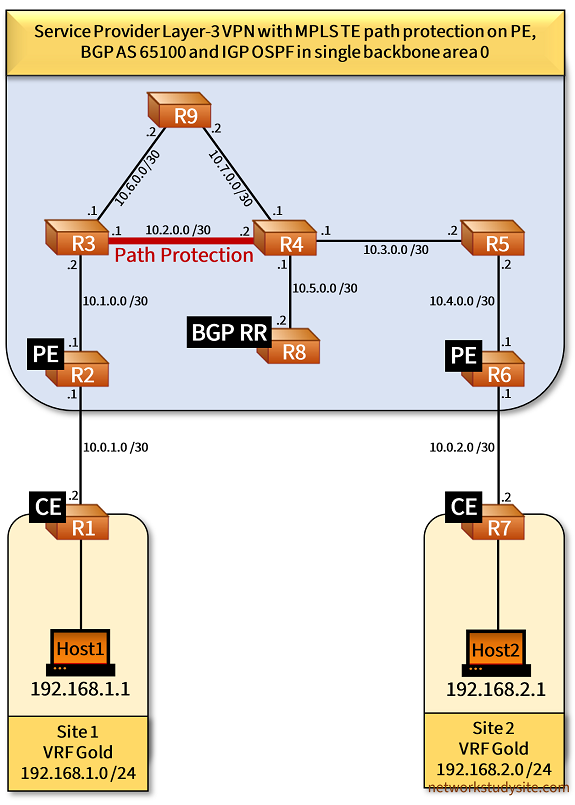
In the following example topology PE R2 and PE R6 are connected through an MPLS TE tunnel using an explicit path option. This means, a list is configured on the PEs identifying each next-hop router to create an end-to-end LSP. This method of defining an LSP is called an Explicit Route Object (ERO), and it can be applied to create a backup LSP as well.
Thus, a primary and backup LSP are created on the PEs, and the backup LSP (through R9) provides path protection in case the primary path between R3 - R4 fails. Note that an MPLS TE tunnel is unidirectional, so two explicit paths (primary/backup) are required in both directions.
Configuration:
R2 (PE)
R2#show run | sec ^mpls
mpls label range 200 299
mpls traffic-eng tunnels

R2#show run | sec ^vrf
vrf definition Gold
 rd 65100:1
 !
 address-family ipv4
  route-target export 65100:1
  route-target import 65100:2
 exit-address-family

R2#show run int Lo10 | sec int
interface Loopback10
 ip address 2.2.2.2 255.255.255.255

R2#show run int Gi0/0 | sec int
interface GigabitEthernet0/0
 description ** to CE R1 **
 no ip address
 duplex auto
 speed auto
 media-type rj45

R2#show run int Gi0/0.10 | sec int
interface GigabitEthernet0/0.10
 description ** to CE R1 in VRF Gold **
 encapsulation dot1Q 10
 vrf forwarding Gold
 ip address 10.0.1.1 255.255.255.252

R2#show run int Gi0/1 | sec int
interface GigabitEthernet0/1
 description ** to R3 **
 ip address 10.1.0.1 255.255.255.252
 ip ospf network point-to-point
 duplex auto
 speed auto
 media-type rj45
 mpls traffic-eng tunnels
 ip rsvp bandwidth 100 50

R2#show run int Tu10 | sec int
interface Tunnel10
 description ** MPLS TE tunnel to PE R6 **
 ip unnumbered Loopback10
 tunnel mode mpls traffic-eng
 tunnel destination 6.6.6.6
 tunnel mpls traffic-eng autoroute announce
 tunnel mpls traffic-eng priority 1 1
 tunnel mpls traffic-eng bandwidth 50
 tunnel mpls traffic-eng path-option 10 explicit name EXAMPLE-PATH
 tunnel mpls traffic-eng path-option protect 10 explicit name EXAMPLE-BACKUP-PATH
 no routing dynamic

R2#show run | sec ^ip exp
ip explicit-path name EXAMPLE-PATH enable
 next-address 3.3.3.3
 next-address 4.4.4.4
 next-address 5.5.5.5
 next-address 6.6.6.6
ip explicit-path name EXAMPLE-BACKUP-PATH enable
 next-address 3.3.3.3
 next-address 9.9.9.9
 next-address 4.4.4.4
 next-address 5.5.5.5
 next-address 6.6.6.6

R2#show run | sec ^router
router ospf 10
 mpls traffic-eng router-id Loopback10
 mpls traffic-eng area 0
 router-id 2.2.2.2
 network 2.2.2.2 0.0.0.0 area 0
 network 10.1.0.0 0.0.0.3 area 0
router bgp 65100
 bgp router-id 2.2.2.2
 bgp log-neighbor-changes
 neighbor 8.8.8.8 remote-as 65100
 neighbor 8.8.8.8 update-source Loopback10
 !
 address-family vpnv4
  neighbor 8.8.8.8 activate
  neighbor 8.8.8.8 send-community extended
 exit-address-family
 !
 address-family ipv4 vrf Gold
  network 10.0.1.0 mask 255.255.255.252
  neighbor 10.0.1.2 remote-as 65001
  neighbor 10.0.1.2 activate
 exit-address-family
R6 (PE)
R6#show run | sec ^mpls
mpls label range 600 699
mpls traffic-eng tunnels

R6#show run | sec ^vrf
vrf definition Gold
 rd 65100:2
 !
 address-family ipv4
  route-target export 65100:2
  route-target import 65100:1
 exit-address-family

R6#show run int Lo10 | sec int
interface Loopback10
 ip address 6.6.6.6 255.255.255.255

R6#show run int Gi0/0 | sec int
interface GigabitEthernet0/0
 description ** to CE R7 **
 no ip address
 duplex auto
 speed auto
 media-type rj45

R6#show run int Gi0/0.10 | sec int
interface GigabitEthernet0/0.10
 description ** to CE R7 in VRF Gold **
 encapsulation dot1Q 10
 vrf forwarding Gold
 ip address 10.0.2.1 255.255.255.252

R6#show run int Gi0/1 | sec int
interface GigabitEthernet0/1
 description ** to R5 **
 ip address 10.4.0.1 255.255.255.252
 ip ospf network point-to-point
 duplex auto
 speed auto
 media-type rj45
 mpls traffic-eng tunnels
 ip rsvp bandwidth 100 50

R6#show run int Tu10 | sec int
interface Tunnel10
 description ** MPLS TE tunnel to PE R2 **
 ip unnumbered Loopback10
 tunnel mode mpls traffic-eng
 tunnel destination 2.2.2.2
 tunnel mpls traffic-eng autoroute announce
 tunnel mpls traffic-eng priority 1 1
 tunnel mpls traffic-eng bandwidth 50
 tunnel mpls traffic-eng path-option 10 explicit name EXAMPLE-PATH
 tunnel mpls traffic-eng path-option protect 10 explicit name EXAMPLE-BACKUP-PATH
 no routing dynamic

R6#show run | sec ^ip exp
ip explicit-path name EXAMPLE-PATH enable
 next-address 5.5.5.5
 next-address 4.4.4.4
 next-address 3.3.3.3
 next-address 2.2.2.2
ip explicit-path name EXAMPLE-BACKUP-PATH enable
 next-address 5.5.5.5
 next-address 4.4.4.4
 next-address 9.9.9.9
 next-address 3.3.3.3
 next-address 2.2.2.2

R6#show run | sec ^router
router ospf 10
 mpls traffic-eng router-id Loopback10
 mpls traffic-eng area 0
 router-id 6.6.6.6
 network 6.6.6.6 0.0.0.0 area 0
 network 10.4.0.0 0.0.0.3 area 0
router bgp 65100
 bgp router-id 6.6.6.6
 bgp log-neighbor-changes
 neighbor 8.8.8.8 remote-as 65100
 neighbor 8.8.8.8 update-source Loopback10
 !
 address-family vpnv4
  neighbor 8.8.8.8 activate
  neighbor 8.8.8.8 send-community extended
 exit-address-family
 !
 address-family ipv4 vrf Gold
  network 10.0.2.0 mask 255.255.255.252
  neighbor 10.0.2.2 remote-as 65002
  neighbor 10.0.2.2 activate
 exit-address-family
R3
R3#show run | sec ^mpls
mpls label range 300 399
mpls traffic-eng tunnels

R3#show run | sec ^ip rsvp
ip rsvp signalling hello

R3#show run int Lo10 | sec int
interface Loopback10
 ip address 3.3.3.3 255.255.255.255

R3#show run int Gi0/0 | sec int
interface GigabitEthernet0/0
 description ** to PE R2 **
 ip address 10.1.0.2 255.255.255.252
 ip ospf network point-to-point
 duplex auto
 speed auto
 media-type rj45
 mpls traffic-eng tunnels
 ip rsvp bandwidth 100 50

R3#show run int Gi0/1 | sec int
interface GigabitEthernet0/1
 description ** to R4 **
 ip address 10.2.0.1 255.255.255.252
 ip ospf network point-to-point
 duplex auto
 speed auto
 media-type rj45
 mpls traffic-eng tunnels
 ip rsvp bandwidth 100 50
 ip rsvp signalling hello

R3#show run int Gi0/2 | sec int
interface GigabitEthernet0/2
 description ** to R9 - backup path **
 ip address 10.6.0.1 255.255.255.252
 ip ospf network point-to-point
 duplex auto
 speed auto
 media-type rj45
 mpls traffic-eng tunnels
 ip rsvp bandwidth 100 50

R3#show run | sec ^router
router ospf 10
 mpls traffic-eng router-id Loopback10
 mpls traffic-eng area 0
 router-id 3.3.3.3
 network 3.3.3.3 0.0.0.0 area 0
 network 10.1.0.0 0.0.0.3 area 0
 network 10.2.0.0 0.0.0.3 area 0
 network 10.6.0.0 0.0.0.3 area 0
R4
R4#show run | sec ^mpls
mpls label range 400 499
mpls traffic-eng tunnels

R4#show run | sec ^ip rsvp
ip rsvp signalling hello

R4#show run int Lo10 | sec int
interface Loopback10
 ip address 4.4.4.4 255.255.255.255

R4#show run int Gi0/0 | sec int
interface GigabitEthernet0/0
 description ** to R3 **
 ip address 10.2.0.2 255.255.255.252
 ip ospf network point-to-point
 duplex auto
 speed auto
 media-type rj45
 mpls traffic-eng tunnels
 ip rsvp bandwidth 100 50
 ip rsvp signalling hello

R4#show run int Gi0/1 | sec int
interface GigabitEthernet0/1
 description ** to R5 **
 ip address 10.3.0.1 255.255.255.252
 ip ospf network point-to-point
 duplex auto
 speed auto
 media-type rj45
 mpls traffic-eng tunnels
 ip rsvp bandwidth 100 50

R4#show run int Gi0/2 | sec int
interface GigabitEthernet0/2
 description ** to BGP RR R8 **
 ip address 10.5.0.1 255.255.255.252
 ip ospf network point-to-point
 duplex auto
 speed auto
 media-type rj45

R4#show run int Gi0/3 | sec int
interface GigabitEthernet0/3
 description ** to R9 - backup path **
 ip address 10.7.0.1 255.255.255.252
 ip ospf network point-to-point
 duplex auto
 speed auto
 media-type rj45
 mpls traffic-eng tunnels
 ip rsvp bandwidth 100 50

R4#show run | sec ^router
router ospf 10
 mpls traffic-eng router-id Loopback10
 mpls traffic-eng area 0
 router-id 4.4.4.4
 network 4.4.4.4 0.0.0.0 area 0
 network 10.2.0.0 0.0.0.3 area 0
 network 10.3.0.0 0.0.0.3 area 0
 network 10.5.0.0 0.0.0.3 area 0
 network 10.7.0.0 0.0.0.3 area 0
R9
R9#show run | sec ^mpls
mpls label range 900 999
mpls traffic-eng tunnels

R9#show run int Lo10 | sec int
interface Loopback10
 ip address 9.9.9.9 255.255.255.255

R9#show run int Gi0/0 | sec int
interface GigabitEthernet0/0
 description ** to R3 **
 ip address 10.6.0.2 255.255.255.252
 ip ospf network point-to-point
 duplex auto
 speed auto
 media-type rj45
 mpls traffic-eng tunnels
 ip rsvp bandwidth 100 50

R9#show run int Gi0/1 | sec int
interface GigabitEthernet0/1
 description ** to R4 **
 ip address 10.7.0.2 255.255.255.252
 ip ospf network point-to-point
 duplex auto
 speed auto
 media-type rj45
 mpls traffic-eng tunnels
 ip rsvp bandwidth 100 50

R9#show run | sec ^router
router ospf 10
 mpls traffic-eng router-id Loopback10
 mpls traffic-eng area 0
 router-id 9.9.9.9
 network 9.9.9.9 0.0.0.0 area 0
 network 10.6.0.0 0.0.0.3 area 0
 network 10.7.0.0 0.0.0.3 area 0
R8 (BGP RR)
R8#show run int Lo10 | sec int
interface Loopback10
 ip address 8.8.8.8 255.255.255.255

R8#show run int Gi0/0 | sec int
interface GigabitEthernet0/0
 description ** to R4 **
 ip address 10.5.0.2 255.255.255.252
 ip ospf network point-to-point
 duplex auto
 speed auto
 media-type rj45

R8#show run | sec ^router
router ospf 10
 router-id 8.8.8.8
 network 8.8.8.8 0.0.0.0 area 0
 network 10.5.0.0 0.0.0.3 area 0
router bgp 65100
 bgp router-id 8.8.8.8
 bgp log-neighbor-changes
 neighbor 2.2.2.2 remote-as 65100
 neighbor 2.2.2.2 update-source Loopback10
 neighbor 6.6.6.6 remote-as 65100
 neighbor 6.6.6.6 update-source Loopback10
 !
 address-family vpnv4
  neighbor 2.2.2.2 activate
  neighbor 2.2.2.2 send-community extended
  neighbor 2.2.2.2 route-reflector-client
  neighbor 6.6.6.6 activate
  neighbor 6.6.6.6 send-community extended
  neighbor 6.6.6.6 route-reflector-client
 exit-address-family
R1 (CE)
R1#show run | sec ^vrf
vrf definition Gold
 rd 1:1
 !
 address-family ipv4
 exit-address-family

R1#show run int Gi0/0 | sec int
interface GigabitEthernet0/0
 description ** to Host1 **
 no ip address
 duplex auto
 speed auto
 media-type rj45

R1#show run int Gi0/0.1 | sec int
interface GigabitEthernet0/0.1
 description ** to Host1 in VRF Gold (VLAN 1) **
 encapsulation dot1Q 1 native
 vrf forwarding Gold
 ip address 192.168.1.2 255.255.255.0

R1#show run int Gi0/1 | sec int
interface GigabitEthernet0/1
 description ** to PE R2 **
 no ip address
 duplex auto
 speed auto
 media-type rj45

R1#show run int Gi0/1.10 | sec int
interface GigabitEthernet0/1.10
 description ** to PE R2 in VRF Gold **
 encapsulation dot1Q 10
 vrf forwarding Gold
 ip address 10.0.1.2 255.255.255.252

R1#show run | sec ^router
router bgp 65001
 bgp router-id 1.1.1.1
 bgp log-neighbor-changes
 !
 address-family ipv4 vrf Gold
  network 192.168.1.0
  neighbor 10.0.1.1 remote-as 65100
  neighbor 10.0.1.1 activate
 exit-address-family
R7 (CE)
R7#show run | sec ^vrf
vrf definition Gold
 rd 1:1
 !
 address-family ipv4
 exit-address-family

R7#show run int Gi0/0 | sec int
interface GigabitEthernet0/0
 description ** to Host2 **
 no ip address
 duplex auto
 speed auto
 media-type rj45

R7#show run int Gi0/0.1 | sec int
interface GigabitEthernet0/0.1
 description ** to Host2 in VRF Gold (VLAN 1) **
 encapsulation dot1Q 1 native
 vrf forwarding Gold
 ip address 192.168.2.2 255.255.255.0

R7#show run int Gi0/1 | sec int
interface GigabitEthernet0/1
 description ** to PE R6 **
 no ip address
 duplex auto
 speed auto
 media-type rj45

R7#show run int Gi0/1.10 | sec int
interface GigabitEthernet0/1.10
 description ** to PE R6 in VRF Gold **
 encapsulation dot1Q 10
 vrf forwarding Gold
 ip address 10.0.2.2 255.255.255.252

R7#show run | sec ^router
router bgp 65002
 bgp router-id 7.7.7.7
 bgp log-neighbor-changes
 !
 address-family ipv4 vrf Gold
  network 192.168.2.0
  neighbor 10.0.2.1 remote-as 65100
  neighbor 10.0.2.1 activate
 exit-address-family
Host1
Host1#show run int Gi0/0 | sec int
interface GigabitEthernet0/0
 description ** to CE R1 **
 ip address 192.168.1.1 255.255.255.0
 duplex auto
 speed auto
 media-type rj45

Host1#show run | sec ^ip route
ip route 0.0.0.0 0.0.0.0 192.168.1.2
R2#show mpls traffic-eng tunnels Tu10 protection
** MPLS TE tunnel to PE R6 **
  LSP Head, Tunnel10, Admin: up, Oper: up
  Src 2.2.2.2, Dest 6.6.6.6, Instance 7
  Fast Reroute Protection: None                « Fast Reroute is not configured
  Path Protection: 3 Common Link(s), 3 Common Node(s)
    Primary lsp path:10.1.0.2 10.2.0.2
                     10.3.0.2 10.4.0.1
                     6.6.6.6
    Protect lsp path:10.1.0.2 10.6.0.2         « Backup path Label Switched Path (LSP)
                     10.7.0.1 10.3.0.2
                     10.4.0.1 6.6.6.6

    Path Protect Parameters:
      Bandwidth: 50       kbps (Global)  Priority: 1  1   Affinity: 0x0/0xFFFF
      Metric Type: TE (default)
    InLabel  :  -
    OutLabel : GigabitEthernet0/1, 302
    RSVP Signalling Info:
         Src 2.2.2.2, Dst 6.6.6.6, Tun_Id 10, Tun_Instance 12
      RSVP Path Info:
        My Address: 10.1.0.1
        Explicit Route: 10.1.0.2 10.6.0.2 10.7.0.1 10.3.0.2           « LSP of the backup path through R9
                        10.4.0.1 6.6.6.6
        Record   Route:   NONE
        Tspec: ave rate=50 kbits, burst=1000 bytes, peak rate=50 kbits
      RSVP Resv Info:
        Record   Route:   NONE
        Fspec: ave rate=50 kbits, burst=1000 bytes, peak rate=50 kbits


R2#show mpls traffic-eng tunnels brief
Signalling Summary:
    LSP Tunnels Process:            running
    Passive LSP Listener:           running
    RSVP Process:                   running
    Forwarding:                     enabled
    Periodic reoptimization:        every 3600 seconds, next in 3033 seconds
    Periodic FRR Promotion:         Not Running
    Periodic auto-bw collection:    every 300 seconds, next in 33 seconds
TUNNEL NAME                      DESTINATION      UP IF      DOWN IF    STATE/PROT
** MPLS TE tunnel to PE R6 *...  6.6.6.6          -         Gi0/1     up/up        « MPLE TE tunnels are up
** MPLS TE tunnel to PE R2 *...  2.2.2.2          Gi0/1      -          up/up
** MPLS TE tunnel to PE R2 *...  2.2.2.2          Gi0/1      -          up/up
Displayed 1 (of 1) heads, 0 (of 0) midpoints, 2 (of 2) tails


Host1#trace 192.168.2.1 probe 1
Type escape sequence to abort.
Tracing the route to 192.168.2.1
VRF info: (vrf in name/id, vrf out name/id)
  1 192.168.1.2 1 msec
  2 10.0.1.1 22 msec
  3 10.1.0.2 [MPLS: Labels 301/601 Exp 0] 69 msec              « MPLS label stack is used
  4 10.2.0.2 [MPLS: Labels 401/601 Exp 0] 70 msec
  5 10.3.0.2 [MPLS: Labels 501/601 Exp 0] 66 msec
  6 10.0.2.1 [MPLS: Label 601 Exp 0] 48 msec                   « MPLS VPN service label assigned by R6
  7 10.0.2.2 70 msec
  8 192.168.2.1 70 msec


Host1#ping 192.168.2.1 re 100
Type escape sequence to abort.
Sending 100, 100-byte ICMP Echos to 192.168.2.1, timeout is 2 seconds:
!!!!!!!!!!!!!!!!!!!!!!!!!!!!!!!!!!!!!!!!....!!!!!!!!!!!!!!!!!!!!!!!!!!
!!!!!!!!!!!!!!!!!!!!!!!!!!!!!!
Success rate is 96 percent (96/100), round-trip min/avg/max = 66/82/108 ms           « Packet loss during link failover to backup LSP


Host1#trace 192.168.2.1 probe 1
Type escape sequence to abort.
Tracing the route to 192.168.2.1
VRF info: (vrf in name/id, vrf out name/id)
  1 192.168.1.2 2 msec
  2 10.0.1.1 23 msec
  3 10.1.0.2 [MPLS: Labels 302/601 Exp 0] 91 msec
  4 10.6.0.2 [MPLS: Labels 900/601 Exp 0] 91 msec              « Backup path goes through R9, no extra MPLS label added
  5 10.7.0.1 [MPLS: Labels 402/601 Exp 0] 90 msec
  6 10.3.0.2 [MPLS: Labels 502/601 Exp 0] 91 msec
  7 10.0.2.1 [MPLS: Label 601 Exp 0] 70 msec
  8 10.0.2.2 90 msec
  9 192.168.2.1 91 msec


R2#show mpls traffic-eng tunnels Tu10 protection
** MPLS TE tunnel to PE R6 **
  LSP Head, Tunnel10, Admin: up, Oper: up
  Src 2.2.2.2, Dest 6.6.6.6, Instance 16
  Fast Reroute Protection: None
  Path Protection: Backup lsp in use.                          « The backup LSP is currently used, displayed on PE show command output
As visible in the above outputs, the explicit path of the backup LSP is displayed besides the primary path. When the primary LSP fails between R3 - R4 an additional backup tunnel MPLS label is not added, because the backup LSP is configured as an ERO.
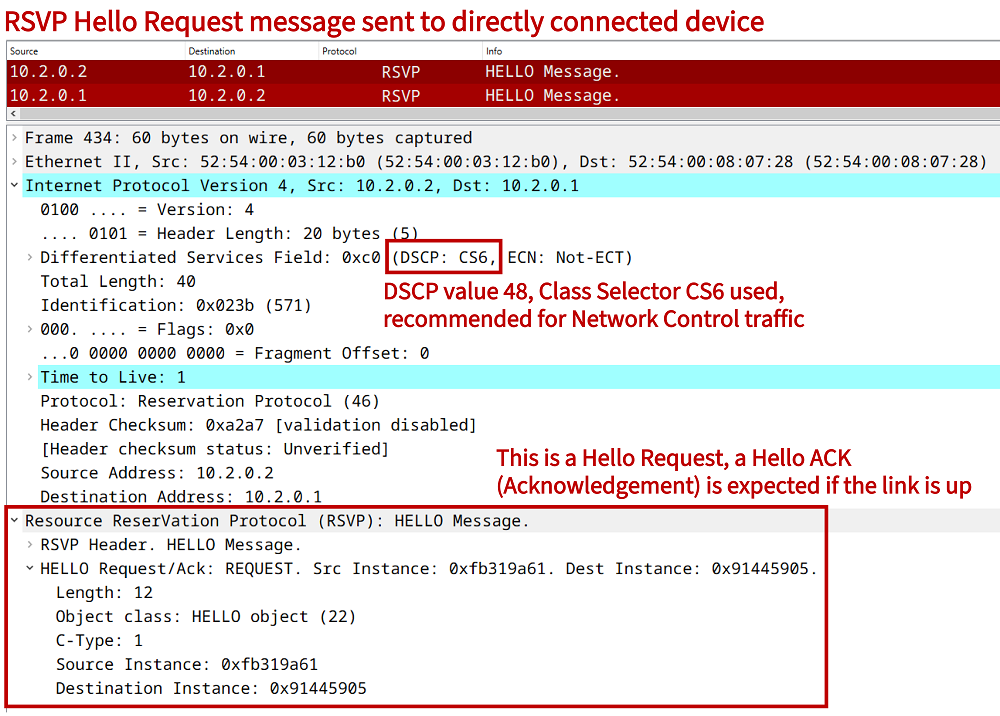
Between R3 - R4 the failure detection mechanism is configured with RSVP Hello signaling. Directly connected devices exchange RSVP Hello Request and Acknowledgement packets to confirm liveliness of the link. This is shown in the following output. RSVP Hello signaling is described in the RFC 3209 under section 5. (Hello Extension). The purpose of RSVP Hello signaling is similar to the failure detection mechanism of BFD.
R3#show ip rsvp hello instance detail
  Neighbor 10.2.0.2 (router ID: 4.4.4.4)  Source  10.2.0.1
    Type: Active    (sending requests)
    I/F:  GigabitEthernet0/1
    State:   Up        (Since: 2025 May Monday 19 08:03:50 )
    Clients: ReRoute
    LSPs protecting: 2
    Missed acks: 4, IP DSCP: 0x30
    Refresh Interval (msec)
      Configured: 2000
      Statistics: (from 103 samples)
        Min:      2000
        Max:      2000
        Average:  2000
        Waverage: 2000 (Weight = 0.8)
        Current:  2000
    Last sent Src_instance: 0x2B296523
    Last recv nbr's Src_instance: 0xD8B1C74E
    Counters:
      Communication with neighbor lost:
        Num times:                    1  (last time at 00:39:44)
        Reasons:
          Missed acks:                1
          Bad Src_Inst received:      0
          Bad Dst_Inst received:      0
          I/F went down:              0
          Neighbor disabled Hello:    0
      Msgs Received:   201
           Sent:       205
           Suppressed: 0


R3#show ip rsvp hello instance summary
Active Instances:
  Client  Neighbor        I/F        State      LostCnt  LSPs Interval
  RR      10.2.0.2        Gi0/1      Up               1     2 2000

Passive Instances:
  - None -

Active = Actively tracking neighbor state on behalf of clients:
         RR = ReRoute, FRR = Fast ReRoute, or GR = Graceful Restart
Passive = Responding to hello requests from neighbor
Configuring path option list for multiple backup LSPs
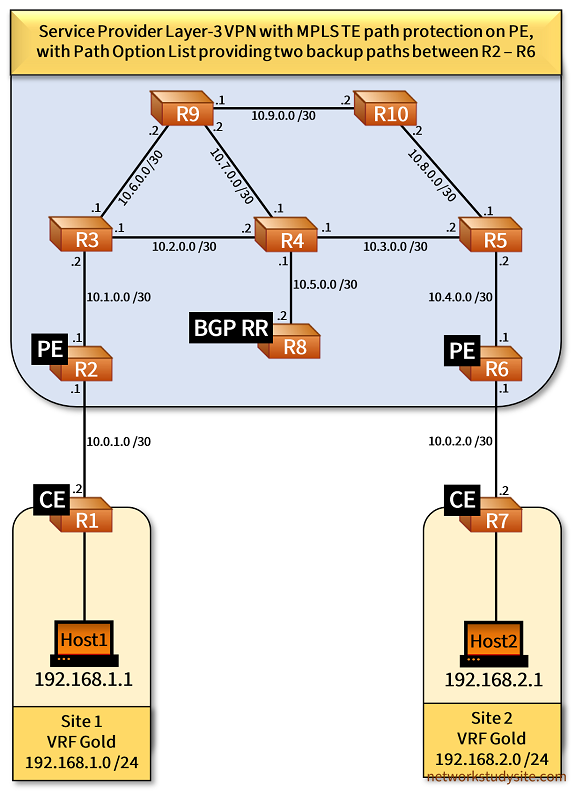
A Path Option List allows to create multiple backup LSPs protecting a primary LSP. This means, if the primary LSP fails, there are multiple secondary LSPs to choose from. The secondary (backup) LSPs are configured in order, and prioritized based on the network requirements.
In the following example topology the primary LSP uses the dynamic path option, and finds the shortest path is between R2 - R3 - R4 - R5 - R6. If this path fails, the next LSP in line is through R3 - R9 - R4. And if that path were to fail, the third LSP in line is R3 - R9 - R10 - R5. This is accomplished with the Path Option List 999 confgured on the PE routers.
Configuration:
R2 (PE)
R2#show run int Tu10 | sec int
interface Tunnel10
 description ** MPLS TE tunnel to PE R6 **
 ip unnumbered Loopback10
 tunnel mode mpls traffic-eng
 tunnel destination 6.6.6.6
 tunnel mpls traffic-eng autoroute announce
 tunnel mpls traffic-eng priority 1 1
 tunnel mpls traffic-eng bandwidth 50
 tunnel mpls traffic-eng path-option 10 dynamic
 tunnel mpls traffic-eng path-option protect 10 list identifier 999

R2#show run | sec ^mpls
mpls label range 200 299
mpls traffic-eng tunnels
mpls traffic-eng reoptimize timers frequency 1
mpls traffic-eng path-option list identifier 999
 path-option 20 explicit identifier 100
 path-option 30 explicit identifier 200

R2#show run | sec ^ip exp
ip explicit-path identifier 100 enable
 index 1 next-address 3.3.3.3
 index 2 next-address 9.9.9.9
 index 3 next-address 4.4.4.4
 index 4 next-address 5.5.5.5
 index 5 next-address 6.6.6.6
ip explicit-path identifier 200 enable
 index 1 next-address 3.3.3.3
 index 2 next-address 9.9.9.9
 index 3 next-address 10.10.10.10
 index 4 next-address 5.5.5.5
 index 5 next-address 6.6.6.6

R2#show run int Lo10 | sec int
interface Loopback10
 ip address 2.2.2.2 255.255.255.255

R2#show run | sec ^router
router ospf 10
 router-id 2.2.2.2
 network 2.2.2.2 0.0.0.0 area 0
 network 10.1.0.0 0.0.0.3 area 0
 mpls traffic-eng router-id Loopback10
 mpls traffic-eng area 0
router bgp 65100
 bgp router-id 2.2.2.2
 bgp log-neighbor-changes
 neighbor 8.8.8.8 remote-as 65100
 neighbor 8.8.8.8 update-source Loopback10
 !
 address-family vpnv4
  neighbor 8.8.8.8 activate
  neighbor 8.8.8.8 send-community extended
 exit-address-family
 !
 address-family ipv4 vrf Gold
  network 10.0.1.0 mask 255.255.255.252
  neighbor 10.0.1.2 remote-as 65001
  neighbor 10.0.1.2 activate
 exit-address-family
R6 (PE)
R6#show run int Tu10 | sec int
interface Tunnel10
 description ** MPLS TE tunnel to PE R2 **
 ip unnumbered Loopback10
 tunnel mode mpls traffic-eng
 tunnel destination 2.2.2.2
 tunnel mpls traffic-eng autoroute announce
 tunnel mpls traffic-eng priority 1 1
 tunnel mpls traffic-eng bandwidth 50
 tunnel mpls traffic-eng path-option 10 dynamic
 tunnel mpls traffic-eng path-option protect 10 list identifier 999

R6#show run | sec ^mpls
mpls label range 600 699
mpls traffic-eng tunnels
mpls traffic-eng reoptimize timers frequency 1
mpls traffic-eng path-option list identifier 999
 path-option 20 explicit identifier 100
 path-option 30 explicit identifier 200

R6#show run | sec ^ip exp
ip explicit-path identifier 100 enable
 index 1 next-address 5.5.5.5
 index 2 next-address 4.4.4.4
 index 3 next-address 9.9.9.9
 index 4 next-address 3.3.3.3
 index 5 next-address 2.2.2.2
ip explicit-path identifier 200 enable
 index 1 next-address 5.5.5.5
 index 2 next-address 10.10.10.10
 index 3 next-address 9.9.9.9
 index 4 next-address 3.3.3.3
 index 5 next-address 2.2.2.2

R6#show run int Lo10 | sec int
interface Loopback10
 ip address 6.6.6.6 255.255.255.255

R6#show run | sec ^router
router ospf 10
 router-id 6.6.6.6
 network 6.6.6.6 0.0.0.0 area 0
 network 10.4.0.0 0.0.0.3 area 0
 mpls traffic-eng router-id Loopback10
 mpls traffic-eng area 0
router bgp 65100
 bgp router-id 6.6.6.6
 bgp log-neighbor-changes
 neighbor 8.8.8.8 remote-as 65100
 neighbor 8.8.8.8 update-source Loopback10
 !
 address-family vpnv4
  neighbor 8.8.8.8 activate
  neighbor 8.8.8.8 send-community extended
 exit-address-family
 !
 address-family ipv4 vrf Gold
  network 10.0.2.0 mask 255.255.255.252
  neighbor 10.0.2.2 remote-as 65002
  neighbor 10.0.2.2 activate
 exit-address-family
R2#show mpls traffic-eng path-option list
Path-option list identifier 999
  path-option 20 explicit identifier 100        « Backup path configured in path option list
  path-option 30 explicit identifier 200


Host1#trace 192.168.2.1 probe 1
Type escape sequence to abort.
Tracing the route to 192.168.2.1
VRF info: (vrf in name/id, vrf out name/id)
  1 192.168.1.2 1 msec
  2 10.0.1.1 22 msec
  3 10.1.0.2 [MPLS: Labels 306/602 Exp 0] 89 msec
  4 10.2.0.2 [MPLS: Labels 401/602 Exp 0] 89 msec          « Primary LSP
  5 10.3.0.2 [MPLS: Labels 503/602 Exp 0] 91 msec
  6 10.0.2.1 [MPLS: Label 602 Exp 0] 68 msec
  7 10.0.2.2 90 msec
  8 192.168.2.1 91 msec


Host1#trace 192.168.2.1 probe 1
Type escape sequence to abort.
Tracing the route to 192.168.2.1
VRF info: (vrf in name/id, vrf out name/id)
  1 192.168.1.2 2 msec
  2 10.0.1.1 23 msec
  3 10.1.0.2 [MPLS: Labels 310/602 Exp 0] 113 msec
  4 10.6.0.2 [MPLS: Labels 903/602 Exp 0] 113 msec         « First backup LSP
  5 10.7.0.1 [MPLS: Labels 406/602 Exp 0] 113 msec
  6 10.3.0.2 [MPLS: Labels 506/602 Exp 0] 113 msec
  7 10.0.2.1 [MPLS: Label 602 Exp 0] 89 msec
  8 10.0.2.2 113 msec
  9 192.168.2.1 114 msec


Host1#trace 192.168.2.1 probe 1
Type escape sequence to abort.
Tracing the route to 192.168.2.1
VRF info: (vrf in name/id, vrf out name/id)
  1 192.168.1.2 1 msec
  2 10.0.1.1 24 msec
  3 10.1.0.2 [MPLS: Labels 311/602 Exp 0] 95 msec
  4 10.6.0.2 [MPLS: Labels 902/602 Exp 0] 91 msec
  5 10.9.0.2 [MPLS: Labels 1003/602 Exp 0] 91 msec         « Second backup LSP
  6 10.8.0.1 [MPLS: Labels 507/602 Exp 0] 91 msec
  7 10.0.2.1 [MPLS: Label 602 Exp 0] 69 msec
  8 10.0.2.2 88 msec
  9 192.168.2.1 91 msec


Host1#ping 192.168.2.1 re 100
Type escape sequence to abort.
Sending 100, 100-byte ICMP Echos to 192.168.2.1, timeout is 2 seconds:
!!!!!!!!!!!!!!!!!!!!!!!!!!.!!!!!!!!!!!!!!!!!!!!!!!!!!!!!!!!!!!!!!!!!!!
!!!!!!!!!!!!!!!!!!!!!.!!!!!!!!
Success rate is 98 percent (98/100), round-trip min/avg/max = 79/92/110 ms      « Two failovers, to first backup and second backup LSP
As visible in the above outputs during failover from the primary to the first backup, and from the first backup to the second backup path there is a single packet lost. Note that in this example topology the MPLS core network uses BFD (with OSPF) between each router for fast failure detection.
Furthermore, the command mpls traffic-eng reoptimize timers frequency 1 is configured on the PE routers to speed up the path reoptimization mechanism. In other words, the PE routers are instructed to verify the existence of a better path every second.
If a (more) optimal path is found other than the current path, the optimal LSP will be created and traffic switched to that LSP. This is useful during switchback from a secondary LSP to a primary path. The default value of periodic path reoptimization is every 3600 seconds.
R2#show mpls traffic-eng tunnels brief | sec reop
    Periodic reoptimization:        every 3600 seconds, next in 3598 seconds