IPSec Site-to-Site VPN with Crypto Map Configuration
Table of Contents
Jump to section:
- • What is a Policy-Based VPN?
- • What is the difference between a Policy-Based VPN and a Route-Based VPN?
- • How to configure IPSec with a crypto map?
- • IPSec crypto map with IKEv2 configuration
- • IPSec crypto map with IKEv1 and VRF configuration
- • Configuring a crypto map to encrypt GRE traffic
- • Download section
- What is a Policy-Based VPN? ‹
- What is the difference between a Policy-Based VPN and a Route-Based VPN? ‹
- How to configure IPSec with a crypto map? ‹
- IPSec crypto map with IKEv2 configuration ‹
- IPSec crypto map with IKEv1 and VRF configuration ‹
- Configuring a crypto map to encrypt GRE traffic ‹
- Download section ‹
What is a Policy-Based VPN?
A policy-based VPN uses an Access-Control List (ACL) to filter traffic intended for encryption. In other words, the ACL specifies a policy that decides whether to send traffic through the IPSec connection. In terms of IPSec VPN configuration, the ACL is called a crypto ACL. The crypto ACL is attached to a crypto map which includes further details about the negotiatied IPSec connection. A crypto map applied to a physical interface is part of a policy-based IPSec VPN configuration.
What is the difference between a Policy-Based VPN and a Route-Based VPN?
| Policy-Based VPN | Route-Based VPN |
|---|---|
| No GRE tunnel, crypto map is configured on physical interface | Uses GRE tunnel, IPSec tunnel protection is configured on tunnel interface |
| Cannot use NAT for source and destination IPsec encrypted traffic | Can use NAT, as long as GRE tunnel endpoints can reach each other |
| Does not support dynamic routing protocols, no support for multicast | Does support dynamic routing protocols, multicast traffic is supported |
| Uses a crypto ACL to define traffic for encryption | Uses an IP route (static or dynamic) to send traffic to GRE tunnel interface |
How to configure IPSec with a crypto map?
In the following example topology two sites are connected over a simulated public network. The public network is unsecured and therefore an IPSec Site-to-Site VPN is configured between R1 and R2. The IPSec VPN encrypts traffic between Site 1 and Site 2. The configuration is applied with a crypto map and applied to the physical Gi0/1 interface on both routers.
Notice that IPSec crypto map is a Policy Based VPN and has a crypto ACL configured on both routers to define interesting traffic that should be sent encrypted over the public network. The IPSec Security Association (SA) does not establish until traffic is initiated between the two sites. IKEv1 is used to establish the SA.

Configuration:
R1
R1#show run int Gi0/1 | sec int
interface GigabitEthernet0/1
 description ** to public network **
 ip address 10.1.0.1 255.255.255.252
 duplex auto
 speed auto
 media-type rj45
 crypto map CRYPTO-MAP

R1#show run int Gi0/0 | sec int
interface GigabitEthernet0/0
 description ** to Host1 **
 ip address 192.168.1.2 255.255.255.0
 duplex auto
 speed auto
 media-type rj45

R1#show run | sec ^crypto
crypto isakmp policy 2
 authentication pre-share
crypto isakmp key p4ssw0rd.123 address 10.2.0.1
crypto ipsec transform-set CRYPTO-TRANSFORM esp-aes
 mode tunnel
crypto map CRYPTO-MAP 10 ipsec-isakmp
 set peer 10.2.0.1
 set transform-set CRYPTO-TRANSFORM
 match address ACL-CRYPTO

R1#show run | sec ^ip access
ip access-list extended ACL-CRYPTO
 permit ip 192.168.1.0 0.0.0.255 192.168.2.0 0.0.0.255

R1#show run | sec ^ip route
ip route 0.0.0.0 0.0.0.0 GigabitEthernet0/1 10.1.0.2
R2
R2#show run int Gi0/1 | sec int
interface GigabitEthernet0/1
 description ** to public network **
 ip address 10.2.0.1 255.255.255.252
 duplex auto
 speed auto
 media-type rj45
 crypto map CRYPTO-MAP

R2#show run int Gi0/0 | sec int
interface GigabitEthernet0/0
 description ** to Host2 **
 ip address 192.168.2.2 255.255.255.0
 duplex auto
 speed auto
 media-type rj45

R2#show run | sec ^crypto
crypto isakmp policy 2
 authentication pre-share
crypto isakmp key p4ssw0rd.123 address 10.1.0.1
crypto ipsec transform-set CRYPTO-TRANSFORM esp-aes
 mode tunnel
crypto map CRYPTO-MAP 10 ipsec-isakmp
 set peer 10.1.0.1
 set transform-set CRYPTO-TRANSFORM
 match address ACL-CRYPTO

R2#show run | sec ^ip access
ip access-list extended ACL-CRYPTO
 permit ip 192.168.2.0 0.0.0.255 192.168.1.0 0.0.0.255

R2#show run | sec ^ip route
ip route 0.0.0.0 0.0.0.0 GigabitEthernet0/1 10.2.0.2
R1#show crypto session
Crypto session current status

Interface: GigabitEthernet0/1
Session status: UP-ACTIVE
Peer: 10.2.0.1 port 500
  Session ID: 0
  IKEv1 SA: local 10.1.0.1/500 remote 10.2.0.1/500 Active                      « IKEv1 is being used
  IPSEC FLOW: permit ip 192.168.1.0/255.255.255.0 192.168.2.0/255.255.255.0
        Active SAs: 2, origin: crypto map                                      « Crypto map is being used


R1#show crypto session brief
Status: A- Active, U - Up, D - Down, I - Idle, S - Standby, N - Negotiating
        K - No IKE
ivrf = (none)
Peer            I/F          Username        Group/Phase1_id          Uptime   Status
10.2.0.1        Gi0/1                        10.2.0.1                 00:15:55 UA            « Security Association Up and Active


Host1#ping 192.168.2.1
Type escape sequence to abort.
Sending 5, 100-byte ICMP Echos to 192.168.2.1, timeout is 2 seconds:
!!!!!
Success rate is 100 percent (5/5), round-trip min/avg/max = 46/47/49 ms                      « Host1 can reach Host2 throug the IPSec VPN


Host1#trace 192.168.2.1 probe 1
Type escape sequence to abort.
Tracing the route to 192.168.2.1
VRF info: (vrf in name/id, vrf out name/id)
  1 192.168.1.2 2 msec
  2  *
  3 192.168.2.1 47 msec
IPSec crypto map with IKEv2 configuration
In the following scenario Site 1 and Site 2 are connected with a crypto map IPSec VPN using IKEv2. This configuration provides improved security over the IKEv1 key exchange and SA establishment. The crypto map configuration is applied on the physical interface of both routers and uses a crypto ACL to filter traffic that will be sent encrypted through the IPSec connection.

Configuration:
R1
R1#show run int Gi0/1 | sec int
interface GigabitEthernet0/1
 description ** to public network **
 ip address 10.1.0.1 255.255.255.252
 duplex auto
 speed auto
 media-type rj45
 crypto map CRYPTO-MAP

R1#show run int Gi0/0 | sec int
interface GigabitEthernet0/0
 description ** to Host1 **
 ip address 192.168.1.2 255.255.255.0
 duplex auto
 speed auto
 media-type rj45

R1#show run | sec ^crypto
crypto ikev2 proposal CRYPTO-PROPOSAL
 encryption aes-cbc-256
 integrity sha256
 group 14
crypto ikev2 policy CRYPTO-POLICY
 match address local 10.1.0.1
 proposal CRYPTO-PROPOSAL
crypto ikev2 keyring CRYPTO-KEYRING
 peer CRYPTO-PEER
  address 0.0.0.0 0.0.0.0
  pre-shared-key p4ssw0rd.123
 !
crypto ikev2 profile IKEv2-PROFILE
 match identity remote address 10.2.0.1 255.255.255.255
 authentication remote pre-share
 authentication local pre-share
 keyring local CRYPTO-KEYRING
crypto ipsec transform-set CRYPTO-TRANSFORM esp-aes
 mode tunnel
crypto map CRYPTO-MAP 10 ipsec-isakmp
 set peer 10.2.0.1
 set transform-set CRYPTO-TRANSFORM
 set ikev2-profile IKEv2-PROFILE
 match address ACL-CRYPTO

R1#show run | sec ^ip access
ip access-list extended ACL-CRYPTO
 permit ip 192.168.1.0 0.0.0.255 192.168.2.0 0.0.0.255

R1#show run | sec ^ip route
ip route 0.0.0.0 0.0.0.0 GigabitEthernet0/1 10.1.0.2
R2
R2#show run int Gi0/1 | sec int
interface GigabitEthernet0/1
 description ** to public network **
 ip address 10.2.0.1 255.255.255.252
 duplex auto
 speed auto
 media-type rj45
 crypto map CRYPTO-MAP

R2#show run int Gi0/0 | sec int
interface GigabitEthernet0/0
 description ** to Host2 **
 ip address 192.168.2.2 255.255.255.0
 duplex auto
 speed auto
 media-type rj45

R2#show run | sec ^crypto
crypto ikev2 proposal CRYPTO-PROPOSAL
 encryption aes-cbc-256
 integrity sha256
 group 14
crypto ikev2 policy CRYPTO-POLICY
 match address local 10.2.0.1
 proposal CRYPTO-PROPOSAL
crypto ikev2 keyring CRYPTO-KEYRING
 peer CRYPTO-PEER
  address 0.0.0.0 0.0.0.0
  pre-shared-key p4ssw0rd.123
 !
crypto ikev2 profile IKEv2-PROFILE
 match identity remote address 10.1.0.1 255.255.255.255
 authentication remote pre-share
 authentication local pre-share
 keyring local CRYPTO-KEYRING
crypto ipsec transform-set CRYPTO-TRANSFORM esp-aes
 mode tunnel
crypto map CRYPTO-MAP 10 ipsec-isakmp
 set peer 10.1.0.1
 set transform-set CRYPTO-TRANSFORM
 set ikev2-profile IKEv2-PROFILE
 match address ACL-CRYPTO

R2#show run | sec ^ip access
ip access-list extended ACL-CRYPTO
 permit ip 192.168.2.0 0.0.0.255 192.168.1.0 0.0.0.255

R2#show run | sec ^ip route
ip route 0.0.0.0 0.0.0.0 GigabitEthernet0/1 10.2.0.2
R1#show crypto session
Crypto session current status

Interface: GigabitEthernet0/1
Profile: IKEv2-PROFILE
Session status: UP-ACTIVE
Peer: 10.2.0.1 port 500
  Session ID: 3
  IKEv2 SA: local 10.1.0.1/500 remote 10.2.0.1/500 Active                « IKEv2 is used
  IPSEC FLOW: permit ip 192.168.1.0/255.255.255.0 192.168.2.0/255.255.255.0
        Active SAs: 2, origin: crypto map


R1#show crypto session brief
Status: A- Active, U - Up, D - Down, I - Idle, S - Standby, N - Negotiating
        K - No IKE
ivrf = (none)
Peer            I/F          Username        Group/Phase1_id          Uptime   Status
10.2.0.1        Gi0/1                        10.2.0.1                 00:10:33 UA
IPSec crypto map with IKEv1 and VRF configuration
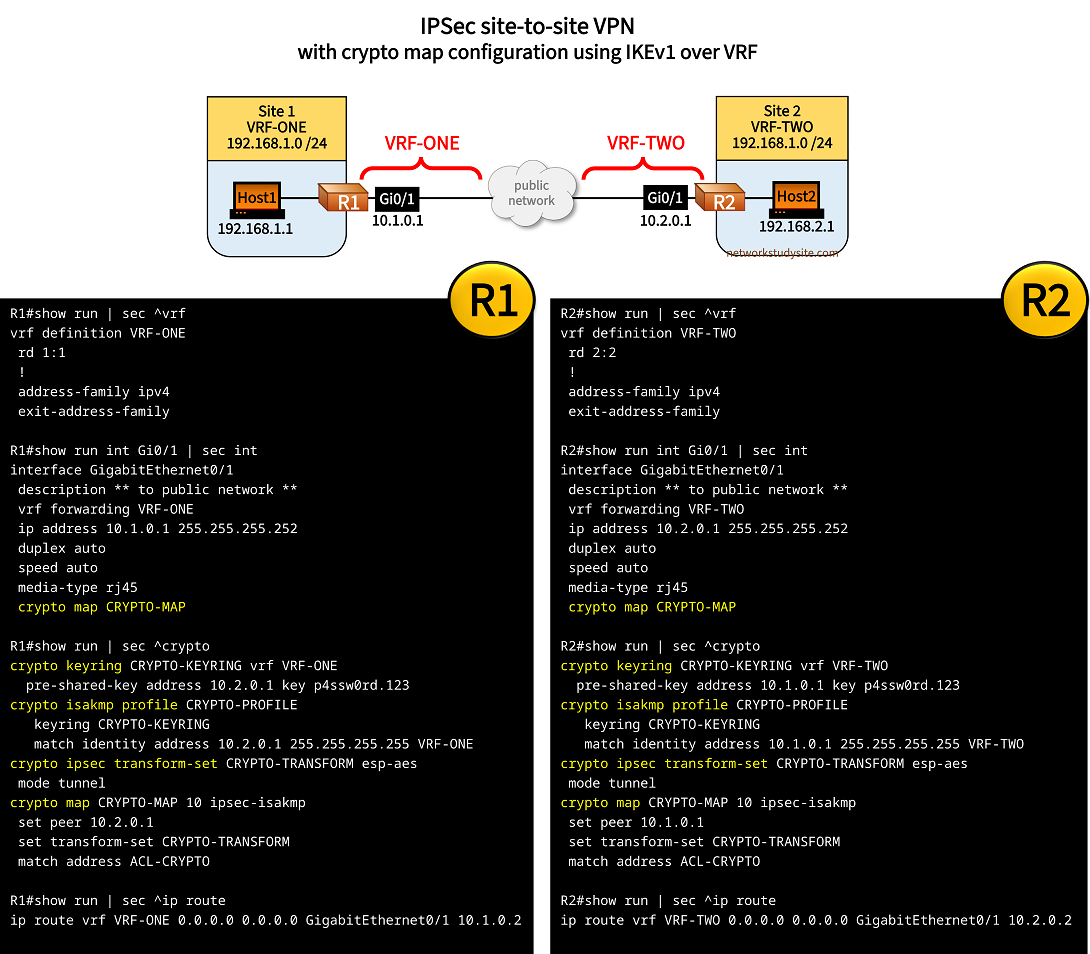
In this example scenario, two sites are connected through a public network using a crypto map IPSec VPN. Site 1 is configured in a VRF named VRF-ONE, and Site 2 uses VRF-TWO. Thus, R1 and R2 use different VRFs. Routes are exchanged between the two VRFs using BGP VPNv4 and route-target import/export rules configured in the public network. This allows R1 and R2 to communicate.
Notice that the crypto map configuration is applied on the interfaces using the appropriate VRF on R1 and R2. A crypto keyring ensures that the pre-shared key is communicated within the correct VRF. Also, an ISAKMP profile ensures that the IPSec peer's identity resides in a VRF. As a result, Host1 and Host2 can securely communicate over the public network using IPSec encryption in a VRF.
Configuration:
R1
R1#show run | sec ^vrf
vrf definition VRF-ONE
 rd 1:1
 !
 address-family ipv4
 exit-address-family

R1#show run int Gi0/1 | sec int
interface GigabitEthernet0/1
 description ** to public network **
 vrf forwarding VRF-ONE
 ip address 10.1.0.1 255.255.255.252
 duplex auto
 speed auto
 media-type rj45
 crypto map CRYPTO-MAP

R1#show run int Gi0/0 | sec int
interface GigabitEthernet0/0
 description ** to Host1 **
 vrf forwarding VRF-ONE
 ip address 192.168.1.2 255.255.255.0
 duplex auto
 speed auto
 media-type rj45

R1#show run | sec ^crypto
crypto keyring CRYPTO-KEYRING vrf VRF-ONE
  pre-shared-key address 10.2.0.1 key p4ssw0rd.123
crypto isakmp profile CRYPTO-PROFILE
   keyring CRYPTO-KEYRING
   match identity address 10.2.0.1 255.255.255.255 VRF-ONE
crypto ipsec transform-set CRYPTO-TRANSFORM esp-aes
 mode tunnel
crypto map CRYPTO-MAP 10 ipsec-isakmp
 set peer 10.2.0.1
 set transform-set CRYPTO-TRANSFORM
 match address ACL-CRYPTO

R1#show run | sec ^ip route
ip route vrf VRF-ONE 0.0.0.0 0.0.0.0 GigabitEthernet0/1 10.1.0.2
R2
R2#show run | sec ^vrf
vrf definition VRF-TWO
 rd 2:2
 !
 address-family ipv4
 exit-address-family

R2#show run int Gi0/1 | sec int
interface GigabitEthernet0/1
 description ** to public network **
 vrf forwarding VRF-TWO
 ip address 10.2.0.1 255.255.255.252
 duplex auto
 speed auto
 media-type rj45
 crypto map CRYPTO-MAP

R2#show run int Gi0/0 | sec int
interface GigabitEthernet0/0
 description ** to Host2 **
 vrf forwarding VRF-TWO
 ip address 192.168.2.2 255.255.255.0
 duplex auto
 speed auto
 media-type rj45

R2#show run | sec ^crypto
crypto keyring CRYPTO-KEYRING vrf VRF-TWO
  pre-shared-key address 10.1.0.1 key p4ssw0rd.123
crypto isakmp profile CRYPTO-PROFILE
   keyring CRYPTO-KEYRING
   match identity address 10.1.0.1 255.255.255.255 VRF-TWO
crypto ipsec transform-set CRYPTO-TRANSFORM esp-aes
 mode tunnel
crypto map CRYPTO-MAP 10 ipsec-isakmp
 set peer 10.1.0.1
 set transform-set CRYPTO-TRANSFORM
 match address ACL-CRYPTO

R2#show run | sec ^ip route
ip route vrf VRF-TWO 0.0.0.0 0.0.0.0 GigabitEthernet0/1 10.2.0.2
PE1 (public network)
PE1#show run int Gi0/0 | sec int
interface GigabitEthernet0/0
 description ** to R1 VRF-ONE **
 vrf forwarding VRF-ONE
 ip address 10.1.0.2 255.255.255.252
 duplex auto
 speed auto
 media-type rj45

PE1#show run int Gi0/1 | sec int
interface GigabitEthernet0/1
 description ** to PE2 - public network edge **
 ip address 10.0.0.1 255.255.255.0
 duplex auto
 speed auto
 media-type rj45
 mpls ip

PE1#show run | sec ^vrf
vrf definition VRF-ONE
 rd 1:1
 route-target export 65001:1
 route-target import 65001:2
 !
 address-family ipv4
 exit-address-family

PE1#show run | sec ^router
router bgp 65001
 bgp router-id 1.1.1.1
 bgp log-neighbor-changes
 neighbor 10.0.0.2 remote-as 65001
 neighbor 10.0.0.2 next-hop-self
 !
 address-family vpnv4
  neighbor 10.0.0.2 activate
  neighbor 10.0.0.2 send-community extended
 exit-address-family
 !
 address-family ipv4 vrf VRF-ONE
  redistribute connected
 exit-address-family

PE1#show run all | sec ^mpls ip__
mpls ip
PE2 (public network)
PE2#show run int Gi0/0 | sec int
interface GigabitEthernet0/0
 description ** to R2 VRF-TWO **
 vrf forwarding VRF-TWO
 ip address 10.2.0.2 255.255.255.252
 duplex auto
 speed auto
 media-type rj45

PE2#show run int Gi0/1 | sec int
interface GigabitEthernet0/1
 description ** to PE1 - public network edge **
 ip address 10.0.0.2 255.255.255.0
 duplex auto
 speed auto
 media-type rj45
 mpls ip

PE2#show run | sec ^vrf
vrf definition VRF-TWO
 rd 2:2
 !
 address-family ipv4
  route-target export 65001:2
  route-target import 65001:1
 exit-address-family

PE2#show run | sec ^router
router bgp 65001
 bgp router-id 2.2.2.2
 bgp log-neighbor-changes
 neighbor 10.0.0.1 remote-as 65001
 neighbor 10.0.0.1 next-hop-self
 !
 address-family vpnv4
  neighbor 10.0.0.1 activate
  neighbor 10.0.0.1 send-community extended
 exit-address-family
 !
 address-family ipv4 vrf VRF-TWO
  redistribute connected
 exit-address-family

PE2#show run all | sec ^mpls ip__
mpls ip
Host1
Host1#show run int Gi0/0 | sec int
interface GigabitEthernet0/0
 description ** to R1 **
 ip address 192.168.1.1 255.255.255.0
 duplex auto
 speed auto
 media-type rj45

Host1#show run | sec ^ip route
ip route 0.0.0.0 0.0.0.0 GigabitEthernet0/0 192.168.1.2
Host2
Host2#show run int Gi0/0 | sec int
interface GigabitEthernet0/0
 description ** to R2 **
 ip address 192.168.2.1 255.255.255.0
 duplex auto
 speed auto
 media-type rj45

Host2#show run | sec ^ip route
ip route 0.0.0.0 0.0.0.0 GigabitEthernet0/0 192.168.2.2
R1#show crypto session
Crypto session current status

Interface: GigabitEthernet0/1
Profile: CRYPTO-PROFILE
Session status: UP-ACTIVE
Peer: 10.2.0.1 port 500
  Session ID: 0
  IKEv1 SA: local 10.1.0.1/500 remote 10.2.0.1/500 Active             « IKEv1 is used
  IPSEC FLOW: permit ip 192.168.1.0/255.255.255.0 192.168.2.0/255.255.255.0
        Active SAs: 2, origin: crypto map


R1#show crypto session detail
Crypto session current status

Code: C - IKE Configuration mode, D - Dead Peer Detection
K - Keepalives, N - NAT-traversal, T - cTCP encapsulation
X - IKE Extended Authentication, F - IKE Fragmentation
R - IKE Auto Reconnect, U - IKE Dynamic Route Update
S - SIP VPN

Interface: GigabitEthernet0/1
Profile: CRYPTO-PROFILE
Uptime: 00:24:13
Session status: UP-ACTIVE
Peer: 10.2.0.1 port 500 fvrf: VRF-ONE ivrf: VRF-ONE                   « VRF is being used with crypto map
      Phase1_id: 10.2.0.1
      Desc: (none)
  Session ID: 0
  IKEv1 SA: local 10.1.0.1/500 remote 10.2.0.1/500 Active
          Capabilities:(none) connid:1004 lifetime:23:35:46
  IPSEC FLOW: permit ip 192.168.1.0/255.255.255.0 192.168.2.0/255.255.255.0
        Active SAs: 2, origin: crypto map
        Inbound:  #pkts dec'ed 16 drop 0 life (KB/Sec) 4251658/2146
        Outbound: #pkts enc'ed 26 drop 0 life (KB/Sec) 4251657/2146


R1#show crypto session brief
Status: A- Active, U - Up, D - Down, I - Idle, S - Standby, N - Negotiating
        K - No IKE
ivrf = VRF-ONE
Peer            I/F          Username        Group/Phase1_id          Uptime   Status
10.2.0.1        Gi0/1                        10.2.0.1                 00:24:39 UA       « IPSec connection Up and Active


Host1#ping 192.168.2.1
Type escape sequence to abort.
Sending 5, 100-byte ICMP Echos to 192.168.2.1, timeout is 2 seconds:
!!!!!
Success rate is 100 percent (5/5), round-trip min/avg/max = 46/46/47 ms                 « Host1 can reach Host2 over IPsec
Configuring a crypto map to encrypt GRE traffic
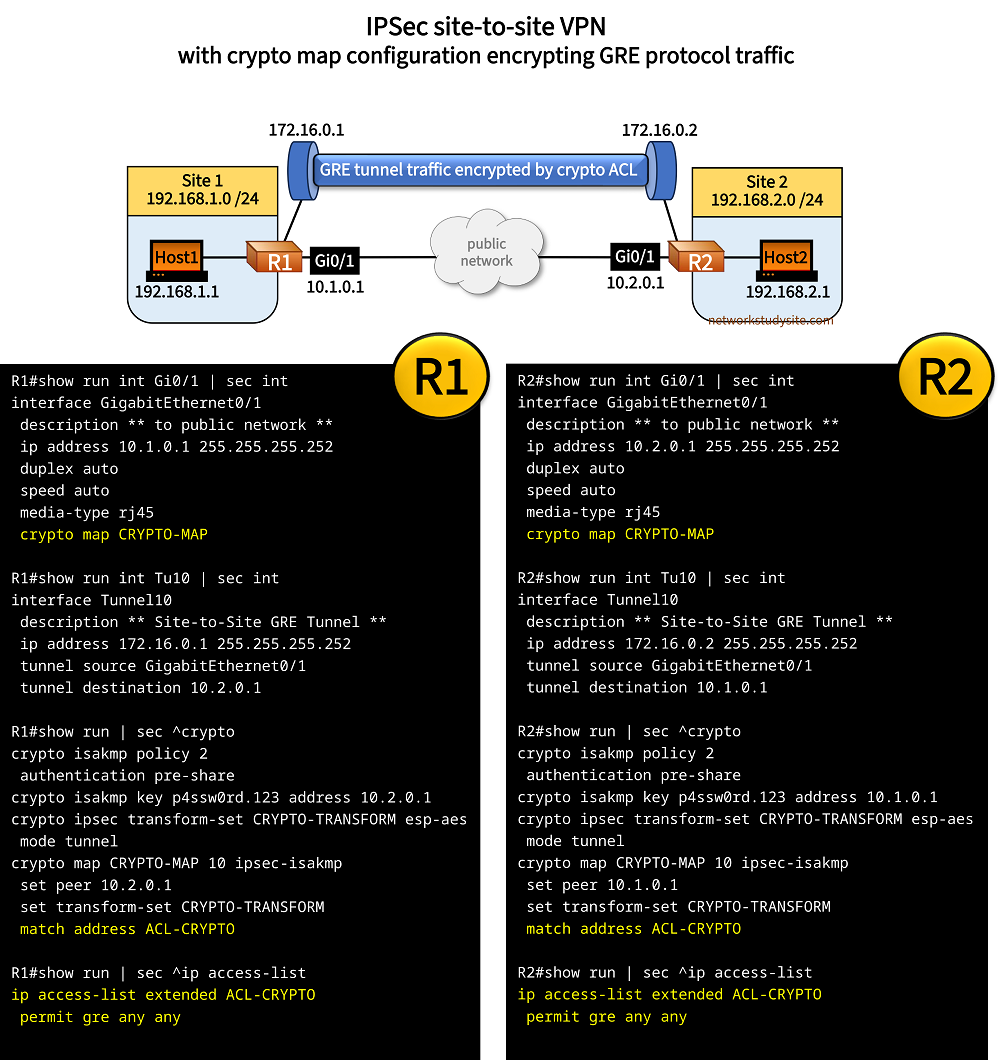
In the following scenario a crypto map is configured on the physical interface Gi0/1 of R1 and R2. The crypto ACL selects all GRE tunnel protocol traffic to be encrypted. This means that the GRE tunnel configured between R1 and R2 is encrypted by the crypto map. The advantage of a GRE tunnel is that multicast traffic is forwarded, thus a dynamic routing protocol such as OSPF can be configured between the two sites.
Configuration:
R1
R1#show run int Gi0/1 | sec int
interface GigabitEthernet0/1
 description ** to public network **
 ip address 10.1.0.1 255.255.255.252
 duplex auto
 speed auto
 media-type rj45
 crypto map CRYPTO-MAP

R1#show run int Tu10 | sec int
interface Tunnel10
 description ** Site-to-Site GRE Tunnel **
 ip address 172.16.0.1 255.255.255.252
 tunnel source GigabitEthernet0/1
 tunnel destination 10.2.0.1

R1#show run int Gi0/0 | sec int
interface GigabitEthernet0/0
 description ** to Host1 **
 ip address 192.168.1.2 255.255.255.0
 duplex auto
 speed auto
 media-type rj45

R1#show run | sec ^crypto
crypto isakmp policy 2
 authentication pre-share
crypto isakmp key p4ssw0rd.123 address 10.2.0.1
crypto ipsec transform-set CRYPTO-TRANSFORM esp-aes
 mode tunnel
crypto map CRYPTO-MAP 10 ipsec-isakmp
 set peer 10.2.0.1
 set transform-set CRYPTO-TRANSFORM
 match address ACL-CRYPTO

R1#show run | sec ^ip access-list
ip access-list extended ACL-CRYPTO
 permit gre any any

R1#show run | sec ^ip route
ip route 0.0.0.0 0.0.0.0 GigabitEthernet0/1 10.1.0.2
R2
R2#show run int Gi0/1 | sec int
interface GigabitEthernet0/1
 description ** to public network **
 ip address 10.2.0.1 255.255.255.252
 duplex auto
 speed auto
 media-type rj45
 crypto map CRYPTO-MAP

R2#show run int Tu10 | sec int
interface Tunnel10
 description ** Site-to-Site GRE Tunnel **
 ip address 172.16.0.2 255.255.255.252
 tunnel source GigabitEthernet0/1
 tunnel destination 10.1.0.1

R2#show run int Gi0/0 | sec int
interface GigabitEthernet0/0
 description ** to Host2 **
 ip address 192.168.2.2 255.255.255.0
 duplex auto
 speed auto
 media-type rj45

R2#show run | sec ^crypto
crypto isakmp policy 2
 authentication pre-share
crypto isakmp key p4ssw0rd.123 address 10.1.0.1
crypto ipsec transform-set CRYPTO-TRANSFORM esp-aes
 mode tunnel
crypto map CRYPTO-MAP 10 ipsec-isakmp
 set peer 10.1.0.1
 set transform-set CRYPTO-TRANSFORM
 match address ACL-CRYPTO

R2#show run | sec ^ip access-list
ip access-list extended ACL-CRYPTO
 permit gre any any

R2#show run | sec ^ip route
ip route 0.0.0.0 0.0.0.0 GigabitEthernet0/1 10.2.0.2
R1#show ip ospf neighbor

Neighbor ID     Pri   State           Dead Time   Address         Interface
2.2.2.2           0   FULL/  -        00:00:38    172.16.0.2      Tunnel10         « OSPF neighborship established on Tunnel interface


R1#show ip access-list
Extended IP access list ACL-CRYPTO
    10 permit gre any any (141 matches)               « ACL filters GRE traffic for encryption


R1#show crypto session detail
Crypto session current status

Code: C - IKE Configuration mode, D - Dead Peer Detection
K - Keepalives, N - NAT-traversal, T - cTCP encapsulation
X - IKE Extended Authentication, F - IKE Fragmentation
R - IKE Auto Reconnect, U - IKE Dynamic Route Update
S - SIP VPN

Interface: GigabitEthernet0/1
Uptime: 00:18:32
Session status: UP-ACTIVE
Peer: 10.2.0.1 port 500 fvrf: (none) ivrf: (none)
      Phase1_id: 10.2.0.1
      Desc: (none)
  Session ID: 0
  IKEv1 SA: local 10.1.0.1/500 remote 10.2.0.1/500 Active
          Capabilities:(none) connid:1001 lifetime:23:41:26
  IPSEC FLOW: permit 47 0.0.0.0/0.0.0.0 0.0.0.0/0.0.0.0
        Active SAs: 2, origin: crypto map
        Inbound:  #pkts dec'ed 138 drop 0 life (KB/Sec) 4250217/2487         « Packets are being decrypted and encrypted
        Outbound: #pkts enc'ed 140 drop 0 life (KB/Sec) 4250217/2487


R1#show crypto session brief
Status: A- Active, U - Up, D - Down, I - Idle, S - Standby, N - Negotiating
        K - No IKE
ivrf = (none)
Peer            I/F          Username        Group/Phase1_id          Uptime   Status
10.2.0.1        Gi0/1                        10.2.0.1                 00:18:49 UA            « The IPSec connection is Up and Active


Host1#ping 192.168.2.1
Type escape sequence to abort.
Sending 5, 100-byte ICMP Echos to 192.168.2.1, timeout is 2 seconds:
!!!!!
Success rate is 100 percent (5/5), round-trip min/avg/max = 47/47/48 ms            « Host1 can ping Host2


Host1#trace 192.168.2.1 probe 1
Type escape sequence to abort.
Tracing the route to 192.168.2.1
VRF info: (vrf in name/id, vrf out name/id)
  1 192.168.1.2 2 msec
  2 172.16.0.2 47 msec             « The GRE Tunnel is used to reach Host2 from Host1
  3 192.168.2.1 47 msec