Create Your Network with EIGRP Over the Top (OTP) Routing
Table of Contents
Jump to section:
- What is EIGRP OTP? ‹
- How to configure EIGRP OTP? ‹
- EIGRP OTP Route Reflector ‹
- EIGRP OTP IPv6 ‹
- Download section ‹
What is EIGRP Over the Top (OTP)?
EIGRP OTP enables the creation of an overlay network between Customer Edge (CE) routers by using the LISP encapsulation. EIGRP OTP offers a flexible mechanism to maintain control over IP routing and can be used as a WAN technology to connect customer sites across Service Provider (SP) networks.
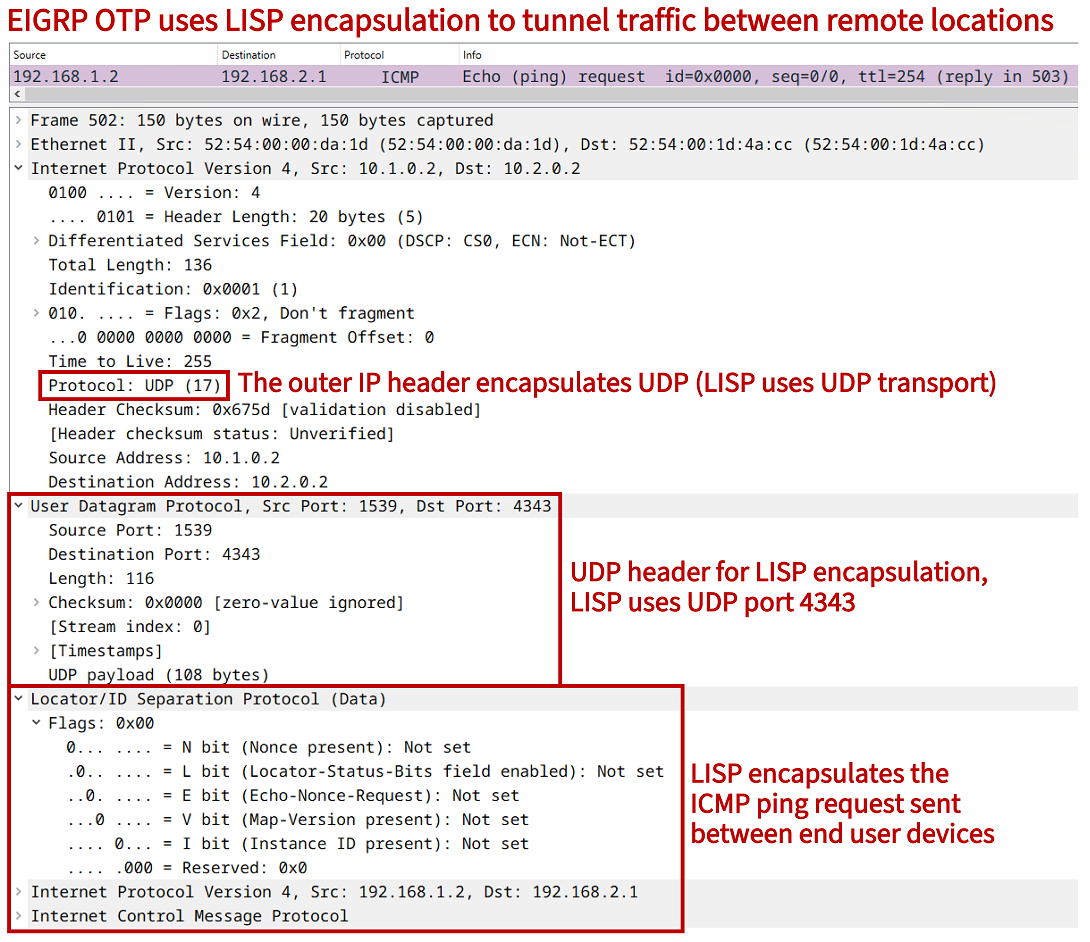
This means, customer routes from the remote sites are not shared with the SP, but they are instead advertised through the EIGRP control plane. The main requirement of EIGRP OTP is IP connectivity between the CE routers.
For improved scalability, an EIGRP Route Reflector (RR) can be configured. The RR is a centralized control plane function that advertises routes between each CE router. As a result, each CE router needs only a single EIGRP neighborship with the RR to receive routes.
How to configure EIGRP OTP?
In the following example scenario, three customer sites are connected through a Service Provider. The three CE routers can reach each other and are configured with EIGRP OTP. Thus, the IP prefix of each site is advertised through the EIGRP control plane, and data traffic between each Host is enapsulated with LISP. As a result, the customer site prefixes are not shared with the SP, however the Hosts can still communicate with each other.
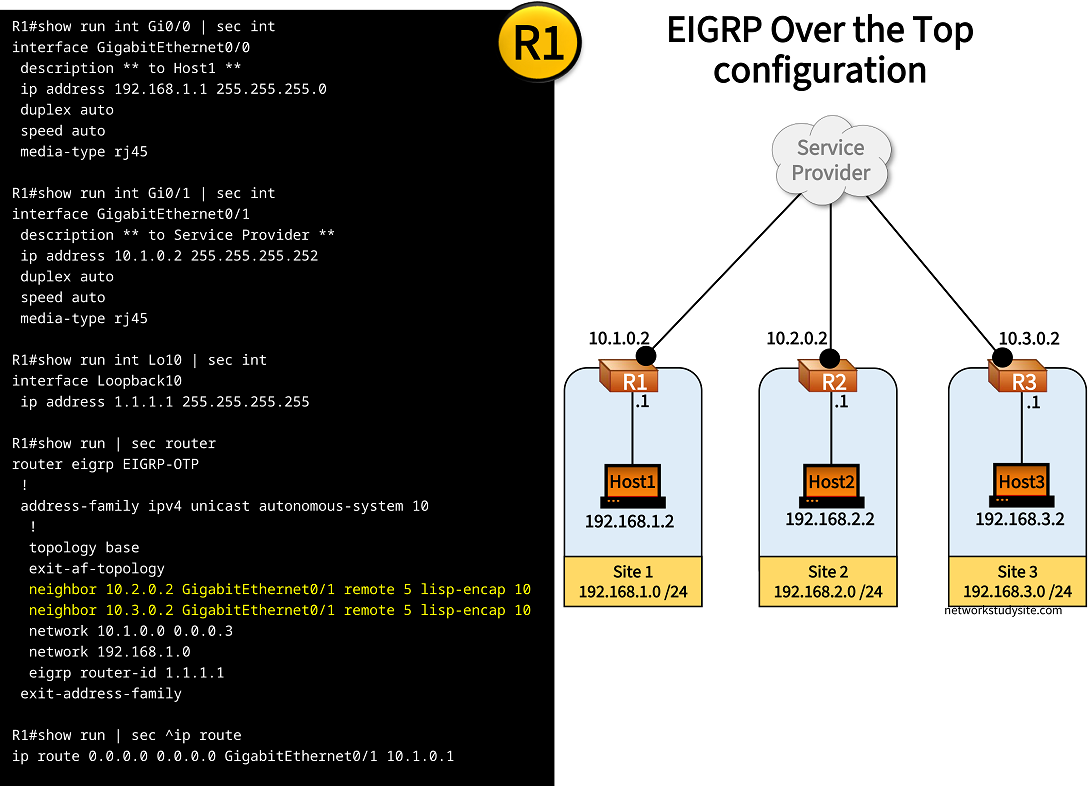
Configuration:
R1
R1#show run int Gi0/0 | sec int
interface GigabitEthernet0/0
 description ** to Host1 **
 ip address 192.168.1.1 255.255.255.0
 duplex auto
 speed auto
 media-type rj45

R1#show run int Gi0/1 | sec int
interface GigabitEthernet0/1
 description ** to Service Provider **
 ip address 10.1.0.2 255.255.255.252
 duplex auto
 speed auto
 media-type rj45

R1#show run int Lo10 | sec int
interface Loopback10
 ip address 1.1.1.1 255.255.255.255

R1#show run | sec router
router eigrp EIGRP-OTP
 !
 address-family ipv4 unicast autonomous-system 10
  !
  topology base
  exit-af-topology
  neighbor 10.2.0.2 GigabitEthernet0/1 remote 5 lisp-encap 10
  neighbor 10.3.0.2 GigabitEthernet0/1 remote 5 lisp-encap 10
  network 10.1.0.0 0.0.0.3
  network 192.168.1.0
  eigrp router-id 1.1.1.1
 exit-address-family

R1#show run | sec ^ip route
ip route 0.0.0.0 0.0.0.0 GigabitEthernet0/1 10.1.0.1
R2
R2#show run int Gi0/0 | sec int
interface GigabitEthernet0/0
 description ** to Host2 **
 ip address 192.168.2.1 255.255.255.0
 duplex auto
 speed auto
 media-type rj45

R2#show run int Gi0/1 | sec int
interface GigabitEthernet0/1
 description ** to Service Provider **
 ip address 10.2.0.2 255.255.255.252
 duplex auto
 speed auto
 media-type rj45

R2#show run int Lo10 | sec int
interface Loopback10
 ip address 2.2.2.2 255.255.255.255

R2#show run | sec router
router eigrp EIGRP-OTP
 !
 address-family ipv4 unicast autonomous-system 10
  !
  topology base
  exit-af-topology
  neighbor 10.1.0.2 GigabitEthernet0/1 remote 5 lisp-encap 10
  neighbor 10.3.0.2 GigabitEthernet0/1 remote 5 lisp-encap 10
  network 10.2.0.0 0.0.0.3
  network 192.168.2.0
  eigrp router-id 2.2.2.2
 exit-address-family

R2#show run | sec ^ip route
ip route 0.0.0.0 0.0.0.0 GigabitEthernet0/1 10.2.0.1
R3
R3#show run int Gi0/0 | sec int
interface GigabitEthernet0/0
 description ** to Host3 **
 ip address 192.168.3.1 255.255.255.0
 duplex auto
 speed auto
 media-type rj45

R3#show run int Gi0/1 | sec int
interface GigabitEthernet0/1
 description ** to Service Provider **
 ip address 10.3.0.2 255.255.255.252
 duplex auto
 speed auto
 media-type rj45

R3#show run int Lo10 | sec int
interface Loopback10
 ip address 3.3.3.3 255.255.255.255

R3#show run | sec ^router
router eigrp EIGRP-OTP
 !
 address-family ipv4 unicast autonomous-system 10
  !
  topology base
  exit-af-topology
  neighbor 10.1.0.2 GigabitEthernet0/1 remote 5 lisp-encap 10
  neighbor 10.2.0.2 GigabitEthernet0/1 remote 5 lisp-encap 10
  network 10.3.0.0 0.0.0.3
  network 192.168.3.0
  eigrp router-id 3.3.3.3
 exit-address-family

R3#show run | sec ^ip route
ip route 0.0.0.0 0.0.0.0 GigabitEthernet0/1 10.3.0.1
Host1
Host1#show run int Gi0/0 | sec int
interface GigabitEthernet0/0
 description ** to R1 **
 ip address 192.168.1.2 255.255.255.0
 duplex auto
 speed auto
 media-type rj45

Host1#show run | sec ^ip route
ip route 0.0.0.0 0.0.0.0 GigabitEthernet0/0 192.168.1.1
R1#show ip eigrp neighbors
EIGRP-IPv4 VR(EIGRP-OTP) Address-Family Neighbors for AS(10)
H   Address                 Interface              Hold Uptime   SRTT   RTO  Q  Seq
                                                   (sec)         (ms)       Cnt Num
1   10.3.0.2                Gi0/1                    14 00:03:08   45   270  0  6
0   10.2.0.2                Gi0/1                    13 00:03:13   46   276  0  6


R1#show ip route eigrp | beg Ga
Gateway of last resort is 10.1.0.1 to network 0.0.0.0

D     192.168.2.0/24 [90/93998811] via 10.2.0.2, 00:03:29, LISP10
D     192.168.3.0/24 [90/93998811] via 10.3.0.2, 00:03:23, LISP10


Host1#ping 192.168.2.2
Type escape sequence to abort.
Sending 5, 100-byte ICMP Echos to 192.168.2.2, timeout is 2 seconds:
!!!!!
Success rate is 100 percent (5/5), round-trip min/avg/max = 46/46/47 ms


Host1#trace 192.168.2.2 probe 1
Type escape sequence to abort.
Tracing the route to 192.168.2.2
VRF info: (vrf in name/id, vrf out name/id)
  1 192.168.1.1 2 msec
  2 2.2.2.2 45 msec
  3 192.168.2.2 47 msec


Host1#ping 192.168.3.2
Type escape sequence to abort.
Sending 5, 100-byte ICMP Echos to 192.168.3.2, timeout is 2 seconds:
!!!!!
Success rate is 100 percent (5/5), round-trip min/avg/max = 45/48/56 ms


Host1#trace 192.168.3.2 probe 1
Type escape sequence to abort.
Tracing the route to 192.168.3.2
VRF info: (vrf in name/id, vrf out name/id)
  1 192.168.1.1 2 msec
  2 3.3.3.3 46 msec
  3 192.168.3.2 46 msec
EIGRP OTP Route Reflector
In the following example topology, EIGRP OTP is configured with an EIGRP Route Reflector (RR). This improves scalability, as now each CE router needs only an EIGRP neighborship with the RR. For this topology, CE router R3 is configured as the RR. This means that on R3 EIGRP split-horizon and the next-hop-self mechanisms are disabled to allow for the advertisement of received routes and for site-to-site connectivity.
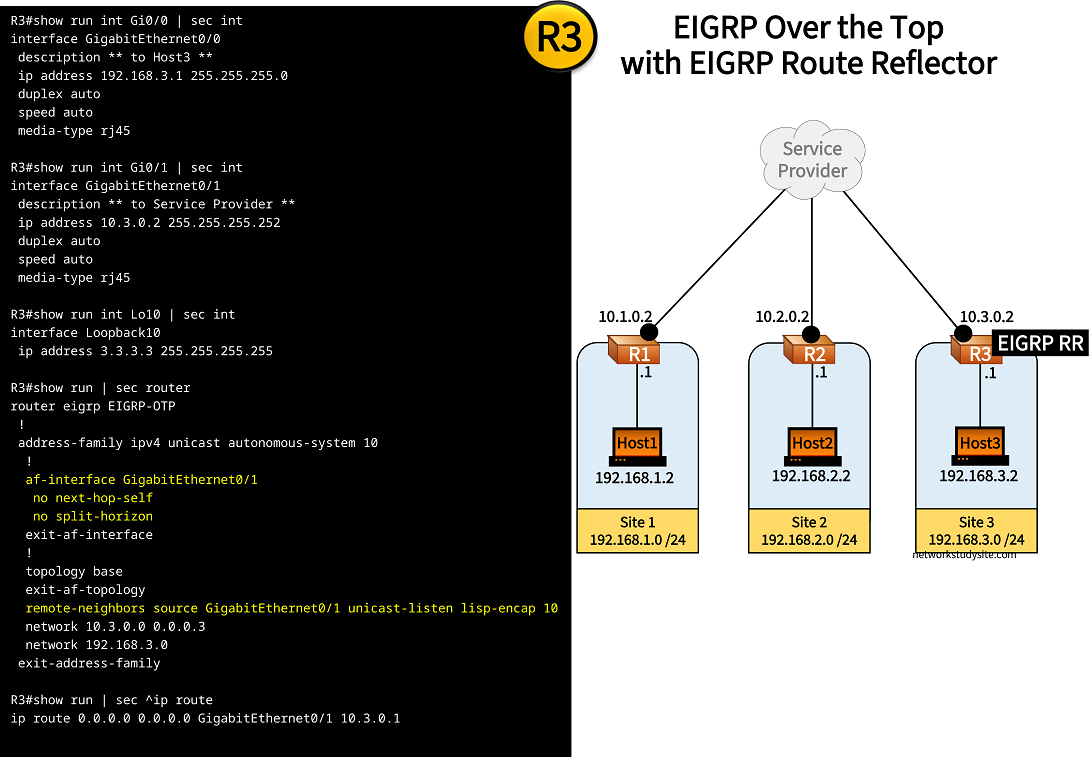
Configuration:
R1
R1#show run int Gi0/0 | sec int
interface GigabitEthernet0/0
 description ** to Host1 **
 ip address 192.168.1.1 255.255.255.0
 duplex auto
 speed auto
 media-type rj45

R1#show run int Gi0/1 | sec int
interface GigabitEthernet0/1
 description ** to Service Provider **
 ip address 10.1.0.2 255.255.255.252
 duplex auto
 speed auto
 media-type rj45

R1#show run int Lo10 | sec int
interface Loopback10
 ip address 1.1.1.1 255.255.255.255

R1#show run | sec router
router eigrp EIGRP-OTP
 !
 address-family ipv4 unicast autonomous-system 10
  !
  topology base
  exit-af-topology
  neighbor 10.3.0.2 GigabitEthernet0/1 remote 5 lisp-encap 10
  network 10.1.0.0 0.0.0.3
  network 192.168.1.0
  eigrp router-id 1.1.1.1
 exit-address-family

R1#show run | sec ^ip route
ip route 0.0.0.0 0.0.0.0 GigabitEthernet0/1 10.1.0.1
R2
R2#show run int Gi0/0 | sec int
interface GigabitEthernet0/0
 description ** to Host2 **
 ip address 192.168.2.1 255.255.255.0
 duplex auto
 speed auto
 media-type rj45

R2#show run int Gi0/1 | sec int
interface GigabitEthernet0/1
 description ** to Service Provider **
 ip address 10.2.0.2 255.255.255.252
 duplex auto
 speed auto
 media-type rj45

R2#show run int Lo10 | sec int
interface Loopback10
 ip address 2.2.2.2 255.255.255.255

R2#show run | sec router
router eigrp EIGRP-OTP
 !
 address-family ipv4 unicast autonomous-system 10
  !
  topology base
  exit-af-topology
  neighbor 10.3.0.2 GigabitEthernet0/1 remote 5 lisp-encap 10
  network 10.2.0.0 0.0.0.3
  network 192.168.2.0
  eigrp router-id 2.2.2.2
 exit-address-family

R2#show run | sec ^ip route
ip route 0.0.0.0 0.0.0.0 GigabitEthernet0/1 10.2.0.1
R3
R3#show run int Gi0/0 | sec int
interface GigabitEthernet0/0
 description ** to Host3 **
 ip address 192.168.3.1 255.255.255.0
 duplex auto
 speed auto
 media-type rj45

R3#show run int Gi0/1 | sec int
interface GigabitEthernet0/1
 description ** to Service Provider **
 ip address 10.3.0.2 255.255.255.252
 duplex auto
 speed auto
 media-type rj45

R3#show run int Lo10 | sec int
interface Loopback10
 ip address 3.3.3.3 255.255.255.255

R3#show run | sec router
router eigrp EIGRP-OTP
 !
 address-family ipv4 unicast autonomous-system 10
  !
  af-interface GigabitEthernet0/1
   no next-hop-self
   no split-horizon
  exit-af-interface
  !
  topology base
  exit-af-topology
  remote-neighbors source GigabitEthernet0/1 unicast-listen lisp-encap 10
  network 10.3.0.0 0.0.0.3
  network 192.168.3.0
  eigrp router-id 3.3.3.3
 exit-address-family

R3#show run | sec ^ip route
ip route 0.0.0.0 0.0.0.0 GigabitEthernet0/1 10.3.0.1
R3#show ip eigrp neighbors
EIGRP-IPv4 VR(EIGRP-OTP) Address-Family Neighbors for AS(10)
H   Address                 Interface              Hold Uptime   SRTT   RTO  Q  Seq
                                                   (sec)         (ms)       Cnt Num
1   10.2.0.2                Gi0/1                    14 00:17:45   45   270  0  18
0   10.1.0.2                Gi0/1                    14 00:17:47   45   270  0  20


R1#show ip eigrp nei
EIGRP-IPv4 VR(EIGRP-OTP) Address-Family Neighbors for AS(10)
H   Address                 Interface              Hold Uptime   SRTT   RTO  Q  Seq
                                                   (sec)         (ms)       Cnt Num
0   10.3.0.2                Gi0/1                    13 00:15:18   44   264  0  20


R1#show ip route eigrp | beg Ga
Gateway of last resort is 10.1.0.1 to network 0.0.0.0

D     192.168.2.0/24 [90/93998811] via 10.2.0.2, 00:15:27, LISP10
D     192.168.3.0/24 [90/93998811] via 10.3.0.2, 00:15:29, LISP10


Host1#ping 192.168.2.2
Type escape sequence to abort.
Sending 5, 100-byte ICMP Echos to 192.168.2.2, timeout is 2 seconds:
!!!!!
Success rate is 100 percent (5/5), round-trip min/avg/max = 46/47/48 ms


Host1#trace 192.168.2.2 probe 1
Type escape sequence to abort.
Tracing the route to 192.168.2.2
VRF info: (vrf in name/id, vrf out name/id)
  1 192.168.1.1 1 msec
  2 2.2.2.2 46 msec
  3 192.168.2.2 47 msec


Host1#ping 192.168.3.2
Type escape sequence to abort.
Sending 5, 100-byte ICMP Echos to 192.168.3.2, timeout is 2 seconds:
!!!!!
Success rate is 100 percent (5/5), round-trip min/avg/max = 46/46/47 ms
EIGRP OTP IPv6
In the following example scenario, EIGRP OTP is configured with IPv6. The CE router R3 is configured as a Route Reflector (RR). The site prefixes are not shared with the Service Provider, but instead the EIGRP control plane advertises these prefixes between each CE router. Within each site, the Hosts receive their IPv6 address with SLAAC.
On each device involved in IPv6 routing, the command ipv6 unicast-routing is added in global configuration mode.
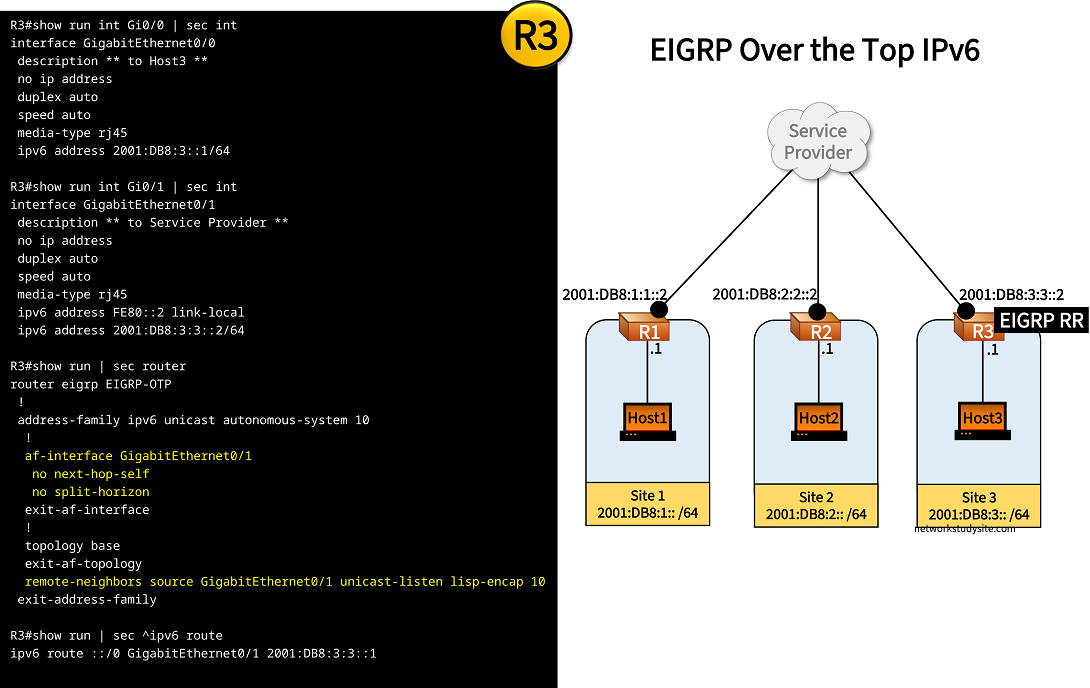
Configuration:
R1
R1#show run int Gi0/0 | sec int
interface GigabitEthernet0/0
 description ** to Host1 **
 no ip address
 duplex auto
 speed auto
 media-type rj45
 ipv6 address 2001:DB8:1::1/64

R1#show run int Gi0/1 | sec int
interface GigabitEthernet0/1
 description ** to Service Provider **
 no ip address
 duplex auto
 speed auto
 media-type rj45
 ipv6 address FE80::2 link-local
 ipv6 address 2001:DB8:1:1::2/64

R1#show run | sec router
router eigrp EIGRP-OTP
 !
 address-family ipv6 unicast autonomous-system 10
  !
  topology base
  exit-af-topology
  neighbor 2001:DB8:3:3::2 GigabitEthernet0/1 remote 5 lisp-encap 10
  eigrp router-id 1.1.1.1
 exit-address-family

R1#show run | sec ^ipv6 route
ipv6 route ::/0 GigabitEthernet0/1 2001:DB8:1:1::1
R2
R2#show run int Gi0/0 | sec int
interface GigabitEthernet0/0
 description ** to Host2 **
 no ip address
 duplex auto
 speed auto
 media-type rj45
 ipv6 address 2001:DB8:2::1/64

R2#show run int Gi0/1 | sec int
interface GigabitEthernet0/1
 description ** to Service Provider **
 no ip address
 duplex auto
 speed auto
 media-type rj45
 ipv6 address FE80::2 link-local
 ipv6 address 2001:DB8:2:2::2/64

R2#show run | sec router
router eigrp EIGRP-OTP
 !
 address-family ipv6 unicast autonomous-system 10
  !
  topology base
  exit-af-topology
  neighbor 2001:DB8:3:3::2 GigabitEthernet0/1 remote 5 lisp-encap 10
  eigrp router-id 2.2.2.2
 exit-address-family

R2#show run | sec ^ipv6 route
ipv6 route ::/0 GigabitEthernet0/1 2001:DB8:2:2::1
R3
R3#show run int Gi0/0 | sec int
interface GigabitEthernet0/0
 description ** to Host3 **
 no ip address
 duplex auto
 speed auto
 media-type rj45
 ipv6 address 2001:DB8:3::1/64

R3#show run int Gi0/1 | sec int
interface GigabitEthernet0/1
 description ** to Service Provider **
 no ip address
 duplex auto
 speed auto
 media-type rj45
 ipv6 address FE80::2 link-local
 ipv6 address 2001:DB8:3:3::2/64

R3#show run | sec router
router eigrp EIGRP-OTP
 !
 address-family ipv6 unicast autonomous-system 10
  !
  af-interface GigabitEthernet0/1
   no next-hop-self
   no split-horizon
  exit-af-interface
  !
  topology base
  exit-af-topology
  remote-neighbors source GigabitEthernet0/1 unicast-listen lisp-encap 10
  eigrp router-id 3.3.3.3
 exit-address-family

R3#show run | sec ^ipv6 route
ipv6 route ::/0 GigabitEthernet0/1 2001:DB8:3:3::1
Host1
Host1#show run int Gi0/0 | sec int
interface GigabitEthernet0/0
 description ** to R1 **
 no ip address
 duplex auto
 speed auto
 media-type rj45
 ipv6 address autoconfig default
 ipv6 enable
R3#show ipv6 eigrp neighbors
EIGRP-IPv6 VR(EIGRP-OTP) Address-Family Neighbors for AS(10)
H   Address                 Interface              Hold Uptime   SRTT   RTO  Q  Seq
                                                   (sec)         (ms)       Cnt Num
1   Global address:         Gi0/1                    14 02:11:42   45   270  0  3
    2001:DB8:1:1::2          « EIGRP neighbor CE R1
0   Global address:         Gi0/1                    12 02:11:42   45   270  0  4
    2001:DB8:2:2::2          « EIGRP neighbor CE R2


R1#show ipv6 eigrp neighbors
EIGRP-IPv6 VR(EIGRP-OTP) Address-Family Neighbors for AS(10)
H   Address                 Interface              Hold Uptime   SRTT   RTO  Q  Seq
                                                   (sec)         (ms)       Cnt Num
0   Global address:         Gi0/1                    14 02:11:31   45   270  0  6
    2001:DB8:3:3::2


R1#show ipv6 route eigrp
IPv6 Routing Table - default - 8 entries
Codes: C - Connected, L - Local, S - Static, U - Per-user Static route
       B - BGP, HA - Home Agent, MR - Mobile Router, R - RIP
       H - NHRP, I1 - ISIS L1, I2 - ISIS L2, IA - ISIS interarea
       IS - ISIS summary, D - EIGRP, EX - EIGRP external, NM - NEMO
       ND - ND Default, NDp - ND Prefix, DCE - Destination, NDr - Redirect
       RL - RPL, O - OSPF Intra, OI - OSPF Inter, OE1 - OSPF ext 1
       OE2 - OSPF ext 2, ON1 - OSPF NSSA ext 1, ON2 - OSPF NSSA ext 2
       la - LISP alt, lr - LISP site-registrations, ld - LISP dyn-eid
       lA - LISP away, a - Application
D   2001:DB8:2::/64 [90/93998811]                 « CE R1 receives Site 1 IPv6 prefix
     via 2001:DB8:2:2::2, LISP10
D   2001:DB8:3::/64 [90/93998811]
     via 2001:DB8:3:3::2, LISP10


Host1#show ipv6 route
IPv6 Routing Table - default - 4 entries
Codes: C - Connected, L - Local, S - Static, U - Per-user Static route
       B - BGP, HA - Home Agent, MR - Mobile Router, R - RIP
       H - NHRP, I1 - ISIS L1, I2 - ISIS L2, IA - ISIS interarea
       IS - ISIS summary, D - EIGRP, EX - EIGRP external, NM - NEMO
       ND - ND Default, NDp - ND Prefix, DCE - Destination, NDr - Redirect
       RL - RPL, O - OSPF Intra, OI - OSPF Inter, OE1 - OSPF ext 1
       OE2 - OSPF ext 2, ON1 - OSPF NSSA ext 1, ON2 - OSPF NSSA ext 2
       la - LISP alt, lr - LISP site-registrations, ld - LISP dyn-eid
       lA - LISP away, a - Application
ND  ::/0 [2/0]                                     « Host1 receives a default route from CE R1
     via FE80::5054:FF:FE14:7CEC, GigabitEthernet0/0
NDp 2001:DB8:1::/64 [2/0]
     via GigabitEthernet0/0, directly connected
L   2001:DB8:1:0:5054:FF:FE0D:43C8/128 [0/0]
     via GigabitEthernet0/0, receive
L   FF00::/8 [0/0]
     via Null0, receive


Host1#ping 2001:DB8:3:0:5054:FF:FE0E:9EF7
Type escape sequence to abort.
Sending 5, 100-byte ICMP Echos to 2001:DB8:3:0:5054:FF:FE0E:9EF7, timeout is 2 seconds:
!!!!!
Success rate is 100 percent (5/5), round-trip min/avg/max = 46/48/51 ms         « Host1 can ping Host3


Host1#trace 2001:DB8:3:0:5054:FF:FE0E:9EF7
Type escape sequence to abort.
Tracing the route to 2001:DB8:3:0:5054:FF:FE0E:9EF7

  1 2001:DB8:1::1 2 msec 1 msec 1 msec
  2 2001:DB8:3:3::2 45 msec 46 msec 46 msec
  3 2001:DB8:3:0:5054:FF:FE0E:9EF7 46 msec 46 msec 45 msec


Host1#ping 2001:DB8:2:0:5054:FF:FE17:46DE
Type escape sequence to abort.
Sending 5, 100-byte ICMP Echos to 2001:DB8:2:0:5054:FF:FE17:46DE, timeout is 2 seconds:
!!!!!
Success rate is 100 percent (5/5), round-trip min/avg/max = 45/47/52 ms         « Host1 can ping Host2


Host1#trace 2001:DB8:2:0:5054:FF:FE17:46DE
Type escape sequence to abort.
Tracing the route to 2001:DB8:2:0:5054:FF:FE17:46DE

  1 2001:DB8:1::1 2 msec 1 msec 1 msec
  2 2001:DB8:2:2::2 47 msec 44 msec 46 msec
  3 2001:DB8:2:0:5054:FF:FE17:46DE 47 msec 46 msec 47 msec