MPLS-based EVPN IRB Provides Layer-3 VPN for IPv6 Locations
Table of Contents
- What is MPLS Layer-3 VPN 6VPE with EVPN IRB? ‹
- Configuring EVPN IRB L3VPN for IPv6 ‹
- Packet capture EVPN Route Type 5 with IPv6 prefix ‹
- Download section ‹
What is MPLS Layer-3 VPN 6VPE with EVPN IRB?
A Layer-3 VPN 6VPE solution provides connectivity for IPv6-only customer sites across an IPv4-only MPLS core network. The Provider Edge (PE) routers are dual stack and have interfaces enabled with IPv4/IPv6 address-families. The PE routers establish Multiprotocol BGP (MP-BGP) neighborships to exchange site-local IPv6 prefixes. Meanwhile, the MPLS core uses an IPv4 IGP (OSPF or IS-IS) to provide a transport backbone network between the PE routers.
EVPN IRB together with Segment Routing delivers multiple benefits compared to MPLS 6VPE VPNv6 with LDP/RSVP. In addition to creating L2VPNs, EVPN IRB leverages the flexibility of MP-BGP to advertise IPv4 and/or IPv6 routes. The following output shows a Provider Edge router advertising IPv6 prefixes using the EVPN Route Type 5.
PE1#show ip bgp l2vpn evpn neighbors 8.8.8.8 advertised-routes | beg Ne
     Network          Next Hop            Metric LocPrf Weight Path
Route Distinguisher: 6.6.6.6:100
 *>   [2][6.6.6.6:100][0][48][5254000EA1C3][0][*]/20
                      ::                                 32768 ?
 *>   [3][6.6.6.6:100][0][32][6.6.6.6]/17
                      ::                                 32768 ?
Route Distinguisher: 65100:2 (default for vrf Gold)
 *>   [5][65100:2][0][64][2001:DB8:A2::]/29
                      2001:DB8:E2::2           0             0 65002 i
 *>   [5][65100:2][0][64][2001:DB8:E2::]/29
                      ::                       0         32768 i

Total number of prefixes 4


PE2#show ipv6 cef vrf Gold 2001:DB8:A2::/64
2001:DB8:A2::/64
  nexthop 10.1.0.2 GigabitEthernet2 label 16006-(local:16006) 604
Configuring EVPN IRB L3VPN for IPv6
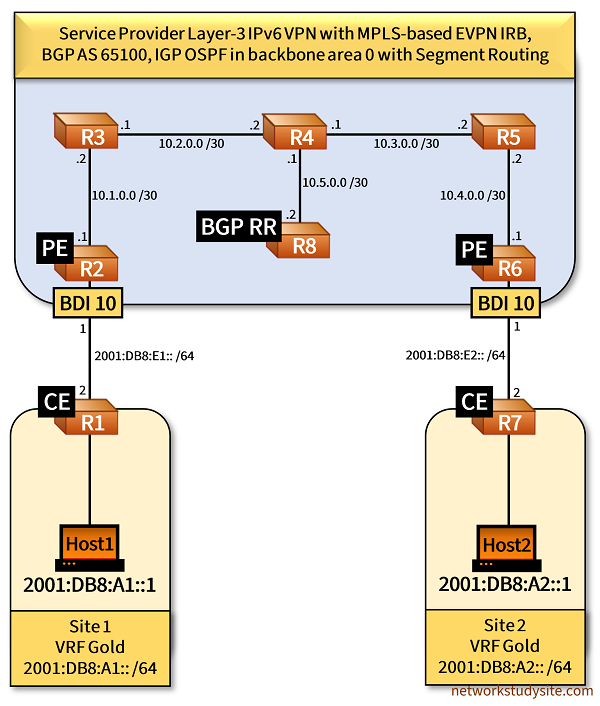
In the following example topology IPv6-only sites in VRF Gold are connected through an IPv4-only MPLS core network. The PE routers R2 and R6 are dual-stack IPv4 and IPv6. The CE-facing Bridge Domain Interface (BDI) on the PE routers is assigned to VRF Gold and uses an IPv6 address to establish an eBGP neighborship with the neighboring CE device. The MPLS core facing interface on the PE routers is assigned an IPv4 address and uses OSPF in the backbone area 0 together with Segment Routing (SR).
The MPLS core network uses IPv4-only, and Segment Routing is configured to provide a Label Switched Path (LSP) between the PE routers. SR assigns a transport label from the Global Block (SRGB) 16000 - 23999 to encapsulate packets in the MPLS core network.
Meanwhile, a VPN service label is assigned with EVPN IRB to provide a Layer-3 VPN architecture in the address-family IPv6. PE R2 assigns VPN service labels in the range 200 - 299, and PE R6 uses 600 - 699.
Configuration:
R2 (PE)
R2#show run | sec ^ipv6
ipv6 unicast-routing

R2#show run | sec ^mpls
mpls label range 200 299

R2#show run | sec ^segment
segment-routing mpls
 !
 connected-prefix-sid-map
  address-family ipv4
   2.2.2.2/32 index 2 range 1
  exit-address-family
 !

R2#show run | sec ^vrf
vrf definition Gold
 rd 65100:1
 !
 address-family ipv6
  route-target export 65100:1 stitching
  route-target import 65100:2 stitching
 exit-address-family

R2#show run int Lo10 | sec int
interface Loopback10
 ip address 2.2.2.2 255.255.255.255

R2#show run int Gi1 | sec int
interface GigabitEthernet1
 description ** to CE R1 **
 no ip address
 negotiation auto
 no mop enabled
 no mop sysid
 service instance 5 ethernet
  encapsulation untagged
 !

R2#show run int Gi2 | sec int
interface GigabitEthernet2
 description ** to R3 **
 ip address 10.1.0.1 255.255.255.252
 ip ospf network point-to-point
 negotiation auto
 no mop enabled
 no mop sysid

R2#show run int BDI 10 | sec int
interface BDI10
 description ** to CE R1 in VRF Gold **
 vrf forwarding Gold
 no ip address
 ipv6 address 2001:DB8:E1::1/64
 no mop enabled
 no mop sysid

R2#show run | sec ^l2vpn
l2vpn evpn
 replication-type ingress
 mpls label mode per-ce
 router-id Loopback10
l2vpn evpn instance 100 vlan-based

R2#show run | sec ^bridge-domain
bridge-domain 10
 member GigabitEthernet1 service-instance 5
 member evpn-instance 100

R2#show run | sec ^router
router ospf 10
 router-id 2.2.2.2
 segment-routing area 0 mpls
 segment-routing mpls
 network 2.2.2.2 0.0.0.0 area 0
 network 10.1.0.0 0.0.0.3 area 0
router bgp 65100
 bgp router-id 2.2.2.2
 bgp log-neighbor-changes
 neighbor 8.8.8.8 remote-as 65100
 neighbor 8.8.8.8 update-source Loopback10
 !
 address-family l2vpn evpn
  neighbor 8.8.8.8 activate
  neighbor 8.8.8.8 send-community both
 exit-address-family
 !
 address-family ipv6 vrf Gold
  advertise l2vpn evpn
  network 2001:DB8:E1::/64
  neighbor 2001:DB8:E1::2 remote-as 65001
  neighbor 2001:DB8:E1::2 activate
 exit-address-family
R6 (PE)
R6#show run | sec ^ipv6
ipv6 unicast-routing

R6#show run | sec ^mpls
mpls label range 600 699

R6#show run | sec ^segment
segment-routing mpls
 !
 connected-prefix-sid-map
  address-family ipv4
   6.6.6.6/32 index 6 range 1
  exit-address-family
 !

R6#show run | sec ^vrf
vrf definition Gold
 rd 65100:2
 !
 address-family ipv6
  route-target export 65100:2 stitching
  route-target import 65100:1 stitching
 exit-address-family

R6#show run int Lo10 | sec int
interface Loopback10
 ip address 6.6.6.6 255.255.255.255

R6#show run int Gi1 | sec int
interface GigabitEthernet1
 description ** to CE R7 **
 no ip address
 negotiation auto
 no mop enabled
 no mop sysid
 service instance 5 ethernet
  encapsulation untagged
 !

R6#show run int Gi2 | sec int
interface GigabitEthernet2
 description ** to R5 **
 ip address 10.4.0.1 255.255.255.252
 ip ospf network point-to-point
 negotiation auto
 no mop enabled
 no mop sysid

R6#show run int BDI 10 | sec int
interface BDI10
 description ** to CE R7 in VRF Gold **
 vrf forwarding Gold
 no ip address
 ipv6 address 2001:DB8:E2::1/64
 no mop enabled
 no mop sysid

R6#show run | sec ^l2vpn
l2vpn evpn
 replication-type ingress
 mpls label mode per-ce
 router-id Loopback10
l2vpn evpn instance 100 vlan-based

R6#show run | sec ^bridge-domain
bridge-domain 10
 member GigabitEthernet1 service-instance 5
 member evpn-instance 100

R6#show run | sec ^router
router ospf 10
 router-id 6.6.6.6
 segment-routing area 0 mpls
 segment-routing mpls
 network 6.6.6.6 0.0.0.0 area 0
 network 10.4.0.0 0.0.0.3 area 0
router bgp 65100
 bgp router-id 6.6.6.6
 bgp log-neighbor-changes
 neighbor 8.8.8.8 remote-as 65100
 neighbor 8.8.8.8 update-source Loopback10
 !
 address-family l2vpn evpn
  neighbor 8.8.8.8 activate
  neighbor 8.8.8.8 send-community both
 exit-address-family
 !
 address-family ipv6 vrf Gold
  advertise l2vpn evpn
  network 2001:DB8:E2::/64
  neighbor 2001:DB8:E2::2 remote-as 65002
  neighbor 2001:DB8:E2::2 activate
 exit-address-family
R8 (BGP RR)
R8#show run int Lo10 | sec int
interface Loopback10
 ip address 8.8.8.8 255.255.255.255

R8#show run int Gi0/0 | sec int
interface GigabitEthernet0/0
 description ** to R4 **
 ip address 10.5.0.2 255.255.255.252
 ip ospf network point-to-point
 duplex auto
 speed auto
 media-type rj45

R8#show run | sec ^router
router ospf 10
 router-id 8.8.8.8
 network 8.8.8.8 0.0.0.0 area 0
 network 10.5.0.0 0.0.0.3 area 0
router bgp 65100
 bgp router-id 8.8.8.8
 bgp log-neighbor-changes
 neighbor 2.2.2.2 remote-as 65100
 neighbor 2.2.2.2 update-source Loopback10
 neighbor 6.6.6.6 remote-as 65100
 neighbor 6.6.6.6 update-source Loopback10
 !
 address-family l2vpn evpn
  neighbor 2.2.2.2 activate
  neighbor 2.2.2.2 send-community both
  neighbor 2.2.2.2 route-reflector-client
  neighbor 6.6.6.6 activate
  neighbor 6.6.6.6 send-community both
  neighbor 6.6.6.6 route-reflector-client
 exit-address-family
R3
R3#show run | sec ^segment
segment-routing mpls
 !
 connected-prefix-sid-map
  address-family ipv4
   3.3.3.3/32 index 3 range 1
  exit-address-family
 !

R3#show run int Lo10 | sec int
interface Loopback10
 ip address 3.3.3.3 255.255.255.255

R3#show run int Gi1 | sec int
interface GigabitEthernet1
 description ** to PE R2 **
 ip address 10.1.0.2 255.255.255.252
 ip ospf network point-to-point
 negotiation auto
 no mop enabled
 no mop sysid

R3#show run int Gi2 | sec int
interface GigabitEthernet2
 description ** to R4 **
 ip address 10.2.0.1 255.255.255.252
 ip ospf network point-to-point
 negotiation auto
 no mop enabled
 no mop sysid

R3#show run | sec ^router
router ospf 10
 router-id 3.3.3.3
 segment-routing area 0 mpls
 segment-routing mpls
 network 3.3.3.3 0.0.0.0 area 0
 network 10.1.0.0 0.0.0.3 area 0
 network 10.2.0.0 0.0.0.3 area 0
R4
R4#show run | sec ^segment
segment-routing mpls
 !
 connected-prefix-sid-map
  address-family ipv4
   4.4.4.4/32 index 4 range 1
  exit-address-family
 !

R4#show run int Lo10 | sec int
interface Loopback10
 ip address 4.4.4.4 255.255.255.255

R4#show run int Gi1 | sec int
interface GigabitEthernet1
 description ** to R3 **
 ip address 10.2.0.2 255.255.255.252
 ip ospf network point-to-point
 negotiation auto
 no mop enabled
 no mop sysid

R4#show run int Gi2 | sec int
interface GigabitEthernet2
 description ** to R5 **
 ip address 10.3.0.1 255.255.255.252
 ip ospf network point-to-point
 negotiation auto
 no mop enabled
 no mop sysid

R4#show run int Gi3 | sec int
interface GigabitEthernet3
 description ** to BGP RR R8 **
 ip address 10.5.0.1 255.255.255.252
 ip ospf network point-to-point
 negotiation auto
 no mop enabled
 no mop sysid

R4#show run | sec ^router
router ospf 10
 router-id 4.4.4.4
 segment-routing area 0 mpls
 segment-routing mpls
 network 4.4.4.4 0.0.0.0 area 0
 network 10.2.0.0 0.0.0.3 area 0
 network 10.3.0.0 0.0.0.3 area 0
 network 10.5.0.0 0.0.0.3 area 0
R1 (CE)
R1#show run | sec ^ipv6 unicast
ipv6 unicast-routing

R1#show run | sec ^vrf
vrf definition Gold
 rd 1:1
 !
 address-family ipv6
 exit-address-family

R1#show run int Gi0/0 | sec int
interface GigabitEthernet0/0
 description ** to Host1 **
 no ip address
 duplex auto
 speed auto
 media-type rj45

R1#show run int Gi0/0.1 | sec int
interface GigabitEthernet0/0.1
 description ** to Host1 in VRF Gold **
 encapsulation dot1Q 1 native
 vrf forwarding Gold
 ipv6 address 2001:DB8:A1::2/64

R1#show run int Gi0/1 | sec int
interface GigabitEthernet0/1
 description ** to PE R2 **
 no ip address
 duplex auto
 speed auto
 media-type rj45

R1#show run int Gi0/1.1 | sec int
interface GigabitEthernet0/1.1
 description ** to PE R2 in VRF Gold **
 encapsulation dot1Q 1 native
 vrf forwarding Gold
 ipv6 address 2001:DB8:E1::2/64

R1#show run | sec ^router
router bgp 65001
 bgp router-id 1.1.1.1
 bgp log-neighbor-changes
 !
 address-family ipv6 vrf Gold
  network 2001:DB8:A1::/64
  neighbor 2001:DB8:E1::1 remote-as 65100
  neighbor 2001:DB8:E1::1 activate
 exit-address-family
R7 (CE)
R7#show run | sec ^ipv6 unicast
ipv6 unicast-routing

R7#show run | sec ^vrf
vrf definition Gold
 rd 1:1
 !
 address-family ipv6
 exit-address-family

R7#show run int Gi0/0 | sec int
interface GigabitEthernet0/0
 description ** to Host2 **
 no ip address
 duplex auto
 speed auto
 media-type rj45

R7#show run int Gi0/0.1 | sec int
interface GigabitEthernet0/0.1
 description ** to Host2 in VRF Gold **
 encapsulation dot1Q 1 native
 vrf forwarding Gold
 ipv6 address 2001:DB8:A2::2/64

R7#show run int Gi0/1 | sec int
interface GigabitEthernet0/1
 description ** to PE R6 **
 no ip address
 duplex auto
 speed auto
 media-type rj45

R7#show run int Gi0/1.1 | sec int
interface GigabitEthernet0/1.1
 description ** to PE R6 in VRF Gold **
 encapsulation dot1Q 1 native
 vrf forwarding Gold
 ipv6 address 2001:DB8:E2::2/64

R7#show run | sec ^router
router bgp 65002
 bgp router-id 7.7.7.7
 bgp log-neighbor-changes
 !
 address-family ipv6 vrf Gold
  network 2001:DB8:A2::/64
  neighbor 2001:DB8:E2::1 remote-as 65100
  neighbor 2001:DB8:E2::1 activate
 exit-address-family
Host1
Host1#show run int Gi0/0 | sec int
interface GigabitEthernet0/0
 description ** to CE R1 **
 no ip address
 duplex auto
 speed auto
 media-type rj45
 ipv6 address 2001:DB8:A1::1/64

Host1#show run | sec ^ipv6 route
ipv6 route ::/0 2001:DB8:A1::2
Host1#ping 2001:DB8:A2::1
Type escape sequence to abort.
Sending 5, 100-byte ICMP Echos to 2001:DB8:A2::1, timeout is 2 seconds:
!!!!!
Success rate is 100 percent (5/5), round-trip min/avg/max = 89/90/91 ms             « Host1 (Site 1) can reach Host2 (Site 2)


Host1#trace 2001:DB8:A2::1
Type escape sequence to abort.
Tracing the route to 2001:DB8:A2::1

  1 2001:DB8:A1::2 2 msec 2 msec 2 msec
  2 2001:DB8:E1::1 7 msec 2 msec 2 msec
  3 ::FFFF:10.1.0.2 [MPLS: Labels 16006/604 Exp 0] 8 msec 5 msec 5 msec             « MPLS label stack is used to transport IPv6 traffic
  4 ::FFFF:10.2.0.2 [MPLS: Labels 16006/604 Exp 0] 7 msec 6 msec 5 msec
  5 ::FFFF:10.3.0.2 [MPLS: Labels 16006/604 Exp 0] 16 msec 6 msec 5 msec
  6 2001:DB8:E2::1 [MPLS: Label 604 Exp 0] 5 msec 5 msec 4 msec                     « VPN service label assigned by PE R6
  7 2001:DB8:E2::2 5 msec 6 msec 6 msec
  8 2001:DB8:A2::1 6 msec 7 msec 5 msec


Host2#trace 2001:DB8:A1::1
Type escape sequence to abort.
Tracing the route to 2001:DB8:A1::1

  1 2001:DB8:A2::2 1 msec 2 msec 2 msec
  2 2001:DB8:E2::1 23 msec 22 msec 23 msec
  3 ::FFFF:10.4.0.2 [MPLS: Labels 16002/204 Exp 0] 91 msec 90 msec 89 msec
  4 ::FFFF:10.3.0.1 [MPLS: Labels 16002/204 Exp 0] 92 msec 90 msec 90 msec
  5 ::FFFF:10.2.0.1 [MPLS: Labels 16002/204 Exp 0] 89 msec 89 msec 90 msec
  6 2001:DB8:E1::1 [MPLS: Label 204 Exp 0] 77 msec 72 msec 68 msec
  7 2001:DB8:E1::2 91 msec 90 msec 90 msec
  8 2001:DB8:A1::1 90 msec 91 msec 91 msec
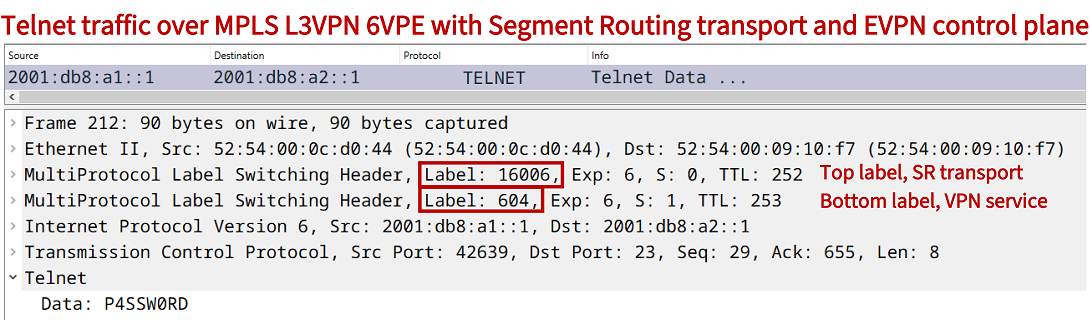
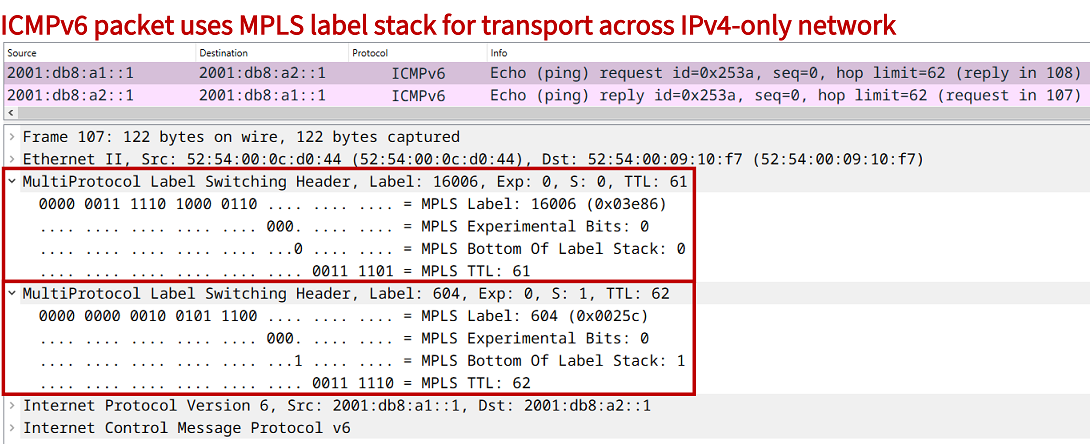
As visible in the above outputs, Host1 can reach Host2 using the IPv4-only MPLS core network. Essentially, IPv6 traffic is tunneled across the network using MPLS encapsulation. The top label (16006 and 16002 respectively) is the transport label which is assigned by Segment Routing. The bottom label (604 and 204) is the VPN service label which is advertised by the PE routers using EVPN IRB.
The IPv6 prefixes are advertised with EVPN IRB using the Route Type 5 encoded in Multiprotocol-BGP (MP-BGP) Update messages. These messages are originated by the PE routers and received through the BGP Route Reflector R8. The following output is taken from PE R2 and shows the IPv6 (L3VPN) prefixes received through EVPN IRB.
R2#show ip bgp l2vpn evpn all sum | beg Ne
Neighbor        V           AS MsgRcvd MsgSent   TblVer  InQ OutQ Up/Down  State/PfxRcd
8.8.8.8         4        65100     165     136       23    0    0 01:54:14        4      « PE R2 receives four EVPN prefixes from the RR R8


R2#show ip bgp l2vpn evpn rd 65100:2 | beg Ne
     Network          Next Hop            Metric LocPrf Weight Path
Route Distinguisher: 65100:2
 *>i  [5][65100:2][0][64][2001:DB8:A2::]/29                               « EVPN Route Type 5 with IPv6 prefix
                      6.6.6.6                  0    100      0 65002 i
 *>i  [5][65100:2][0][64][2001:DB8:E2::]/29
                      6.6.6.6                  0    100      0 i


R2#show ip bgp l2vpn evpn rd 65100:2 route-type 5 0 2001:DB8:A2:: 64
BGP routing table entry for [5][65100:2][0][64][2001:DB8:A2::]/29, version 21          « Site 2 IPv6 prefix received through EVPN IRB
Paths: (1 available, best #1, table EVPN-BGP-Table)
  Not advertised to any peer
  Refresh Epoch 4
  65002
    6.6.6.6 (metric 5) (via default) from 8.8.8.8 (8.8.8.8)
      Origin IGP, metric 0, localpref 100, valid, internal, best
      EVPN ESI: 00000000000000000000, Gateway Address: ::, VNI Label 0, MPLS VPN Label 605        « VPN service label assigned by PE R6
      Extended Community: RT:65100:2
      Originator: 6.6.6.6, Cluster list: 8.8.8.8                                                  « PE R6 originates this prefix
      rx pathid: 0, tx pathid: 0x0
      net: 0x7FDE0A6E1938, path: 0x7FDE3A996D20, pathext: 0x7FDE3AA48D78
      flags: net: 0x0, path: 0x3, pathext: 0x81
      attribute: 0x7FDE3A986B90, ref: 2
      Updated on May 12 2024 13:36:23 UTC
The following output is taken from the BGP RR R8 and shows all the EVPN route updates that are involved in this example topology. As visible there are EVPN Type 2 MAC/IP routes, Type 3 IMET routes and Type 5 IP Prefix routes advertised between the PEs and the RR.
R8#show ip bgp l2vpn evpn all sum | beg Ne
Neighbor        V           AS MsgRcvd MsgSent   TblVer  InQ OutQ Up/Down  State/PfxRcd
2.2.2.2         4        65100     143     172       20    0    0 02:00:12        4          « Four EVPN prefixes received on R8 from PE
6.6.6.6         4        65100     142     165       20    0    0 02:00:09        4


R8#show ip bgp l2vpn evpn all | beg Ne
     Network          Next Hop            Metric LocPrf Weight Path
Route Distinguisher: 2.2.2.2:100
 *>i  [2][2.2.2.2:100][0][48][52540012ED6F][0][*]/20                         « Route Type 2
                       2.2.2.2                  0    100      0 ?
Route Distinguisher: 6.6.6.6:100
 *>i  [2][6.6.6.6:100][0][48][52540004068C][0][*]/20
                       6.6.6.6                  0    100      0 ?
Route Distinguisher: 2.2.2.2:100
 *>i  [3][2.2.2.2:100][0][32][2.2.2.2]/17                                    « Route Type 3
                       2.2.2.2                  0    100      0 ?
Route Distinguisher: 6.6.6.6:100
 *>i  [3][6.6.6.6:100][0][32][6.6.6.6]/17
                       6.6.6.6                  0    100      0 ?
Route Distinguisher: 65100:1
 *>i  [5][65100:1][0][64][2001:DB8:A1::]/29                                  « Route Type 5
                       2.2.2.2                  0    100      0 65001 i
 *>i  [5][65100:1][0][64][2001:DB8:E1::]/29
                       2.2.2.2                  0    100      0 i
Route Distinguisher: 65100:2
 *>i  [5][65100:2][0][64][2001:DB8:A2::]/29
                       6.6.6.6                  0    100      0 65002 i
 *>i  [5][65100:2][0][64][2001:DB8:E2::]/29
                       6.6.6.6                  0    100      0 i
Packet capture EVPN Route Type 5 with IPv6 prefix
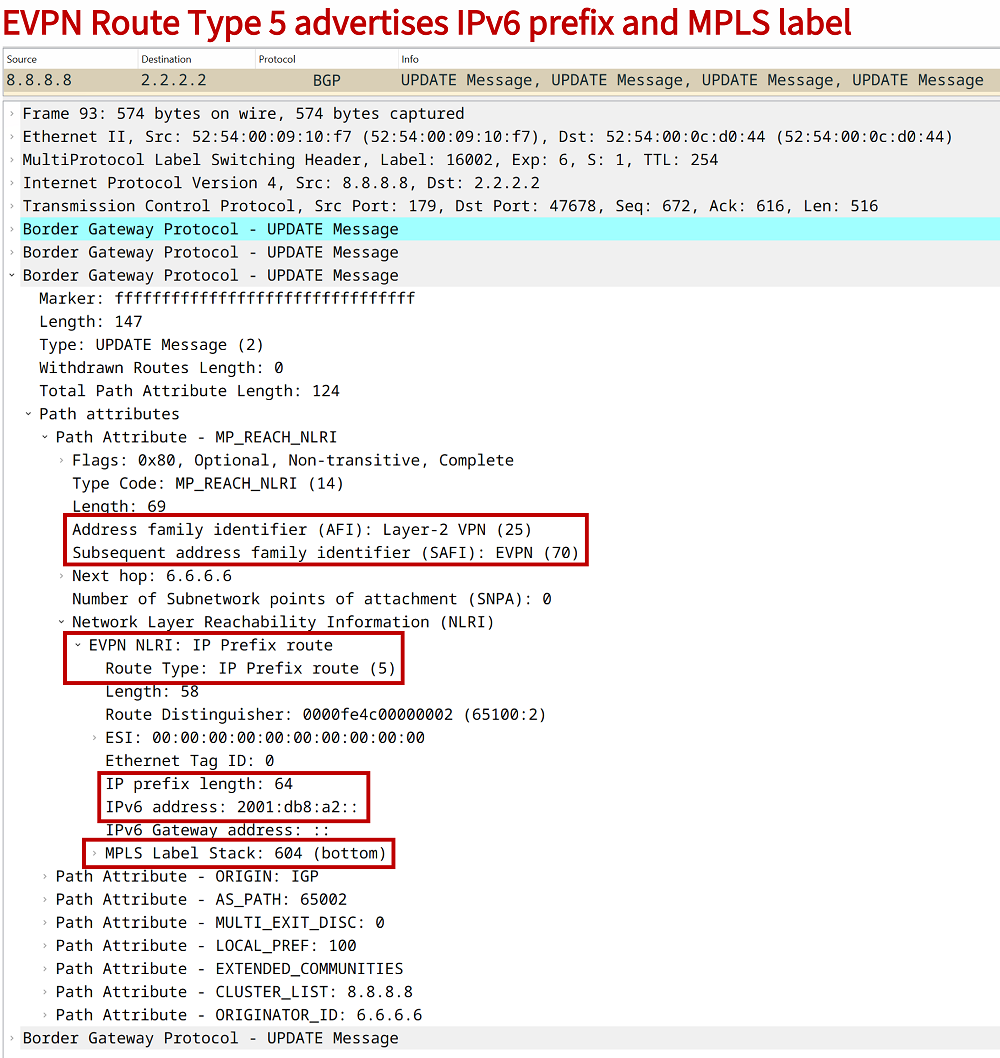
The following packet capture shows an EVPN Type 5 IP Prefix Route advertised in a BGP Update message carrying the Site 2 IPv6 prefix. Note that a VPN service label (bottom label) is also attached to this route, enabling an end-to-end Label Switched Path (LSP) between the VRF Bridge Domain Interface (BDI) on each PE router. The bottom label ensures traffic finds the correct customer VRF when it reaches an egress PE router.