EIGRP Stub Router and Stub Site Explained and Configured
- What is an EIGRP stub router? ‹
- What is the difference between OSPF stub and EIGRP stub? ‹
- How to limit EIGRP Query propagation? ‹
- EIGRP stub router with leak-map ‹
- EIGRP stub site configuration ‹
- EIGRP stub site with dual edge ‹
- Download section ‹
What is an EIGRP stub router?
An EIGRP stub router signals to its neighbors that the advertisement of EIGRP Query packets should be suppressed. This is especially useful for branch locations which generally cannot provide backup paths to one or more hub sites. Also, an EIGRP stub router can avoid being a transit device because it only advertises connected and summary routes (by default setting).
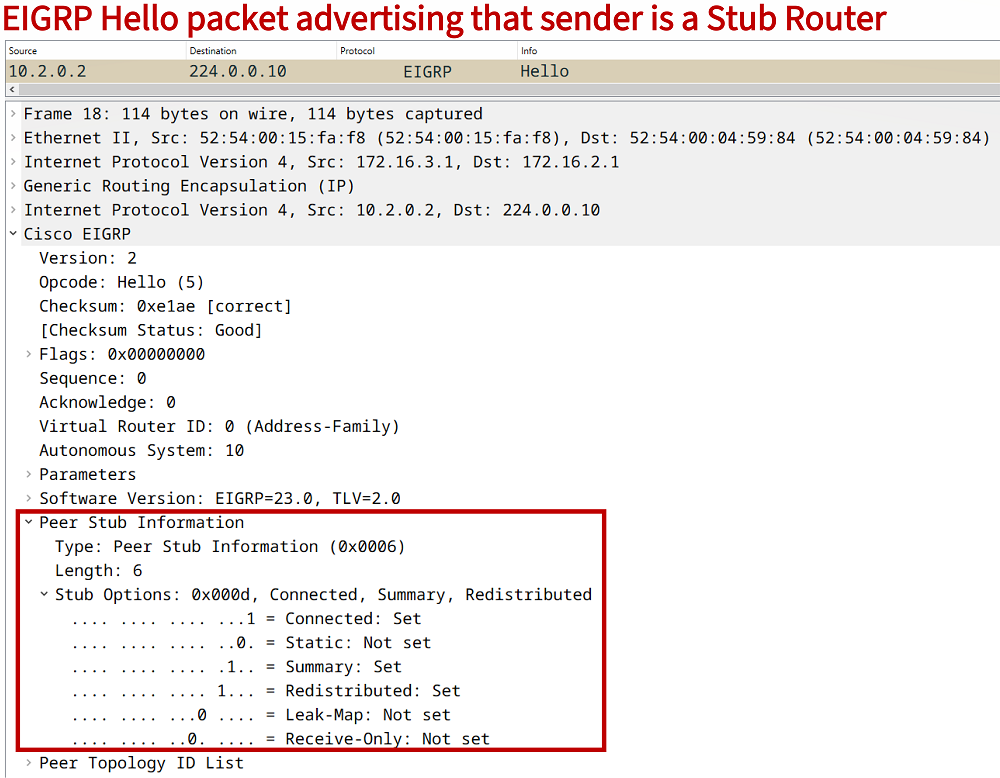
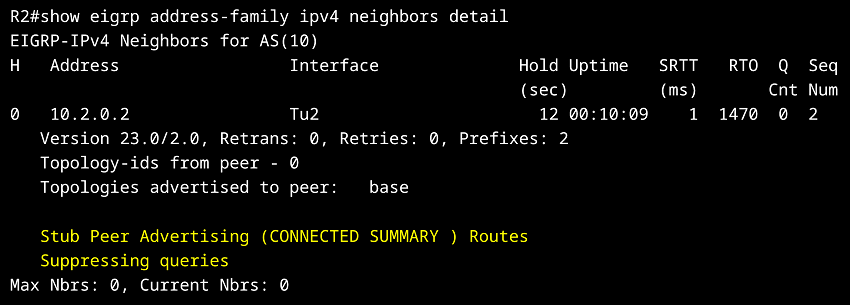
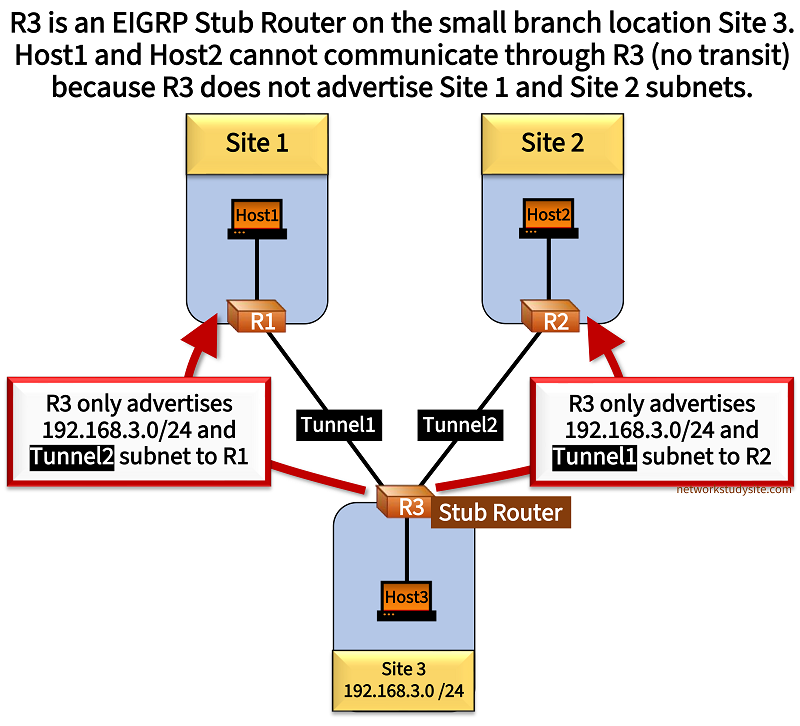
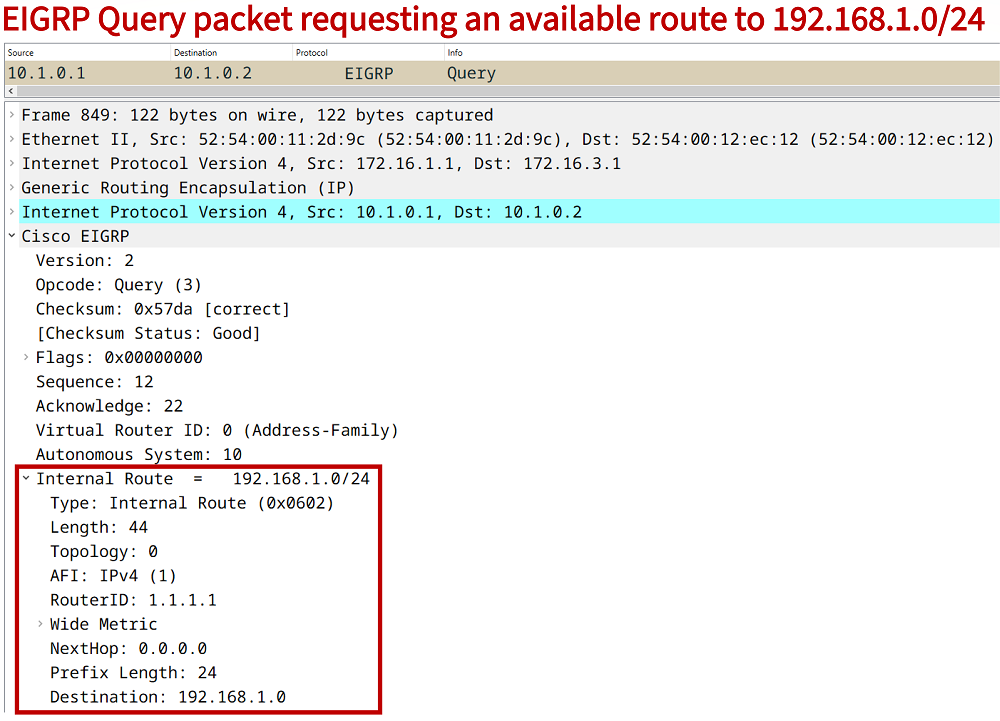
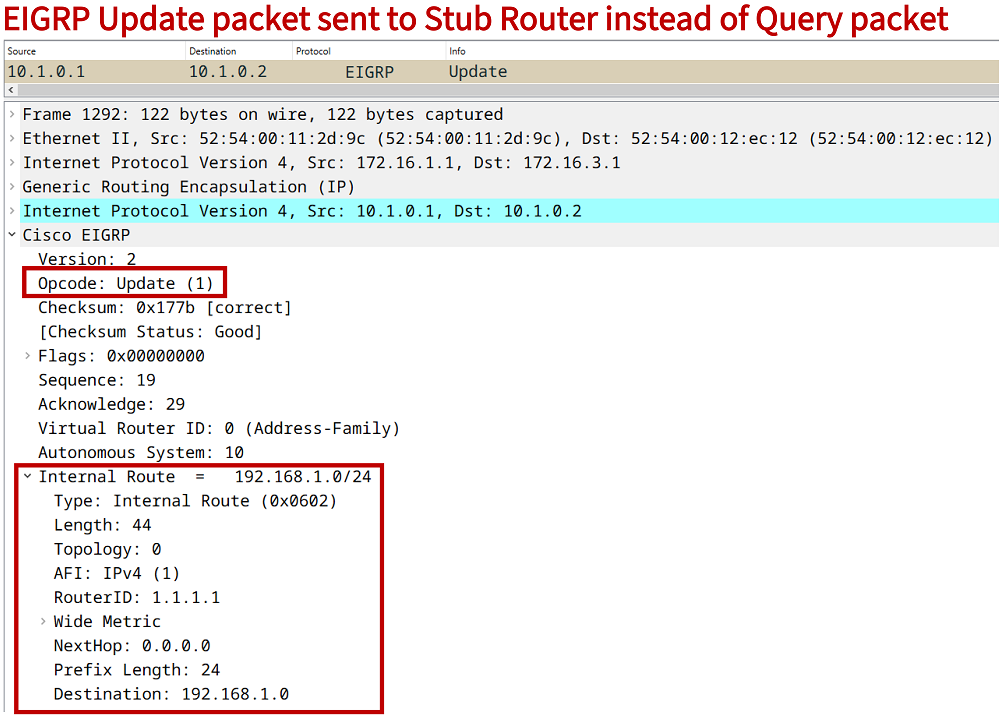
When a network learned through EIGRP becomes unreachable and there is no available backup path, an EIGRP Query packet is sent to neighbors in search of an available route. However, EIGRP Query packets are not sent to stub routers, and this improves protocol convergence and network stability. The following table shows two methods to configure the EIGRP stub router feature.
| Classic Mode | Named Mode |
|---|---|
R3>
R3>enable
R3#configure terminal
Enter configuration commands, one per line.  End with CNTL/Z.
R3(config)#
R3(config)#router eigrp 10
R3(config-router)#eigrp stub
R3(config-router)#
R3(config-router)#end
R3#
|
R3>
R3>enable
R3#configure terminal
Enter configuration commands, one per line.  End with CNTL/Z.
R3(config)#
R3(config)#router eigrp EXAMPLE-EIGRP
R3(config-router)#address-family ipv4 unicast autonomous-system 10
R3(config-router-af)#eigrp stub
R3(config-router-af)#
R3(config-router-af)#end
R3#
|
What is the difference between OSPF stub and EIGRP stub?
Both EIGRP and OSPF use the concept of a stub router or stub network. Even though the two routing protocols function in different ways, the purpose of a stub router in EIGRP and a stub area in OSPF is to optimize protocol convergence. The following table provides a brief comparison.
| Concept | Purpose |
|---|---|
| EIGRP Stub Router | Configured on a router which then signals to its neighbors to suppress EIGRP Query messages. Neighbors of a stub router send an Update message instead of a Query when the EIGRP topology reconverges. This is how a stub router can limit the EIGRP Query domain. Also, by default stub routers advertise only connected and summary routes to ensure they do not become transit routers. Optionally, a leak-map can be configured to also advertise other types of EIGRP routes. |
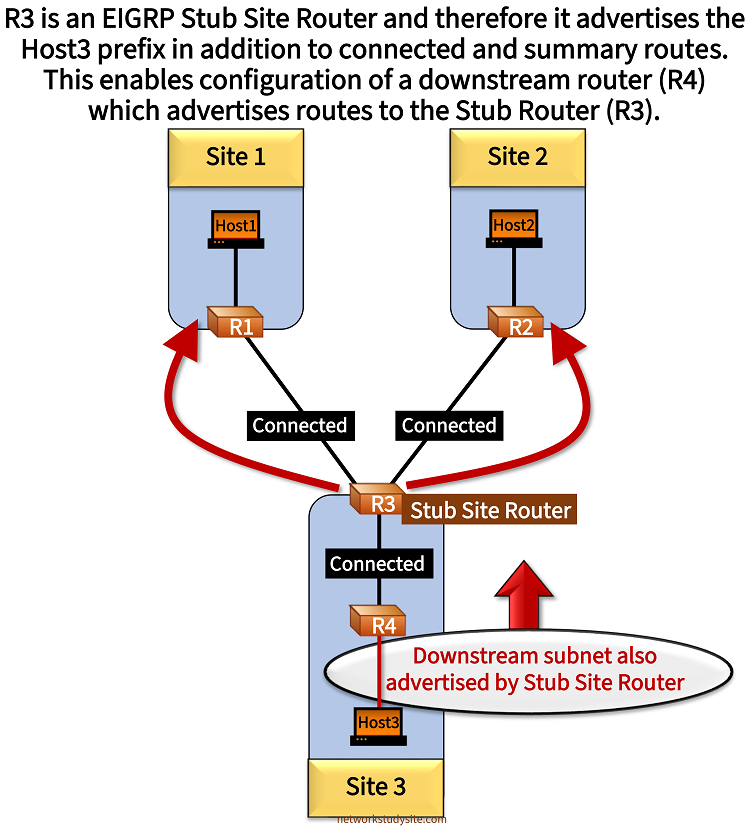
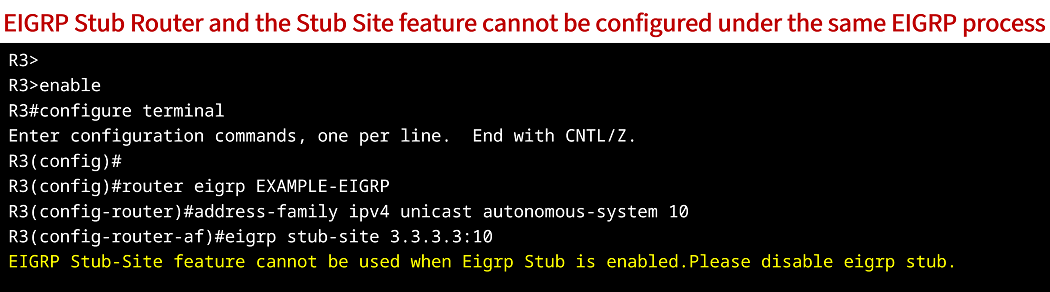
| EIGRP Stub Site | The stub site feature is an addition to the EIGRP stub router. While a stub router only advertises connected and summary routes (by default), a stub site router also advertises routes received from an EIGRP neighbor. This is especially useful on a branch location stub router which has a connected downstream EIGRP neighbor that requires connectivity to hub sites. The stub router and stub site feature cannot be configured on the same router. |
| OSPF Stub Area | Configured on all routers within an OSPF stub area. The stub area flag must match to form an OSPF neighborship. The purpose of an OSPF stub area is to limit the flooding of different types of LSA-s (route updates), depending on the type of stub area. This optimizes the OSPF control plane operation. |
| OSPF Stub Router | The purpose of the OSPF stub router feature is to gracefully insert or remove a device from a network, and to wait for protocol convergence (e.g. wait for BGP) before advertising OSPF routes. The OSPF stub router feature is configured on an individual router, which then advertises OSPF routes with a maximum metric to make it undesirable for transit traffic. As a result, the neighboring OSPF routers send traffic on an alternative path if available. |
How to limit EIGRP Query propagation?
EIGRP Query propagation can be limited in multiple ways. One method is by implementing the Stub Router feature which is the main topic of this blog post. However, EIGRP Query messages can also be limited with route summarization. This is shown in the following example.
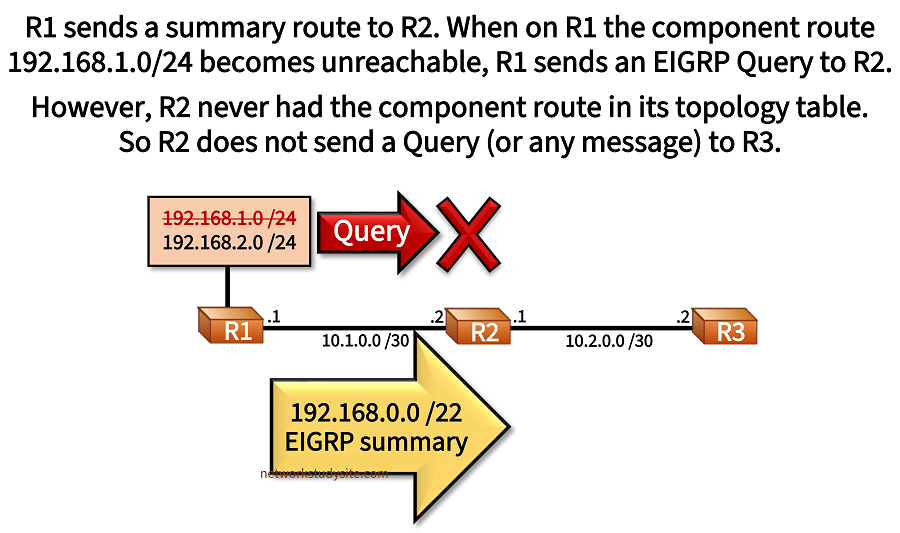
R1 advertises the summary route 192.168.0.0/22 to R2 (instead of the connected individual /24 prefixes). This means, when the single component prefix 192.168.1.0/24 is no longer reachable, R1 sends a Query message to R2. However, R2 does not forward a Query message to R3. This is because R2 never had the route 192.168.1.0/24 in its EIGRP topology table, only the summary route.
Configuration:
R1
R1#show run | sec ^router
router eigrp EXAMPLE-EIGRP
 !
 address-family ipv4 unicast autonomous-system 10
  !
  af-interface GigabitEthernet0/0
   summary-address 192.168.0.0 255.255.252.0
  exit-af-interface
  !
  topology base
  exit-af-topology
  network 10.1.0.0 0.0.0.3
  network 192.168.1.0
  network 192.168.2.0
  eigrp router-id 1.1.1.1
 exit-address-family

R1#show run int Gi0/0 | sec int
interface GigabitEthernet0/0
 description ** to R2 **
 ip address 10.1.0.1 255.255.255.252
 duplex auto
 speed auto
 media-type rj45

R1#show run int Lo10 | sec int
interface Loopback10
 ip address 192.168.1.1 255.255.255.0

R1#show run int Lo20 | sec int
interface Loopback20
 ip address 192.168.2.1 255.255.255.0
R2
R2#show run | sec ^router
router eigrp EXAMPLE-EIGRP
 !
 address-family ipv4 unicast autonomous-system 10
  !
  topology base
  exit-af-topology
  network 10.1.0.0 0.0.0.3
  network 10.2.0.0 0.0.0.3
  eigrp router-id 2.2.2.2
 exit-address-family

R2#show run int Gi0/0 | sec int
interface GigabitEthernet0/0
 description ** to R1 **
 ip address 10.1.0.2 255.255.255.252
 duplex auto
 speed auto
 media-type rj45

R2#show run int Gi0/1 | sec int
interface GigabitEthernet0/1
 description ** to R3 **
 ip address 10.2.0.1 255.255.255.252
 duplex auto
 speed auto
 media-type rj45
R3
R3#show run | sec ^router
router eigrp EXAMPLE-EIGRP
 !
 address-family ipv4 unicast autonomous-system 10
  !
  topology base
  exit-af-topology
  network 10.2.0.0 0.0.0.3
  eigrp router-id 3.3.3.3
 exit-address-family

R3#show run int Gi0/0 | sec int
interface GigabitEthernet0/0
 description ** to R2 **
 ip address 10.2.0.2 255.255.255.252
 duplex auto
 speed auto
 media-type rj45
R2#show log | beg Log Buffer
Log Buffer (8192 bytes):

EIGRP: Sending HELLO on Gi0/1 - paklen 20
  AS 10, Flags 0x0:(NULL), Seq 0/0 interfaceQ 0/0 iidbQ un/rely 0/0
EIGRP: Received HELLO on Gi0/1 - paklen 20 nbr 10.2.0.2
  AS 10, Flags 0x0:(NULL), Seq 0/0 interfaceQ 0/0 iidbQ un/rely 0/0 peerQ un/rely 0/0
EIGRP: Received HELLO on Gi0/0 - paklen 20 nbr 10.1.0.1
  AS 10, Flags 0x0:(NULL), Seq 0/0 interfaceQ 0/0 iidbQ un/rely 0/0 peerQ un/rely 0/0
EIGRP: Received QUERY on Gi0/0 - paklen 44 nbr 10.1.0.1                       « Query received from R1 but never forwarded to R3
  AS 10, Flags 0x0:(NULL), Seq 17/0 interfaceQ 0/0 iidbQ un/rely 0/0 peerQ un/rely 0/0
EIGRP: Enqueueing ACK on Gi0/0 - paklen 0 nbr 10.1.0.1 tid 0
  Ack seq 17 iidbQ un/rely 0/0 peerQ un/rely 1/0
EIGRP: Sending ACK on Gi0/0 - paklen 0 nbr 10.1.0.1 tid 0
  AS 10, Flags 0x0:(NULL), Seq 0/17 interfaceQ 0/0 iidbQ un/rely 0/0 peerQ un/rely 1/0
EIGRP: Enqueueing REPLY on Gi0/0 - paklen 0 nbr 10.1.0.1 tid 0 iidbQ un/rely 0/1 peerQ un/rely 0/0 serno 19-19
EIGRP: Requeued unicast on GigabitEthernet0/0
EIGRP: Sending REPLY on Gi0/0 - paklen 44 nbr 10.1.0.1 tid 0
  AS 10, Flags 0x0:(NULL), Seq 29/17 interfaceQ 0/0 iidbQ un/rely 0/0 peerQ un/rely 0/1 serno 19-19
EIGRP: Received ACK on Gi0/0 - paklen 0 nbr 10.1.0.1
  AS 10, Flags 0x0:(NULL), Seq 0/29 interfaceQ 0/0 iidbQ un/rely 0/0 peerQ un/rely 0/1


R3#show ip route eigrp | beg Ga
Gateway of last resort is not set

      10.0.0.0/8 is variably subnetted, 3 subnets, 2 masks
D        10.1.0.0/30 [90/15360] via 10.2.0.1, 00:29:07, GigabitEthernet0/0
D     192.168.0.0/22 [90/16000] via 10.2.0.1, 00:22:12, GigabitEthernet0/0    « Summary route remains installed on R3
This is also why an EIGRP stub router can advertise summary routes. Doing so does not trigger frequent Query messages on its EIGRP neighbors but at the same time the stub router is still able to advertise its branch location IP address using a summary prefix. If branch location IP addresses need to be advertised that are not directly connected to the stub router, then either a leak-map can be configured or the Stub Site feature can be used.
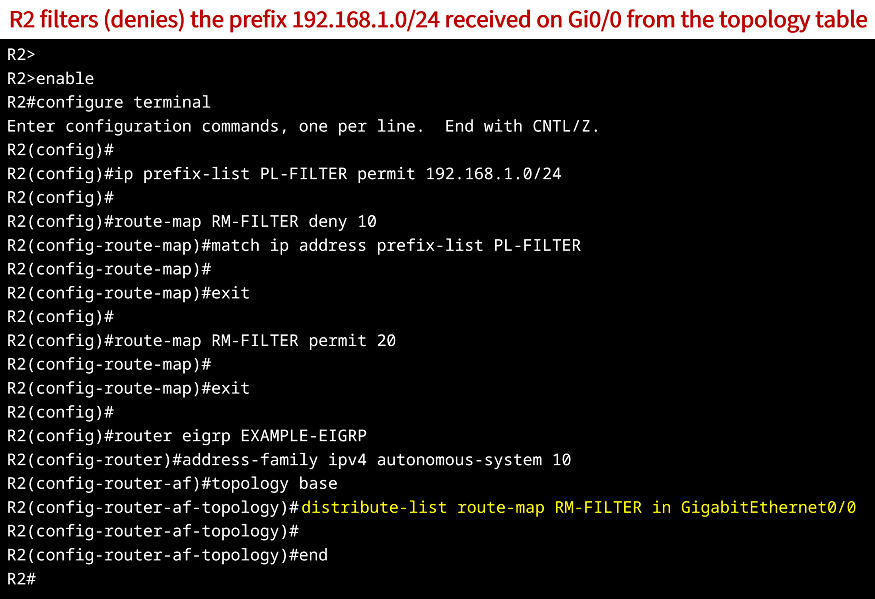
Furthermore, EIGRP route-filtering is another method of limiting the Query domain. For example, an inbound distribute-list on R2 could filter the prefix 192.168.1.0/24. As a result, when R1 sends a Query to R2 in search of an available route to 192.168.1.0/24, R2 does not propagate Query messages to R3.
EIGRP stub router with leak-map
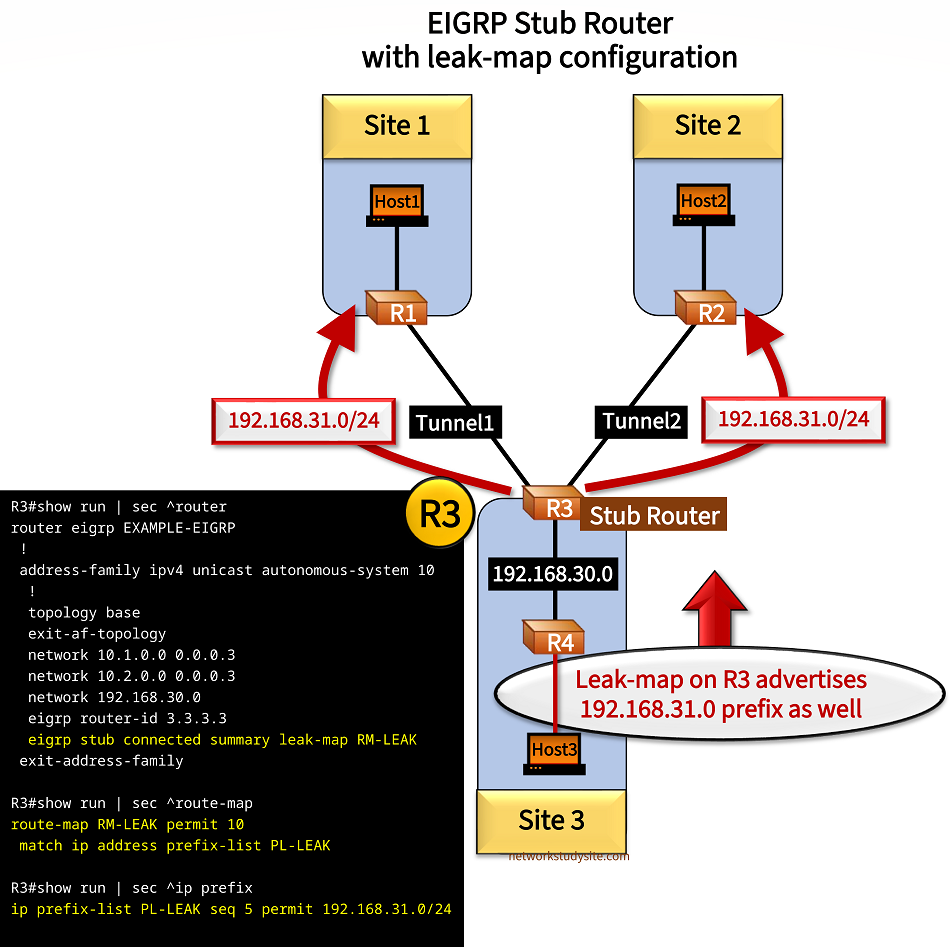
In the following example topology R3 is a stub router that has a leak-map configured. The leak-map is necessary because by default an EIGRP stub router only advertises connected and summary routes. In this scenario, the stub router R3 receives the prefix 192.168.31.0/24 through EIGRP from R4, and does not advertise it to R1 or R2, unless a stub router leak-map is configured.
Configuration:
R1
R1#show run int Gi0/0 | sec int
interface GigabitEthernet0/0
 description ** to Host1 **
 ip address 192.168.1.2 255.255.255.0
 duplex auto
 speed auto
 media-type rj45

R1#show run int Gi0/1 | sec int
interface GigabitEthernet0/1
 description ** WAN link to ISP **
 ip address 172.16.1.1 255.255.255.252
 duplex auto
 speed auto
 media-type rj45

R1#show run int Tu1 | sec int
interface Tunnel1
 description ** P2P tunnel to R3 **
 ip address 10.1.0.1 255.255.255.252
 tunnel source GigabitEthernet0/1
 tunnel destination 172.16.3.1

R1#show run | sec ^router
router eigrp 10
 network 10.1.0.0 0.0.0.3
 network 192.168.1.0
 eigrp router-id 1.1.1.1

R1#show run | sec ^ip route
ip route 172.16.0.0 255.255.0.0 GigabitEthernet0/1 172.16.1.2
R2
R2#show run int Gi0/0 | sec int
interface GigabitEthernet0/0
 description ** to Host2 **
 ip address 192.168.2.2 255.255.255.0
 duplex auto
 speed auto
 media-type rj45

R2#show run int Gi0/1 | sec int
interface GigabitEthernet0/1
 description ** WAN link to ISP **
 ip address 172.16.2.1 255.255.255.252
 duplex auto
 speed auto
 media-type rj45

R2#show run int Tu2 | sec int
interface Tunnel2
 description ** P2P tunnel to R3 **
 ip address 10.2.0.1 255.255.255.252
 tunnel source GigabitEthernet0/1
 tunnel destination 172.16.3.1

R2#show run | sec ^router
router eigrp 10
 network 10.2.0.0 0.0.0.3
 network 192.168.2.0
 eigrp router-id 2.2.2.2

R2#show run | sec ^ip route
ip route 172.16.0.0 255.255.0.0 GigabitEthernet0/1 172.16.2.2
R3 (Stub Router)
R3#show run int Gi0/0 | sec int
interface GigabitEthernet0/0
 description ** to R4 **
 ip address 192.168.30.1 255.255.255.0
 duplex auto
 speed auto
 media-type rj45

R3#show run int Gi0/1 | sec int
interface GigabitEthernet0/1
 description ** WAN link to ISP **
 ip address 172.16.3.1 255.255.255.252
 duplex auto
 speed auto
 media-type rj45

R3#show run int Tu1 | sec int
interface Tunnel1
 description ** P2P tunnel to R1 **
 ip address 10.1.0.2 255.255.255.252
 tunnel source GigabitEthernet0/1
 tunnel destination 172.16.1.1

R3#show run int Tu2 | sec int
interface Tunnel2
 description ** P2P tunnel to R2 **
 ip address 10.2.0.2 255.255.255.252
 tunnel source GigabitEthernet0/1
 tunnel destination 172.16.2.1

R3#show run | sec ^router
router eigrp EXAMPLE-EIGRP
 !
 address-family ipv4 unicast autonomous-system 10
  !
  topology base
  exit-af-topology
  network 10.1.0.0 0.0.0.3
  network 10.2.0.0 0.0.0.3
  network 192.168.30.0
  eigrp router-id 3.3.3.3
  eigrp stub connected summary leak-map RM-LEAK
 exit-address-family

R3#show run | sec ^route-map
route-map RM-LEAK permit 10
 match ip address prefix-list PL-LEAK

R3#show run | sec ^ip prefix
ip prefix-list PL-LEAK seq 5 permit 192.168.31.0/24
R4
R4#show run int Gi0/0 | sec int
interface GigabitEthernet0/0
 description ** to Stub Router R3 **
 ip address 192.168.30.2 255.255.255.0
 duplex auto
 speed auto
 media-type rj45

R4#show run int Gi0/1 | sec int
interface GigabitEthernet0/1
 description ** to Host3 **
 ip address 192.168.31.1 255.255.255.0
 duplex auto
 speed auto
 media-type rj45

R4#show run | sec ^router
router eigrp EXAMPLE-EIGRP
 !
 address-family ipv4 unicast autonomous-system 10
  !
  topology base
  exit-af-topology
  network 192.168.30.0
  network 192.168.31.0
  eigrp router-id 4.4.4.4
 exit-address-family
R3#show ip protocols | section EIGRP
  EIGRP-IPv4 VR(EXAMPLE-EIGRP) Address-Family Protocol for AS(10)
    Metric weight K1=1, K2=0, K3=1, K4=0, K5=0 K6=0
    Metric rib-scale 128
    Metric version 64bit
    Soft SIA disabled
    NSF-aware route hold timer is 240
    Router-ID: 3.3.3.3
    Stub, connected, summary, leakmap RM-LEAK                          « Locally verifying Stub Router configuration on R3
    Topology : 0 (base)
      Active Timer: 3 min
      Distance: internal 90 external 170
      Maximum path: 4
      Maximum hopcount 100
      Maximum metric variance 1
      Total Prefix Count: 6
      Total Redist Count: 0


R2#show ip eigrp neighbors detail
EIGRP-IPv4 Neighbors for AS(10)
H   Address                 Interface              Hold Uptime   SRTT   RTO  Q  Seq
                                                   (sec)         (ms)       Cnt Num
0   10.2.0.2                Tu2                      12 00:16:47   23  1470  0  45
   Version 23.0/2.0, Retrans: 0, Retries: 0, Prefixes: 3
   Topology-ids from peer - 0
   Topologies advertised to peer:   base

   Stub Peer Advertising (CONNECTED SUMMARY LEAKMAP ) Routes           « R3 is a Stub Router with a leak-map configured
   Suppressing queries
Max Nbrs: 0, Current Nbrs: 0


R2#show ip route eigrp | beg Ga
Gateway of last resort is 172.16.2.2 to network 0.0.0.0

      10.0.0.0/8 is variably subnetted, 3 subnets, 2 masks
D        10.1.0.0/30 [90/28160000] via 10.2.0.2, 00:02:42, Tunnel2
D     192.168.30.0/24 [90/26880256] via 10.2.0.2, 00:02:42, Tunnel2
D     192.168.31.0/24 [90/26880512] via 10.2.0.2, 00:02:40, Tunnel2    « R2 learns leaked route


R2#show ip eigrp topology 192.168.31.0
EIGRP-IPv4 Topology Entry for AS(10)/ID(2.2.2.2) for 192.168.31.0/24
  State is Passive, Query origin flag is 1, 1 Successor(s), FD is 26880512
  Descriptor Blocks:
  10.2.0.2 (Tunnel2), from 10.2.0.2, Send flag is 0x0                  « R3 advertises leaked route through Tunnel2
      Composite metric is (26880512/3072), route is Internal
      Vector metric:
        Minimum bandwidth is 100 Kbit
        Total delay is 50020 microseconds
        Reliability is 255/255
        Load is 1/255
        Minimum MTU is 1476
        Hop count is 2
        Originating router is 4.4.4.4                                  « R4 is Site 3 originates the leaked route
EIGRP stub site configuration
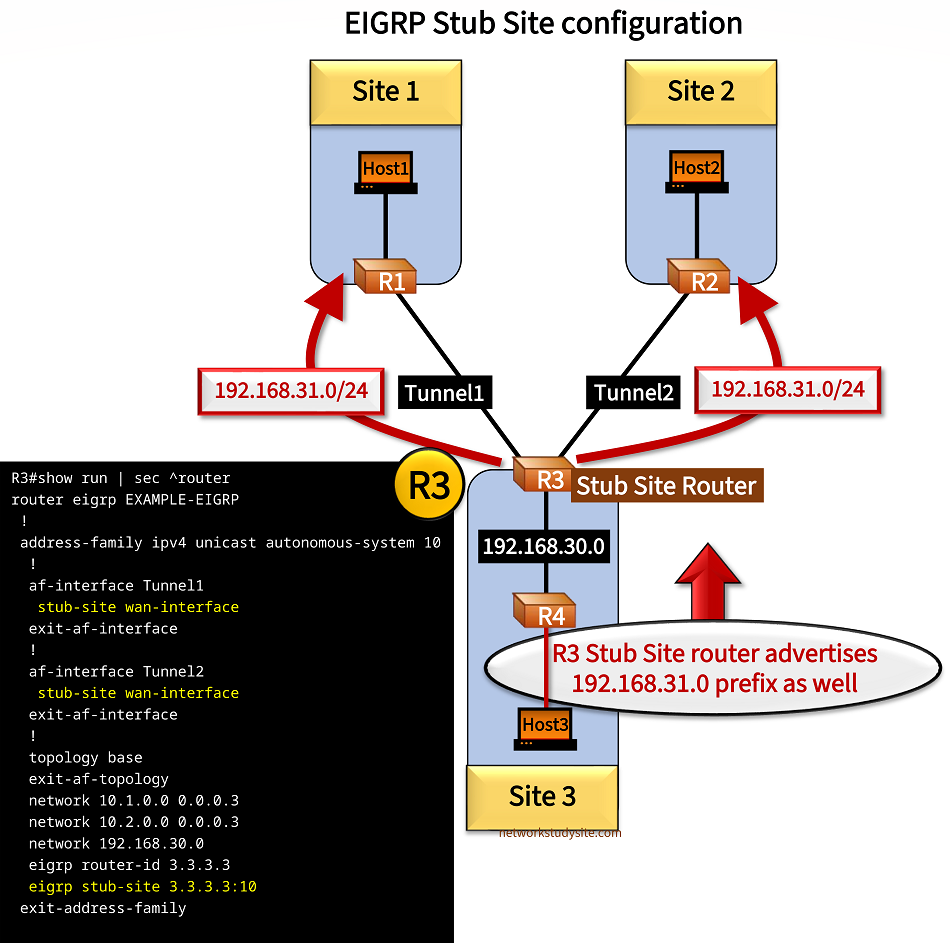
In the following example scenario, R3 is configured as an EIGRP Stub Site router. As a result, the Host3 prefix (192.168.31.0/24) which is received through EIGRP from the downstream router R4 is advertised by R3 across the Tunnel interfaces to R1 and R2. This functionality is similar to the one presented in the previous section (stub router leak-map).
Configuration:
R3
R3#show run int Gi0/0 | sec int
interface GigabitEthernet0/0
 description ** to R4 **
 ip address 192.168.30.1 255.255.255.0
 duplex auto
 speed auto
 media-type rj45

R3#show run int Gi0/1 | sec int
interface GigabitEthernet0/1
 description ** WAN link to ISP **
 ip address 172.16.3.1 255.255.255.252
 duplex auto
 speed auto
 media-type rj45

R3#show run int Tu1 | sec int
interface Tunnel1
 description ** P2P tunnel to R1 **
 ip address 10.1.0.2 255.255.255.252
 tunnel source GigabitEthernet0/1
 tunnel destination 172.16.1.1

R3#show run int Tu2 | sec int
interface Tunnel2
 description ** P2P tunnel to R2 **
 ip address 10.2.0.2 255.255.255.252
 tunnel source GigabitEthernet0/1
 tunnel destination 172.16.2.1

R3#show run | sec ^router
router eigrp EXAMPLE-EIGRP
 !
 address-family ipv4 unicast autonomous-system 10
  !
  af-interface Tunnel1
   stub-site wan-interface
  exit-af-interface
  !
  af-interface Tunnel2
   stub-site wan-interface
  exit-af-interface
  !
  topology base
  exit-af-topology
  network 10.1.0.0 0.0.0.3
  network 10.2.0.0 0.0.0.3
  network 192.168.30.0
  eigrp router-id 3.3.3.3
  eigrp stub-site 3.3.3.3:10
 exit-address-family
R2#show ip eigrp neighbors detail
EIGRP-IPv4 Neighbors for AS(10)
H   Address                 Interface              Hold Uptime   SRTT   RTO  Q  Seq
                                                   (sec)         (ms)       Cnt Num
0   10.2.0.2                Tu2                      11 01:00:56 1286  5000  0  91
   Version 23.0/2.0, Retrans: 0, Retries: 0, Prefixes: 3
   Topology-ids from peer - 0
   Topologies advertised to peer:   base

   Stub Peer Advertising (CONNECTED STATIC SUMMARY REDISTRIBUTED ) Routes        « R3 functions as a stub router
   Suppressing queries
Max Nbrs: 0, Current Nbrs: 0


R2#show ip eigrp topology 192.168.31.0
EIGRP-IPv4 Topology Entry for AS(10)/ID(2.2.2.2) for 192.168.31.0/24
  State is Passive, Query origin flag is 1, 1 Successor(s), FD is 26880512
  Descriptor Blocks:
  10.2.0.2 (Tunnel2), from 10.2.0.2, Send flag is 0x0
      Composite metric is (26880512/3072), route is Internal
      Vector metric:
        Minimum bandwidth is 100 Kbit
        Total delay is 50020 microseconds
        Reliability is 255/255
        Load is 1/255
        Minimum MTU is 1476
        Hop count is 2
        Originating router is 4.4.4.4                                            « R4 originates the prefix which is advertised by R3
EIGRP stub site with dual edge
In the following example scenario, a dual WAN edge branch location is configured with the EIGRP Stub Site feature. This means, routes received from R1 are assigned the Extended Community 3:3 on the router R3 Tunnel interface. This is also configured on R4's tunnel interface. As a result, when R3 advertises Site 1 routes to R4, they are filtered on R4 and not advertised to R2. This also happens vice versa, routes received from R2 are not advertised by R3 to R1.
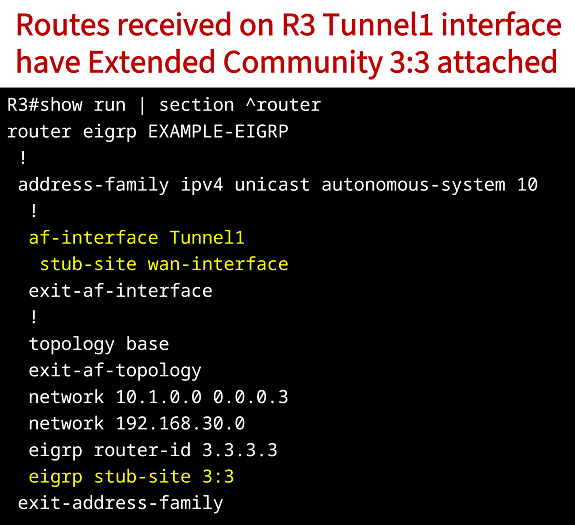
As a result, the Site 3 branch location can have dual WAN edge devices that will not be used as a transit network between Site 1 and Site 2. This is enabled with the Extended Community value assigned through the EIGRP Stub Site feature. The feature is similar to EIGRP Site of Origin (SoO) filtering which is implemented with MPLS L3VPN networks.
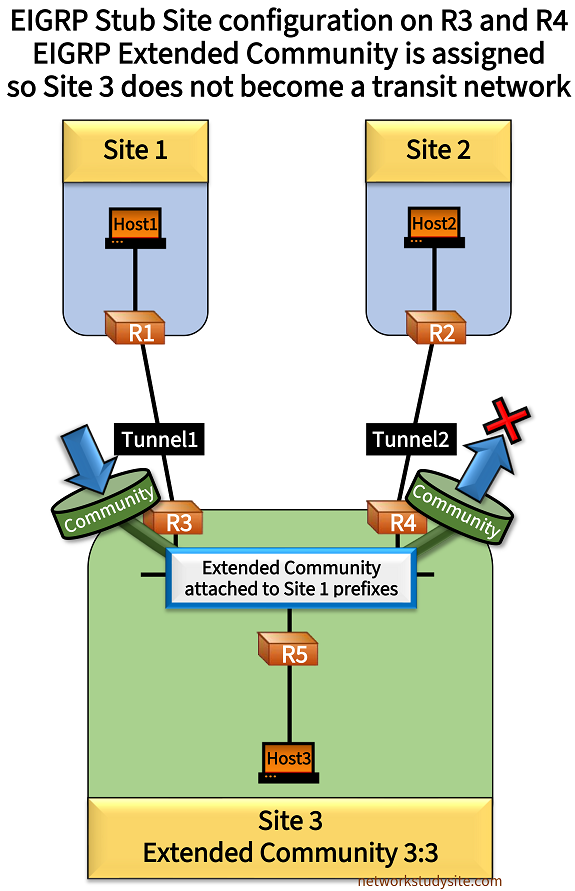
Configuration:
R3
R3#show run int Gi0/0 | sec int
interface GigabitEthernet0/0
 description ** to R4 and R5 **
 ip address 192.168.30.1 255.255.255.0
 duplex auto
 speed auto
 media-type rj45

R3#show run int Gi0/1 | sec int
interface GigabitEthernet0/1
 description ** WAN link to ISP **
 ip address 172.16.3.1 255.255.255.252
 duplex auto
 speed auto
 media-type rj45

R3#show run int Tu1 | sec int
interface Tunnel1
 description ** P2P tunnel to R1 **
 ip address 10.1.0.2 255.255.255.252
 tunnel source GigabitEthernet0/1
 tunnel destination 172.16.1.1

R3#show run | sec ^router
router eigrp EXAMPLE-EIGRP
 !
 address-family ipv4 unicast autonomous-system 10
  !
  af-interface Tunnel1
   stub-site wan-interface
  exit-af-interface
  !
  topology base
  exit-af-topology
  network 10.1.0.0 0.0.0.3
  network 192.168.30.0
  eigrp router-id 3.3.3.3
  eigrp stub-site 3:3
 exit-address-family
R4
R4#show run int Gi0/0 | sec int
interface GigabitEthernet0/0
 description ** to R3 and R5 **
 ip address 192.168.30.2 255.255.255.0
 duplex auto
 speed auto
 media-type rj45

R4#show run int Gi0/1 | sec int
interface GigabitEthernet0/1
 description ** WAN link to ISP **
 ip address 172.16.4.1 255.255.255.252
 duplex auto
 speed auto
 media-type rj45

R4#show run int Tu2 | sec int
interface Tunnel2
 description ** P2P tunnel to R2 **
 ip address 10.2.0.2 255.255.255.252
 tunnel source GigabitEthernet0/1
 tunnel destination 172.16.2.1

R4#show run | sec ^router
router eigrp EXAMPLE-EIGRP
 !
 address-family ipv4 unicast autonomous-system 10
  !
  af-interface Tunnel2
   stub-site wan-interface
  exit-af-interface
  !
  topology base
  exit-af-topology
  network 10.2.0.0 0.0.0.3
  network 192.168.30.0
  eigrp router-id 4.4.4.4
  eigrp stub-site 3:3
 exit-address-family
R5
R5#show run int Gi0/0 | sec int
interface GigabitEthernet0/0
 description ** to R3 and R4 **
 ip address 192.168.30.3 255.255.255.0
 duplex auto
 speed auto
 media-type rj45

R5#show run int Gi0/1 | sec int
interface GigabitEthernet0/1
 description ** to Host3 **
 ip address 192.168.31.1 255.255.255.0
 duplex auto
 speed auto
 media-type rj45

R5#show run | sec ^router
router eigrp EXAMPLE-EIGRP
 !
 address-family ipv4 unicast autonomous-system 10
  !
  topology base
  exit-af-topology
  network 192.168.30.0
  network 192.168.31.0
  eigrp router-id 5.5.5.5
 exit-address-family
R4#show ip eigrp topology 192.168.1.0
EIGRP-IPv4 VR(EXAMPLE-EIGRP) Topology Entry for AS(10)/ID(4.4.4.4) for 192.168.1.0/24
  State is Passive, Query origin flag is 1, 1 Successor(s), FD is 9831710720, RIB is 76810240
  Descriptor Blocks:
  192.168.30.1 (GigabitEthernet0/0), from 192.168.30.1, Send flag is 0x0
      Composite metric is (9831710720/9831055360), route is Internal
      Vector metric:
        Minimum bandwidth is 100 Kbit
        Total delay is 50020000000 picoseconds
        Reliability is 255/255
        Load is 1/255
        Minimum MTU is 1476
        Hop count is 2
        Originating router is 1.1.1.1
      Extended Community: StubSite:3:3         « Extended Community assigned to Site 1 route on R3


R3#show ip eigrp topology 192.168.2.0
EIGRP-IPv4 VR(EXAMPLE-EIGRP) Topology Entry for AS(10)/ID(3.3.3.3) for 192.168.2.0/24
  State is Passive, Query origin flag is 1, 1 Successor(s), FD is 9831710720, RIB is 76810240
  Descriptor Blocks:
  192.168.30.2 (GigabitEthernet0/0), from 192.168.30.2, Send flag is 0x0
      Composite metric is (9831710720/9831055360), route is Internal
      Vector metric:
        Minimum bandwidth is 100 Kbit
        Total delay is 50020000000 picoseconds
        Reliability is 255/255
        Load is 1/255
        Minimum MTU is 1476
        Hop count is 2
        Originating router is 2.2.2.2
      Extended Community: StubSite:3:3         « Extended Community assigned to Site 2 route on R4


R2#show ip route eigrp | beg Ga
Gateway of last resort is 172.16.2.2 to network 0.0.0.0

      10.0.0.0/8 is variably subnetted, 3 subnets, 2 masks
D        10.1.0.0/30 [90/28160256] via 10.2.0.2, 01:09:16, Tunnel2
D     192.168.30.0/24 [90/26880256] via 10.2.0.2, 01:09:16, Tunnel2
D     192.168.31.0/24 [90/26880512] via 10.2.0.2, 00:00:58, Tunnel2


R2#show ip eigrp neighbors detail
EIGRP-IPv4 Neighbors for AS(10)
H   Address                 Interface              Hold Uptime   SRTT   RTO  Q  Seq
                                                   (sec)         (ms)       Cnt Num
0   10.2.0.2                Tu2                      14 01:09:26   20  1470  0  45
   Version 23.0/2.0, Retrans: 0, Retries: 0, Prefixes: 3
   Topology-ids from peer - 0
   Topologies advertised to peer:   base

   Stub Peer Advertising (CONNECTED STATIC SUMMARY REDISTRIBUTED ) Routes
   Suppressing queries
Max Nbrs: 0, Current Nbrs: 0
As visible in the above outputs from Site 2 router R2, the Site 1 prefix is not advertised by the Stub Site router R4. However, R4 does advertise the prefix it has received from its downstream neighbor R5.