Ethernet VPN Introduction and EVPN-MPLS Concepts Explained
- What is EVPN? ‹
- How to configure MPLS-based EVPN using VLAN-based service interface with single VLAN? ‹
- Configuring MPLS-based EVPN with native VLAN (untagged) ‹
- EVPN Route Type 3 - IMET Route for multicast ‹
- Download section ‹
What is EVPN?
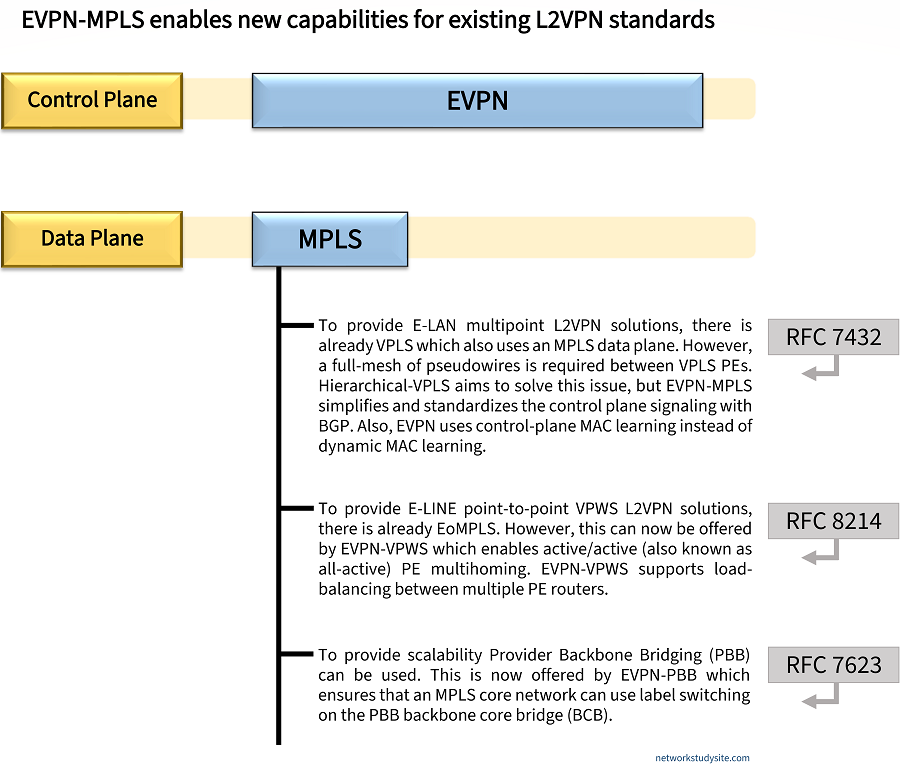
EVPN is a unified control plane technology that uses Multiprotocol-BGP to advertise MAC addresses as well as IP prefixes across an underlying transport network. This enables connectivity between remote locations at OSI model Layer-2 and at Layer-3. An advantage of EVPN is that the underlying transport network can either be IP-based (VXLAN encapsulation) or MPLS-based (label switching).
While EVPN can be paired with either an IP or an MPLS underlay, the EVPN unified control plane always uses MP-BGP. In other words, BGP is the signaling protocol of EVPN. The advertised EVPN route types and network virtualization features offered by EVPN are made possible with extensions to BGP. As a result, the EVPN address-family can be used instead of the VPNv4/VPNv6 address-family to offer Layer-2 and Layer-3 MPLS-based VPN services.

EVPN includes a number of components that make the control plane mechanism work with different data plane technologies. The following is a list of important terminology used by EVPN.
- Route Types: EVPN uses five Route Types that are advertised over Multiprotocol-BGP.
- Route Type 1 is used for EVPN Ethernet Auto-Discovery, it is also called an A-D route. There are two variants of a Type 1 route. The Per-EVI Route Type 1 carries an MPLS label value which identifies a Provider Edge (PE) router, and it has the ESI value set to zero for single-homed designs. On the other hand, the per-ESI Route Type 1 is used in multi-homed designs (two PE connected to one CE), it has a non-zero ESI value and an MPLS label set to zero. A Per-ESI RT 1 carries the MPLS label in Extended Community.
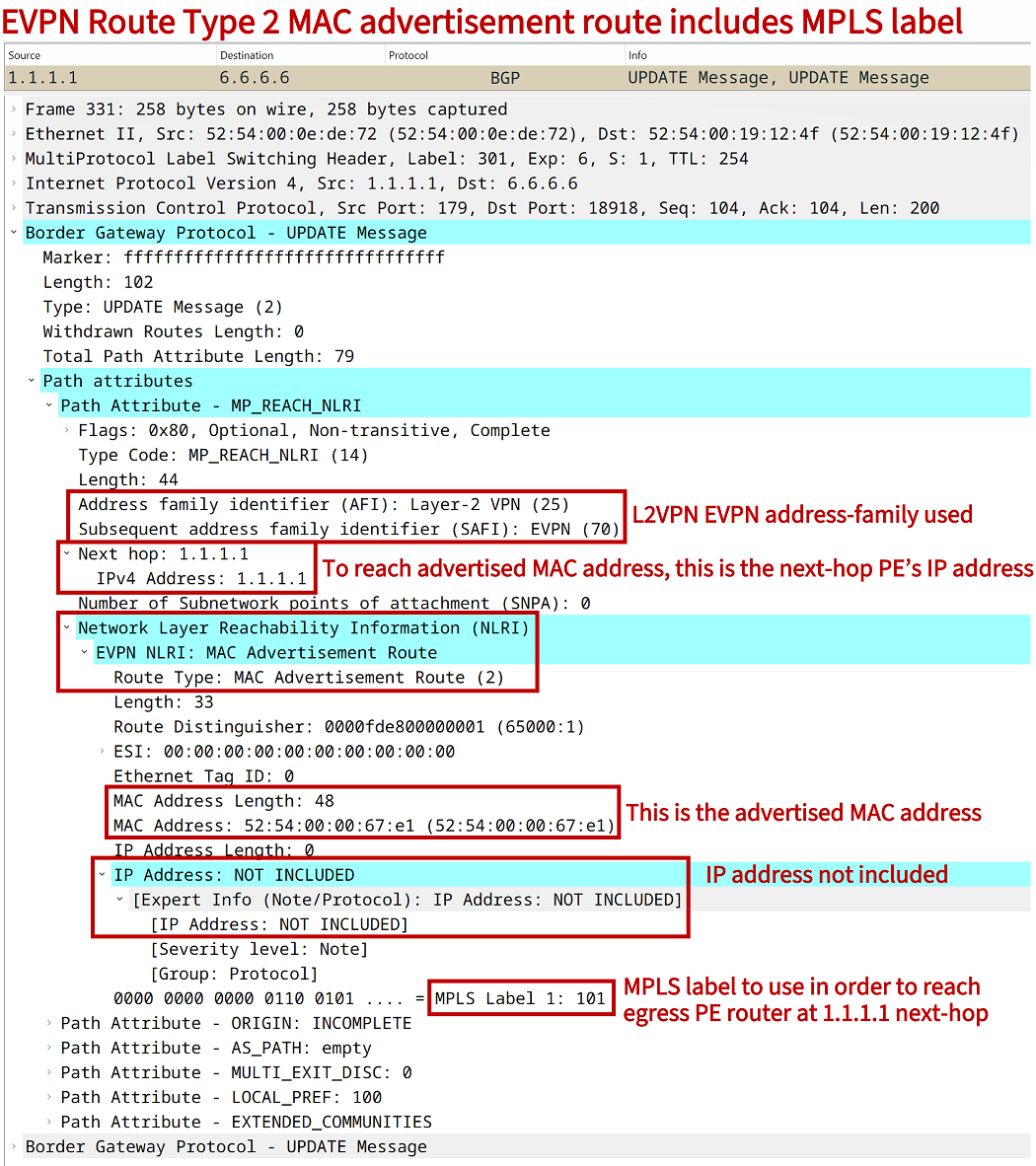
- Route Type 2 is a MAC advertisement route, it is also called a MAC/IP Advertisement route. The purpose of a Route Type 2 is to advertise MAC addresses that are learned from subscriber locations, and transmit MAC address updates between PE routers. In practice, PE1 includes its own IP address and MPLS label together with the advertised MAC address. So when a remote PE2 receives the MAC address update, it knows to send frames to PE1's IP address with PE1's MPLS label encapsulation.
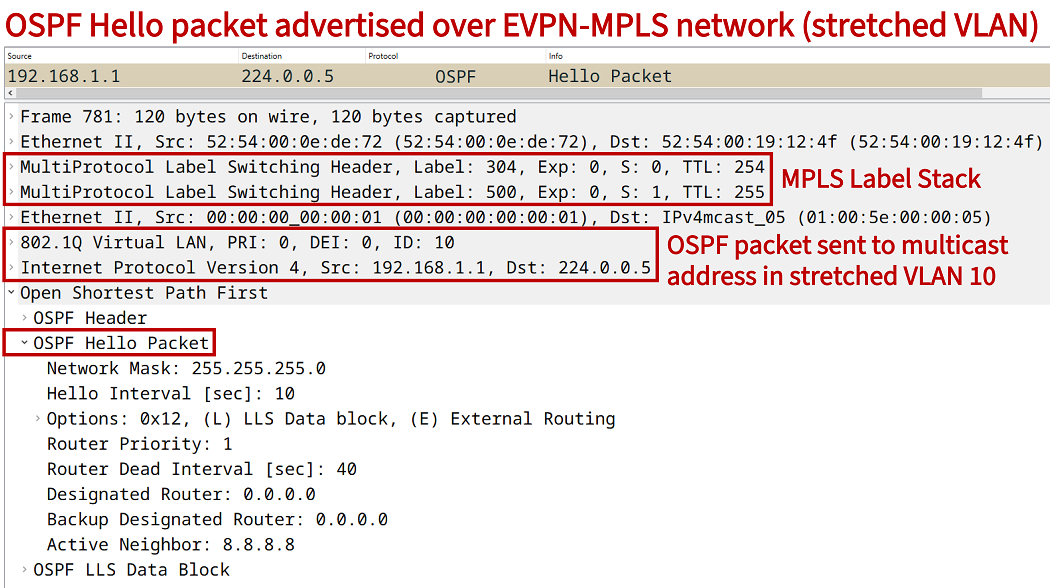
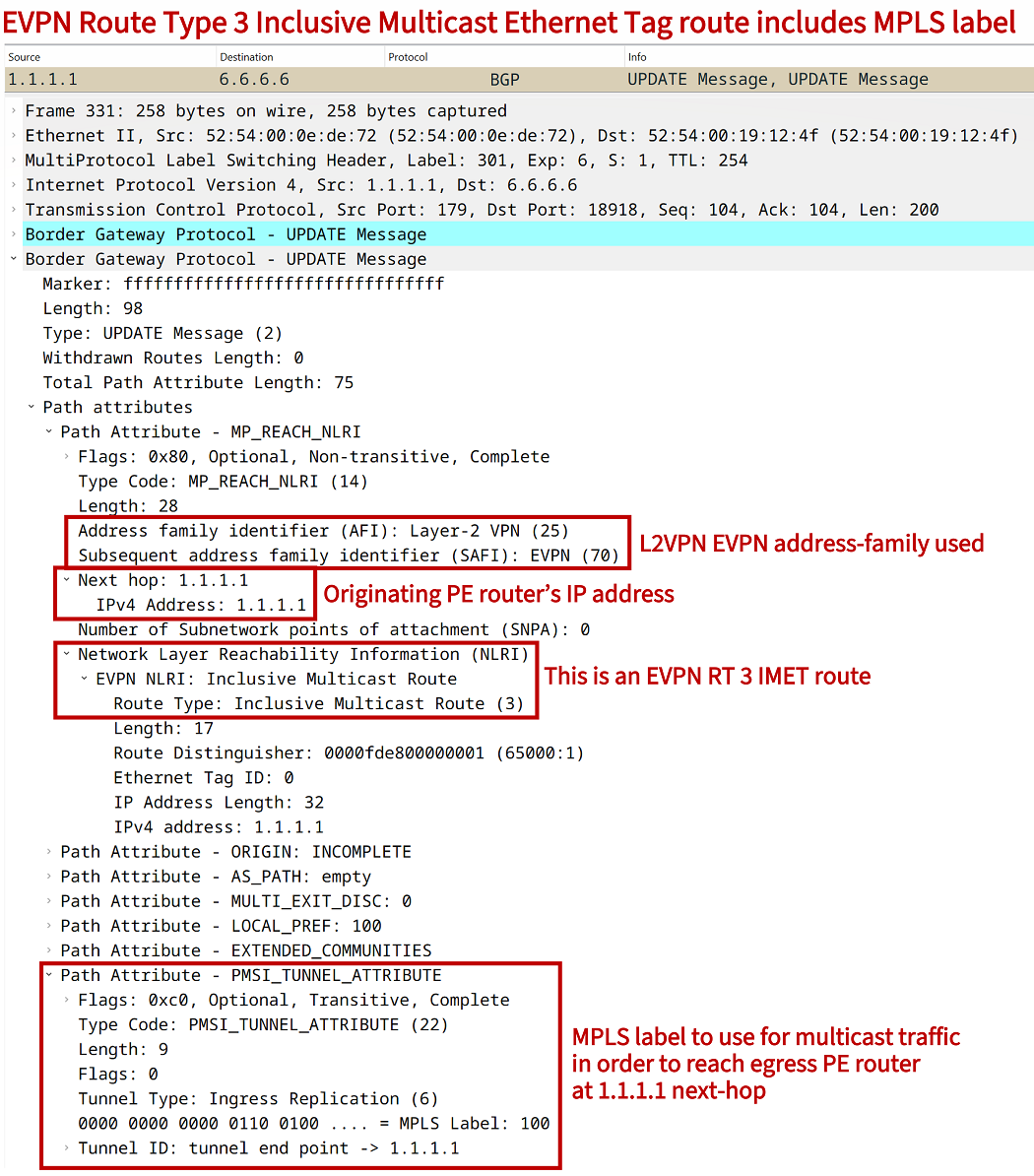
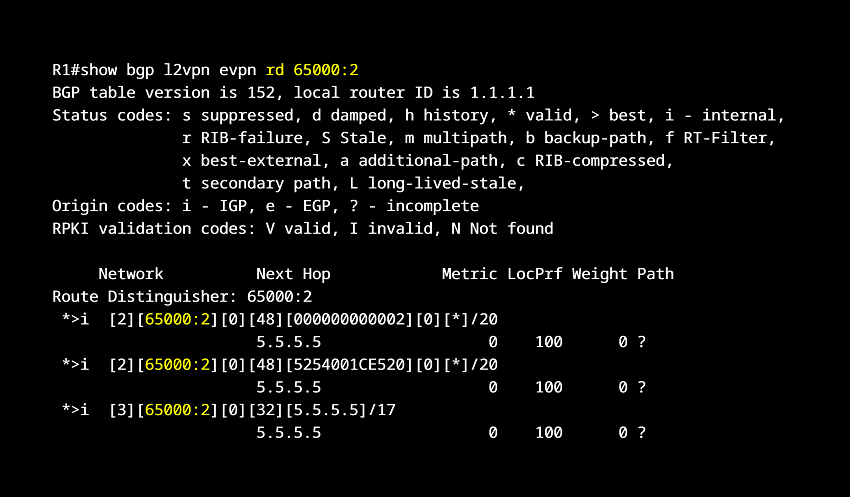
- Route Type 3 advertises P-tunnel information including multicast (BUM) traffic endpoint addresses (called an Inclusive Multicast Ethernet Tag/IMET route). In practice, for example Site 1 and Site 2 connect over VLAN 10 across an EVPN-MPLS network. Now, if R1 in Site 1 establishes an OSPF neighborship with R2 in Site 2 over stretched VLAN 10, then OSPF multicast packets will be sent to the P-tunnel address (using MPLS label in IMET route). Note, the BGP PMSI Tunnel Attribute is also used in Next-Generation Multicast VPN (NG-mVPN).
- Route Type 4 is called an Ethernet Segment route and is used in EVPN multihoming designs.
- Route Type 5 is called an IP Prefix route and advertises IPv4 and IPv6 addresses. It is commonly associated with EVPN Integrated Routing and Bridging (EVPN IRB) for both MPLS and VXLAN. Route Type 5 is also transmitted with EVPN-VXLAN Layer-3 VNI, with BGP extended community to signal VXLAN tunnel encapsulation type.
- MAC-VRF: In practice, this is a routing table that carries MAC addresses for a specific EVPN Instance, together with next-hop IP address and MPLS label. It is uniquely identified by a Route Distinguisher (RD) across the EVPN control plane. This concept originates in Layer-3 MPLS VPNs (VPNv4 address-family), where a shared Service Provider core network is used by many independent customers with the help of different VPN/VRF identifiers. In EVPN each MAC-VRF instance uses control plane learning to install subscriber MAC routes and IP routes.
- Ethernet Services: EVPN-MPLS offers three distinct services configured as EVPN Instances (EVI). Each service has a unique way of sharing system resources such as bridging tables (MAC address tables) and assigned MPLS labels. The name of these solutions are EVPN VLAN Based service, EVPN VLAN Bundle service, and EVPN VLAN Aware service.
How to configure MPLS-based EVPN using VLAN-based service interface with single VLAN?
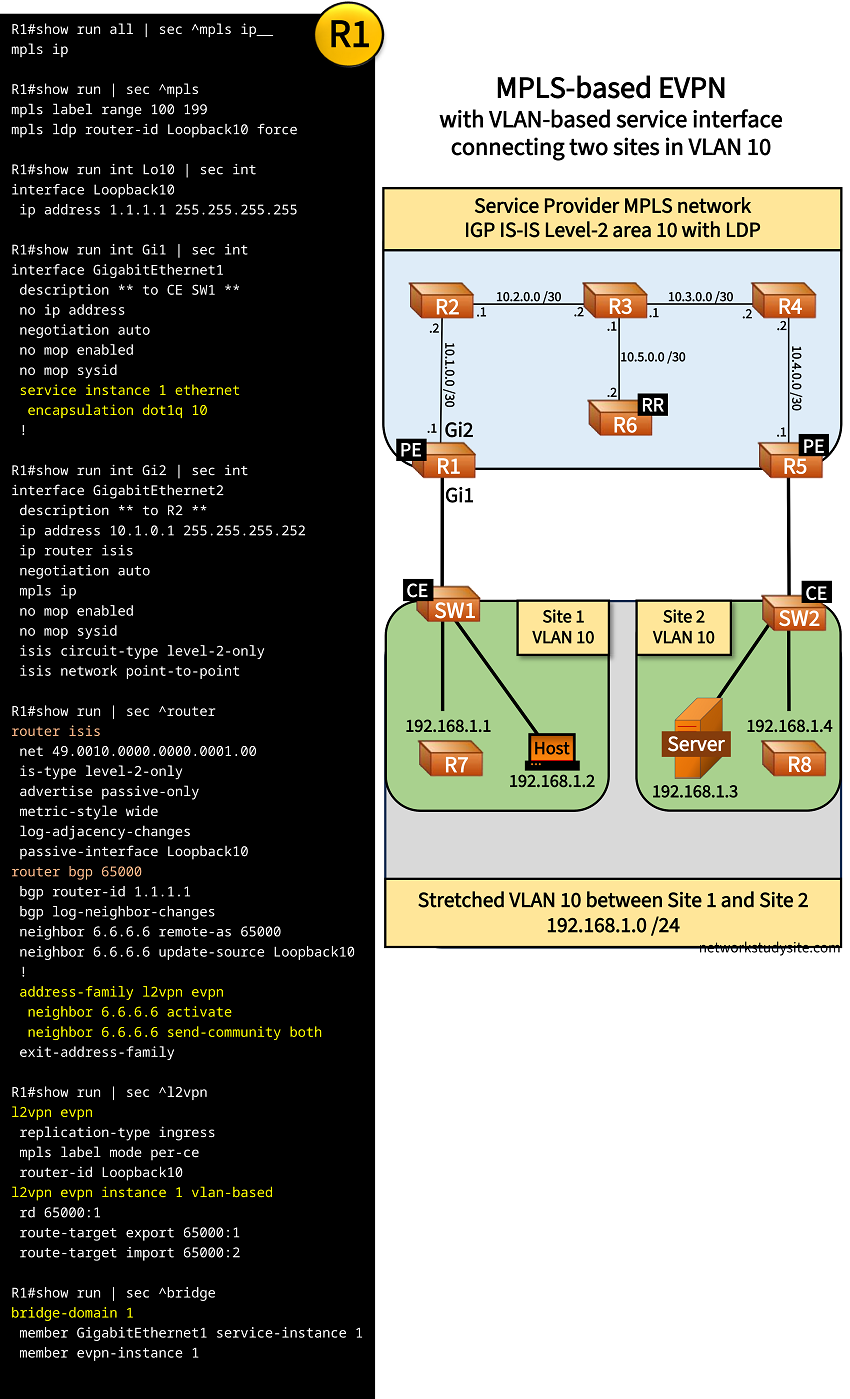
In the following example topology Site 1 and Site 2 are connected with an MPLS-based EVPN network (EVPN ELAN). This means, the two sites share the common Layer-3 IP subnet 192.168.1.0/24, creating a single broadcast domain between devices in Site 1 and Site 2.
To enable this solution, the Service Provider (SP) has an MPLS network configured between the PE R1 and PE R5. The routing protocol IS-IS is used for end-to-end connectivity within the MPLS network, and LDP is configured for label distribution. The label range is defined on each label switch router (LSR). Accordingly, R1 uses labels 100 - 199, R2 uses labels 200 - 299 and so on.
The EVPN control plane is configured on top of the existing MPLS transport network. Multiprotocol-BGP (MP-BGP) exchanges the MAC address of devices within the subnet 192.168.1.0/24. To improve scalability a BGP Route Reflector (RR R6) is also configured.
Configuration:
R1 (PE)
R1#show run all | sec ^mpls ip__
mpls ip

R1#show run | sec ^mpls
mpls label range 100 199
mpls ldp router-id Loopback10 force

R1#show run int Lo10 | sec int
interface Loopback10
 ip address 1.1.1.1 255.255.255.255

R1#show run int Gi1 | sec int
interface GigabitEthernet1
 description ** to CE SW1 **
 no ip address
 negotiation auto
 no mop enabled
 no mop sysid
 service instance 1 ethernet
  encapsulation dot1q 10
 !

R1#show run int Gi2 | sec int
interface GigabitEthernet2
 description ** to R2 **
 ip address 10.1.0.1 255.255.255.252
 ip router isis
 negotiation auto
 mpls ip
 no mop enabled
 no mop sysid
 isis circuit-type level-2-only
 isis network point-to-point

R1#show run | sec ^router
router isis
 net 49.0010.0000.0000.0001.00
 is-type level-2-only
 advertise passive-only
 metric-style wide
 log-adjacency-changes
 passive-interface Loopback10
router bgp 65000
 bgp router-id 1.1.1.1
 bgp log-neighbor-changes
 neighbor 6.6.6.6 remote-as 65000
 neighbor 6.6.6.6 update-source Loopback10
 !
 address-family l2vpn evpn
  neighbor 6.6.6.6 activate
  neighbor 6.6.6.6 send-community both
 exit-address-family

R1#show run | sec ^l2vpn
l2vpn evpn
 replication-type ingress
 mpls label mode per-ce
 router-id Loopback10
l2vpn evpn instance 1 vlan-based
 rd 65000:1
 route-target export 65000:1
 route-target import 65000:2

R1#show run | sec ^bridge
bridge-domain 1
 member GigabitEthernet1 service-instance 1
 member evpn-instance 1
R2
R2#show run all | sec ^mpls ip$
mpls ip

R2#show run | sec ^mpls
mpls label range 200 299
mpls ldp router-id Loopback10 force

R2#show run int Lo10 | sec int
interface Loopback10
 ip address 2.2.2.2 255.255.255.255

R2#show run int Gi0/0 | sec int
interface GigabitEthernet0/0
 description ** to PE R1 **
 ip address 10.1.0.2 255.255.255.252
 ip router isis
 duplex auto
 speed auto
 media-type rj45
 mpls ip
 isis circuit-type level-2-only
 isis network point-to-point

R2#show run int Gi0/1 | sec int
interface GigabitEthernet0/1
 description ** to R3 **
 ip address 10.2.0.1 255.255.255.252
 ip router isis
 duplex auto
 speed auto
 media-type rj45
 mpls ip
 isis circuit-type level-2-only
 isis network point-to-point

R2#show run | sec ^router
router isis
 net 49.0010.0000.0000.0002.00
 is-type level-2-only
 advertise passive-only
 metric-style wide
 log-adjacency-changes
 passive-interface Loopback10
R3
R3#show run all | sec ^mpls ip$
mpls ip

R3#show run | sec ^mpls
mpls label range 300 399
mpls ldp router-id Loopback10 force

R3#show run int Lo10 | sec int
interface Loopback10
 ip address 3.3.3.3 255.255.255.255

R3#show run int Gi0/0 | sec int
interface GigabitEthernet0/0
 description ** to R2 **
 ip address 10.2.0.2 255.255.255.252
 ip router isis
 duplex auto
 speed auto
 media-type rj45
 mpls ip
 isis circuit-type level-2-only
 isis network point-to-point

R3#show run int Gi0/1 | sec int
interface GigabitEthernet0/1
 description ** to R4 **
 ip address 10.3.0.1 255.255.255.252
 ip router isis
 duplex auto
 speed auto
 media-type rj45
 mpls ip
 isis circuit-type level-2-only
 isis network point-to-point

R3#show run int Gi0/2 | sec int
interface GigabitEthernet0/2
 description ** to RR R6 **
 ip address 10.5.0.1 255.255.255.252
 ip router isis
 duplex auto
 speed auto
 media-type rj45
 isis circuit-type level-2-only
 isis network point-to-point

R3#show run | sec ^router
router isis
 net 49.0010.0000.0000.0003.00
 is-type level-2-only
 advertise passive-only
 metric-style wide
 log-adjacency-changes
 passive-interface Loopback10
R5 (PE)
R5#show run all | sec ^mpls ip__
mpls ip

R5#show run | sec ^mpls
mpls label range 500 599
mpls ldp router-id Loopback10 force

R5#show run int Lo10 | sec int
interface Loopback10
 ip address 5.5.5.5 255.255.255.255

R5#show run int Gi1 | sec int
interface GigabitEthernet1
 description ** to CE SW2 **
 no ip address
 negotiation auto
 no mop enabled
 no mop sysid
 service instance 1 ethernet
  encapsulation dot1q 10
 !

R5#show run int Gi2 | sec int
interface GigabitEthernet2
 description ** to R4 **
 ip address 10.4.0.1 255.255.255.252
 ip router isis
 negotiation auto
 mpls ip
 no mop enabled
 no mop sysid
 isis circuit-type level-2-only
 isis network point-to-point

R5#show run | sec ^router
router isis
 net 49.0010.0000.0000.0005.00
 is-type level-2-only
 advertise passive-only
 metric-style wide
 log-adjacency-changes
 passive-interface Loopback10
router bgp 65000
 bgp router-id 5.5.5.5
 bgp log-neighbor-changes
 neighbor 6.6.6.6 remote-as 65000
 neighbor 6.6.6.6 update-source Loopback10
 !
 address-family l2vpn evpn
  neighbor 6.6.6.6 activate
  neighbor 6.6.6.6 send-community both
 exit-address-family

R5#show run | sec ^l2vpn
l2vpn evpn
 replication-type ingress
 mpls label mode per-ce
 router-id Loopback10
l2vpn evpn instance 1 vlan-based
 rd 65000:2
 route-target export 65000:2
 route-target import 65000:1

R5#show run | sec ^bridge
bridge-domain 1
 member GigabitEthernet1 service-instance 1
 member evpn-instance 1
R6 (RR)
R6#show run int Lo10 | sec int
interface Loopback10
 ip address 6.6.6.6 255.255.255.255

R6#show run int Gi0/0 | sec int
interface GigabitEthernet0/0
 description ** to R3 **
 ip address 10.5.0.2 255.255.255.252
 ip router isis
 duplex auto
 speed auto
 media-type rj45
 isis circuit-type level-2-only
 isis network point-to-point

R6#show run | sec ^router
router isis
 net 49.0010.0000.0000.0006.00
 is-type level-2-only
 advertise passive-only
 metric-style wide
 log-adjacency-changes
 passive-interface Loopback10
router bgp 65000
 bgp router-id 6.6.6.6
 bgp log-neighbor-changes
 neighbor 1.1.1.1 remote-as 65000
 neighbor 1.1.1.1 update-source Loopback10
 neighbor 5.5.5.5 remote-as 65000
 neighbor 5.5.5.5 update-source Loopback10
 !
 address-family l2vpn evpn
  neighbor 1.1.1.1 activate
  neighbor 1.1.1.1 send-community both
  neighbor 1.1.1.1 route-reflector-client
  neighbor 5.5.5.5 activate
  neighbor 5.5.5.5 send-community both
  neighbor 5.5.5.5 route-reflector-client
 exit-address-family
SW1 (CE)
SW1#show run int Gi0/0 | sec int
interface GigabitEthernet0/0
 description ** to PE R1 **
 switchport trunk allowed vlan 10
 switchport trunk encapsulation dot1q
 switchport mode trunk
 negotiation auto

SW1#show run int Gi0/1 | sec int
interface GigabitEthernet0/1
 description ** to R7 **
 switchport access vlan 10
 switchport mode access
 negotiation auto

SW1#show run int Gi0/2 | sec int
interface GigabitEthernet0/2
 description ** to Host **
 switchport access vlan 10
 switchport mode access
 negotiation auto
SW2 (CE)
SW2#show run int Gi0/0 | sec int
interface GigabitEthernet0/0
 description ** to PE R5 **
 switchport trunk allowed vlan 10
 switchport trunk encapsulation dot1q
 switchport mode trunk
 negotiation auto

SW2#show run int Gi0/1 | sec int
interface GigabitEthernet0/1
 description ** to Server **
 switchport access vlan 10
 switchport mode access
 negotiation auto

SW2#show run int Gi0/2 | sec int
interface GigabitEthernet0/2
 description ** to R8 **
 switchport access vlan 10
 switchport mode access
 negotiation auto
R7
R7#show run int Gi0/0 | sec int
interface GigabitEthernet0/0
 description ** to R8 - over SP EVPN **
 ip address 192.168.1.1 255.255.255.0
 duplex auto
 speed auto
 media-type rj45

R7#show run int Lo10 | sec int
interface Loopback10
 ip address 7.7.7.7 255.255.255.255

R7#show run int Lo20 | sec int
interface Loopback20
 ip address 192.168.11.1 255.255.255.252
 ip ospf network point-to-point

R7#show run int Lo30 | sec int
interface Loopback30
 ip address 192.168.11.9 255.255.255.248
 ip ospf network point-to-point

R7#show run | sec ^router
router ospf 10
 router-id 7.7.7.7
 network 7.7.7.7 0.0.0.0 area 0
 network 192.168.1.0 0.0.0.255 area 0
 network 192.168.11.0 0.0.0.15 area 0
R1#show bgp l2vpn evpn summary | beg Ne
Neighbor        V           AS MsgRcvd MsgSent   TblVer  InQ OutQ Up/Down  State/PfxRcd
6.6.6.6         4        65000     196     182       82    0    0 02:28:56        2       « EVPN MAC/IP routes received from PE R5


R1#show bgp l2vpn evpn rd 65000:2
BGP table version is 85, local router ID is 1.1.1.1
Status codes: s suppressed, d damped, h history, * valid, > best, i - internal,
              r RIB-failure, S Stale, m multipath, b backup-path, f RT-Filter,
              x best-external, a additional-path, c RIB-compressed,
              t secondary path, L long-lived-stale,
Origin codes: i - IGP, e - EGP, ? - incomplete
RPKI validation codes: V valid, I invalid, N Not found

     Network          Next Hop            Metric LocPrf Weight Path
Route Distinguisher: 65000:2
 *>i  [2][65000:2][0][48][52540010AC97][0][*]/20                        « EVPN Type-2 MAC/IP route showing the MAC address of R8
                      5.5.5.5                  0    100      0 ?
 *>i  [2][65000:2][0][48][5254001C240B][0][*]/20
                      5.5.5.5                  0    100      0 ?
 *>i  [3][65000:2][0][32][5.5.5.5]/17                                   « This is an EVPN Type-3 IMET route pointing to PE R5
                      5.5.5.5                  0    100      0 ?


R1#show bgp l2vpn evpn rd 65000:2 route-type 2
BGP routing table entry for [2][65000:2][0][48][52540010AC97][0][*]/20, version 3    « MAC address of R8
Paths: (1 available, best #1, table EVPN-BGP-Table)
  Flag: 0x100
  Not advertised to any peer
  Refresh Epoch 1
  Local
    5.5.5.5 (metric 40) (via default) from 6.6.6.6 (6.6.6.6)                         « The MAC/IP route is originated by PE R5
      Origin incomplete, metric 0, localpref 100, valid, internal, best
      EVPN ESI: 00000000000000000000, Label1 505                                     « MPLS Label1 assigned to MAC address of R8
      Extended Community: RT:65000:1 RT:65000:2                                      « Route Target export value configured on PE R5
      Originator: 5.5.5.5, Cluster list: 6.6.6.6
      rx pathid: 0, tx pathid: 0x0
      net: 0x7F8432057998, path: 0x7F84652C25B8, pathext: 0x7F84652D2BE8
      flags: net: 0x100, path: 0x3, pathext: 0xA1
      attribute: 0x7F8432067AF8, ref: 5
      Updated on Mar 26 2024 13:17:01 UTC
BGP routing table entry for [2][65000:2][0][48][5254001C240B][0][*]/20, version 84   « This is the MAC address of the Server in Site 2
Paths: (1 available, best #1, table EVPN-BGP-Table)
  Not advertised to any peer
  Refresh Epoch 1
  Local
    5.5.5.5 (metric 40) (via default) from 6.6.6.6 (6.6.6.6)
      Origin incomplete, metric 0, localpref 100, valid, internal, best
      EVPN ESI: 00000000000000000000, Label1 505
      Extended Community: RT:65000:1 RT:65000:2
      Originator: 5.5.5.5, Cluster list: 6.6.6.6
      rx pathid: 0, tx pathid: 0x0
      net: 0x7F84320571F0, path: 0x7F84652C2048, pathext: 0x7F84652D29A8
      flags: net: 0x0, path: 0x3, pathext: 0x81
      attribute: 0x7F8432067AF8, ref: 5
      Updated on Mar 26 2024 15:46:53 UTC


R5#show mpls forwarding-table
Local      Outgoing   Prefix           Bytes Label   Outgoing   Next Hop
Label      Label      or Tunnel Id     Switched      interface
500        Pop Label  4.4.4.4/32       0             Gi2        10.4.0.2
501        401        3.3.3.3/32       0             Gi2        10.4.0.2
502        402        2.2.2.2/32       0             Gi2        10.4.0.2
503        403        1.1.1.1/32       0             Gi2        10.4.0.2
504        404        6.6.6.6/32       0             Gi2        10.4.0.2
505        No Label   evpn(uc:ifh 0x7, efp 1)   \                              « EVPN Type 2 MAC/IP label assigned by PE R5
                                       7448          none       point2point
506        No Label   evpn(mc:bd 1)    108289        none       point2point    « EVPN Type 3 IMET label assigned by PE R5
Configuring MPLS-based EVPN with native VLAN (untagged)
In the following example scenario two sites are connected with an EVPN network and using the native VLAN. Compared to the configuration used in the previous section, the following changes are made:
- PE routers are configured to accept untagged traffic on their service interface (Gi1).
- The CE switches are configured to use VLAN 10 as the native VLAN on their PE-facing trunk interfaces (Gi0/0).
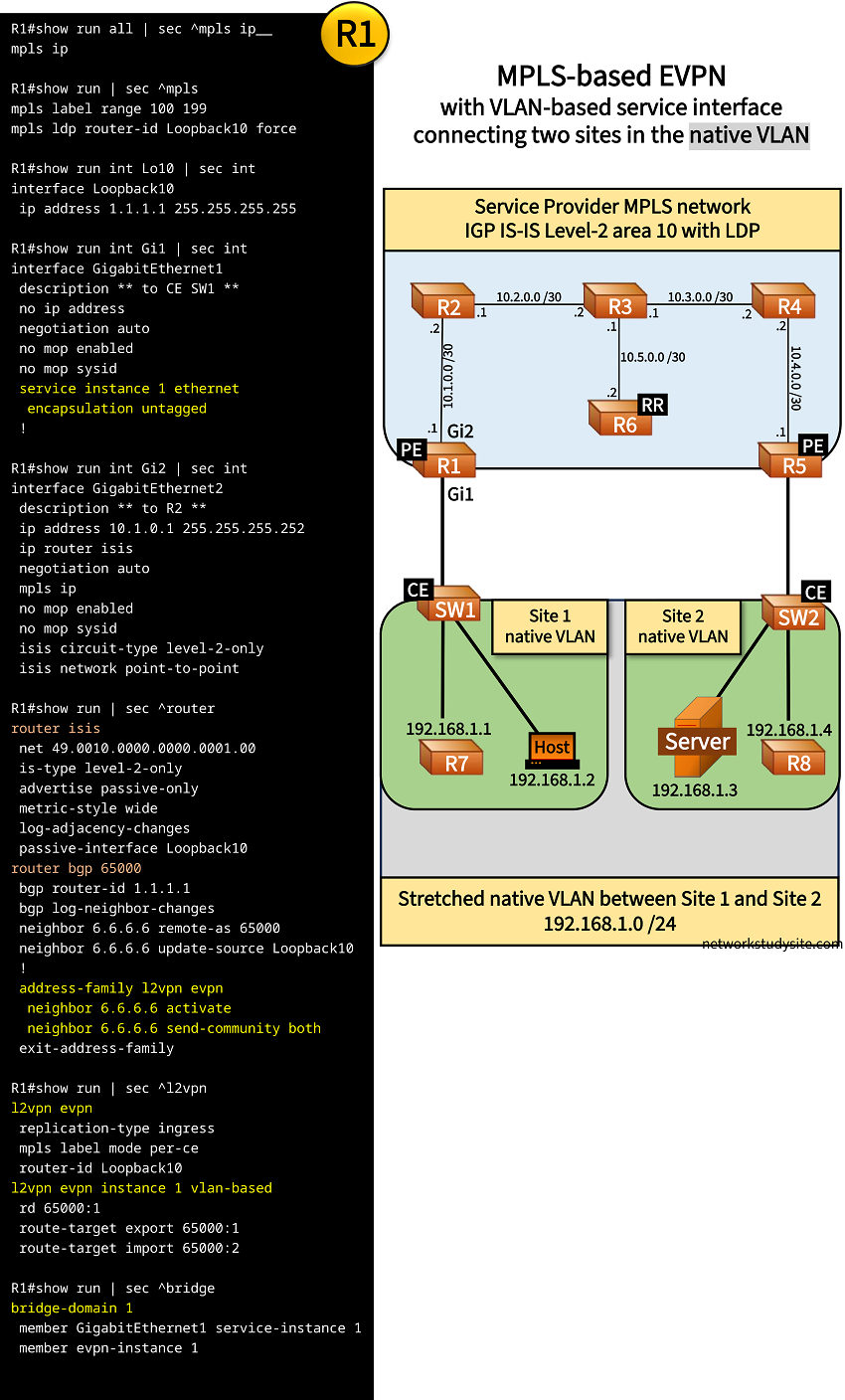
Configuration:
R1 (PE)
R1#show run all | sec ^mpls ip__
mpls ip

R1#show run | sec ^mpls
mpls label range 100 199
mpls ldp router-id Loopback10 force

R1#show run int Lo10 | sec int
interface Loopback10
 ip address 1.1.1.1 255.255.255.255

R1#show run int Gi1 | sec int
interface GigabitEthernet1
 description ** to CE SW1 **
 no ip address
 negotiation auto
 no mop enabled
 no mop sysid
 service instance 1 ethernet
  encapsulation untagged
 !

R1#show run int Gi2 | sec int
interface GigabitEthernet2
 description ** to R2 **
 ip address 10.1.0.1 255.255.255.252
 ip router isis
 negotiation auto
 mpls ip
 no mop enabled
 no mop sysid
 isis circuit-type level-2-only
 isis network point-to-point

R1#show run | sec ^router
router isis
 net 49.0010.0000.0000.0001.00
 is-type level-2-only
 advertise passive-only
 metric-style wide
 log-adjacency-changes
 passive-interface Loopback10
router bgp 65000
 bgp router-id 1.1.1.1
 bgp log-neighbor-changes
 neighbor 6.6.6.6 remote-as 65000
 neighbor 6.6.6.6 update-source Loopback10
 !
 address-family l2vpn evpn
  neighbor 6.6.6.6 activate
  neighbor 6.6.6.6 send-community both
 exit-address-family

R1#show run | sec ^l2vpn
l2vpn evpn
 replication-type ingress
 mpls label mode per-ce
 router-id Loopback10
l2vpn evpn instance 1 vlan-based
 rd 65000:1
 route-target export 65000:1
 route-target import 65000:2

R1#show run | sec ^bridge
bridge-domain 1
 member GigabitEthernet1 service-instance 1
 member evpn-instance 1
R5 (PE)
R5#show run all | sec ^mpls ip__
mpls ip

R5#show run | sec ^mpls
mpls label range 500 599
mpls ldp router-id Loopback10 force

R5#show run int Lo10 | sec int
interface Loopback10
 ip address 5.5.5.5 255.255.255.255

R5#show run int Gi1 | sec int
interface GigabitEthernet1
 description ** to CE SW2 **
 no ip address
 negotiation auto
 no mop enabled
 no mop sysid
 service instance 1 ethernet
  encapsulation untagged
 !

R5#show run int Gi2 | sec int
interface GigabitEthernet2
 description ** to R4 **
 ip address 10.4.0.1 255.255.255.252
 ip router isis
 negotiation auto
 mpls ip
 no mop enabled
 no mop sysid
 isis circuit-type level-2-only
 isis network point-to-point

R5#show run | sec ^router
router isis
 net 49.0010.0000.0000.0005.00
 is-type level-2-only
 advertise passive-only
 metric-style wide
 log-adjacency-changes
 passive-interface Loopback10
router bgp 65000
 bgp router-id 5.5.5.5
 bgp log-neighbor-changes
 neighbor 6.6.6.6 remote-as 65000
 neighbor 6.6.6.6 update-source Loopback10
 !
 address-family l2vpn evpn
  neighbor 6.6.6.6 activate
  neighbor 6.6.6.6 send-community both
 exit-address-family

R5#show run | sec ^l2vpn
l2vpn evpn
 replication-type ingress
 mpls label mode per-ce
 router-id Loopback10
l2vpn evpn instance 1 vlan-based
 rd 65000:2
 route-target export 65000:2
 route-target import 65000:1

R5#show run | sec ^bridge
bridge-domain 1
 member GigabitEthernet1 service-instance 1
 member evpn-instance 1
SW1 (CE)
SW1#show run int Gi0/0 | sec int
interface GigabitEthernet0/0
 description ** to PE R1 **
 switchport trunk allowed vlan 10
 switchport trunk encapsulation dot1q
 switchport trunk native vlan 10
 switchport mode trunk
 negotiation auto

SW1#show run int Gi0/1 | sec int
interface GigabitEthernet0/1
 description ** to R7 **
 switchport access vlan 10
 switchport mode access
 negotiation auto

SW1#show run int Gi0/2 | sec int
interface GigabitEthernet0/2
 description ** to Host **
 switchport access vlan 10
 switchport mode access
 negotiation auto
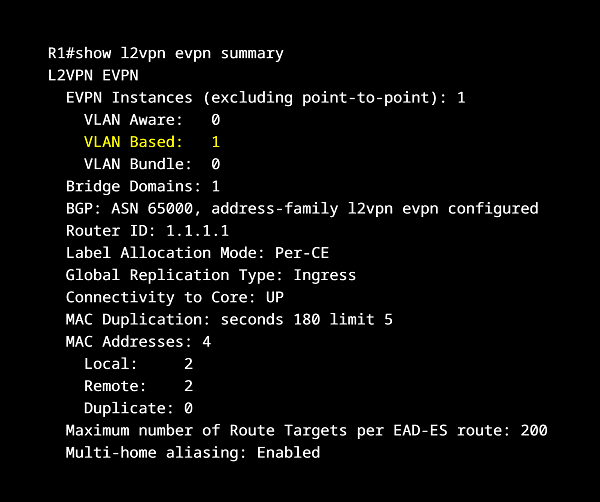
R1#show l2vpn evpn summary
L2VPN EVPN
  EVPN Instances (excluding point-to-point): 1
    VLAN Aware:   0
    VLAN Based:   1           « VLAN Based service is configured
    VLAN Bundle:  0
  Bridge Domains: 1
  BGP: ASN 65000, address-family l2vpn evpn configured
  Router ID: 1.1.1.1
  Label Allocation Mode: Per-CE
  Global Replication Type: Ingress
  Connectivity to Core: UP
  MAC Duplication: seconds 180 limit 5
  MAC Addresses: 4
    Local:     2
    Remote:    2
    Duplicate: 0
  Maximum number of Route Targets per EAD-ES route: 200
  Multi-home aliasing: Enabled


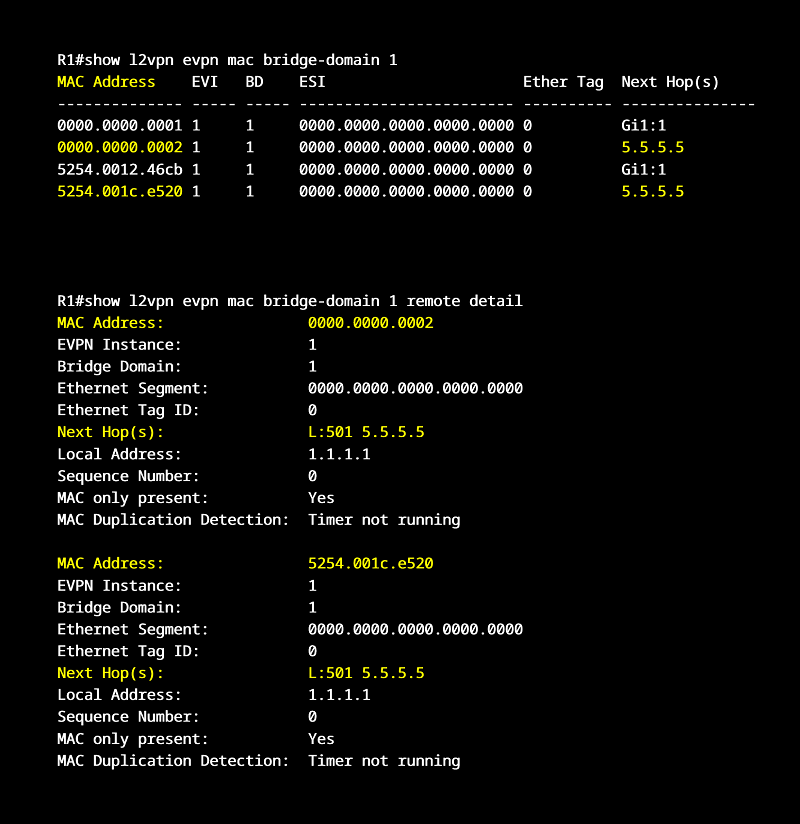
R1#show l2vpn evpn mac
MAC Address    EVI   BD    ESI                      Ether Tag  Next Hop(s)
-------------- ----- ----- ------------------------ ---------- ---------------
5254.0001.5631 1     1     0000.0000.0000.0000.0000 0          Gi1:1
5254.0010.ac97 1     1     0000.0000.0000.0000.0000 0          5.5.5.5         « MAC addresses learned from PE R5
5254.001c.240b 1     1     0000.0000.0000.0000.0000 0          5.5.5.5


R1#show l2vpn evpn peers

EVI    BD    Peer-IP                   Num routes UP time
------ ----- ------------------------  ---------- --------
1      1     5.5.5.5                   3          01:03:57            « EVPN peer PE R5 is established


R7#show arp
Protocol  Address          Age (min)  Hardware Addr   Type   Interface
Internet  192.168.1.1             -   5254.0001.5631  ARPA   GigabitEthernet0/0
Internet  192.168.1.2           142   5254.000e.c9f1  ARPA   GigabitEthernet0/0
Internet  192.168.1.3           142   5254.001c.240b  ARPA   GigabitEthernet0/0
Internet  192.168.1.4           152   5254.0010.ac97  ARPA   GigabitEthernet0/0


R7#ping 192.168.1.2
Type escape sequence to abort.
Sending 5, 100-byte ICMP Echos to 192.168.1.2, timeout is 2 seconds:
!!!!!
Success rate is 100 percent (5/5), round-trip min/avg/max = 2/2/3 ms


R7#ping 192.168.1.3
Type escape sequence to abort.
Sending 5, 100-byte ICMP Echos to 192.168.1.3, timeout is 2 seconds:
!!!!!
Success rate is 100 percent (5/5), round-trip min/avg/max = 8/8/9 ms


R7#ping 192.168.1.4
Type escape sequence to abort.
Sending 5, 100-byte ICMP Echos to 192.168.1.4, timeout is 2 seconds:
!!!!!
Success rate is 100 percent (5/5), round-trip min/avg/max = 7/7/8 ms
EVPN Route Type 3 - IMET Route for multicast
EVPN Type-3 routes are used in combination with P-tunnels to carry Broadcast, Unicast and Multicast (BUM) traffic between PE routers. This is important to enable multicast traffic (such as OSPF control plane) to work with EVPN between the two sites.
Once the EVPN network is established, the devices in both sites see each other in the same Layer-3 IP subnet 192.168.1.0/24, and their ARP tables are populated with each others' MAC addresses. In the above scenarios R7 and R8 form an OSPF neighborship over the EVPN connection. OSPF uses the multicast address 224.0.0.5, and this is enabled over the EVPN control plane by the IMET route.
R1#show bgp l2vpn evpn rd 65000:2 route-type 3
BGP routing table entry for [3][65000:2][0][32][5.5.5.5]/17, version 5
Paths: (1 available, best #1, table EVPN-BGP-Table)
  Flag: 0x100
  Not advertised to any peer
  Refresh Epoch 1
  Local
    5.5.5.5 (metric 40) (via default) from 6.6.6.6 (6.6.6.6)
      Origin incomplete, metric 0, localpref 100, valid, internal, best
      Extended Community: RT:65000:1 RT:65000:2
      Originator: 5.5.5.5, Cluster list: 6.6.6.6
      PMSI Attribute: Flags:0x0, Tunnel type:IR, length 4, label:500 tunnel identifier: < Tunnel Endpoint: 5.5.5.5 >   « Label 500 for multicast
      rx pathid: 0, tx pathid: 0x0
      net: 0x7F5475EF6E30, path: 0x7F54AA3F1870, pathext: 0x7F5475FD9518
      flags: net: 0x100, path: 0x3, pathext: 0xA1
      attribute: 0x7F5475F07030, ref: 3
      Updated on Jun 4 2025 08:59:18 UTC


R5#show mpls forwarding-table
Local      Outgoing   Prefix           Bytes Label   Outgoing   Next Hop
Label      Label      or Tunnel Id     Switched      interface
500        No Label   evpn(mc:bd 1)    163539        none       point2point        « OSPF multicast traffic sent with this label from PE R1 to PE R5
501        No Label   evpn(uc:ifh 0x7, efp 1)   \
                                       3054          none       point2point
502        Pop Label  4.4.4.4/32       0             Gi2        10.4.0.2
503        401        3.3.3.3/32       0             Gi2        10.4.0.2
504        402        2.2.2.2/32       0             Gi2        10.4.0.2
505        403        6.6.6.6/32       0             Gi2        10.4.0.2
506        404        1.1.1.1/32       0             Gi2        10.4.0.2
The following capture is taken within the Service Provider's network and shows an OSPF Hello packet sent from R7 to the OSPF multicast address across the EVPN control plane. The IMET label value 500 is visible in the MPSL label stack. This OSPF Hello packet is received on R8 in the remote Site 2 across the stretched VLAN 10.